Half Marathon VO2max Guide: What You Need for Sub-1:30 to Sub-2:00
The half marathon is one of the most popular race distances in the world — and for good reason. It's long enough to test your endurance, short enough to not destroy your week. But if you want to run faster, there's one metric you need to understand: VO2max.
VO2max: Your Half Marathon Performance Predictor
VO2max measures how much oxygen your body can utilize during maximal effort, expressed in ml/min/kg. It's the single best predictor of your endurance performance. The higher your VO2max, the faster you can sustain a given pace before your body hits its limit.
A Faster You uses the metabolic model developed by Prof. Alois Mader, which calculates your performance potential from two key values: VO2max (aerobic capacity) and VLamax (anaerobic lactate production rate). Together, they determine your threshold pace — and ultimately, your half marathon time.
VO2max and Half Marathon Finish Times
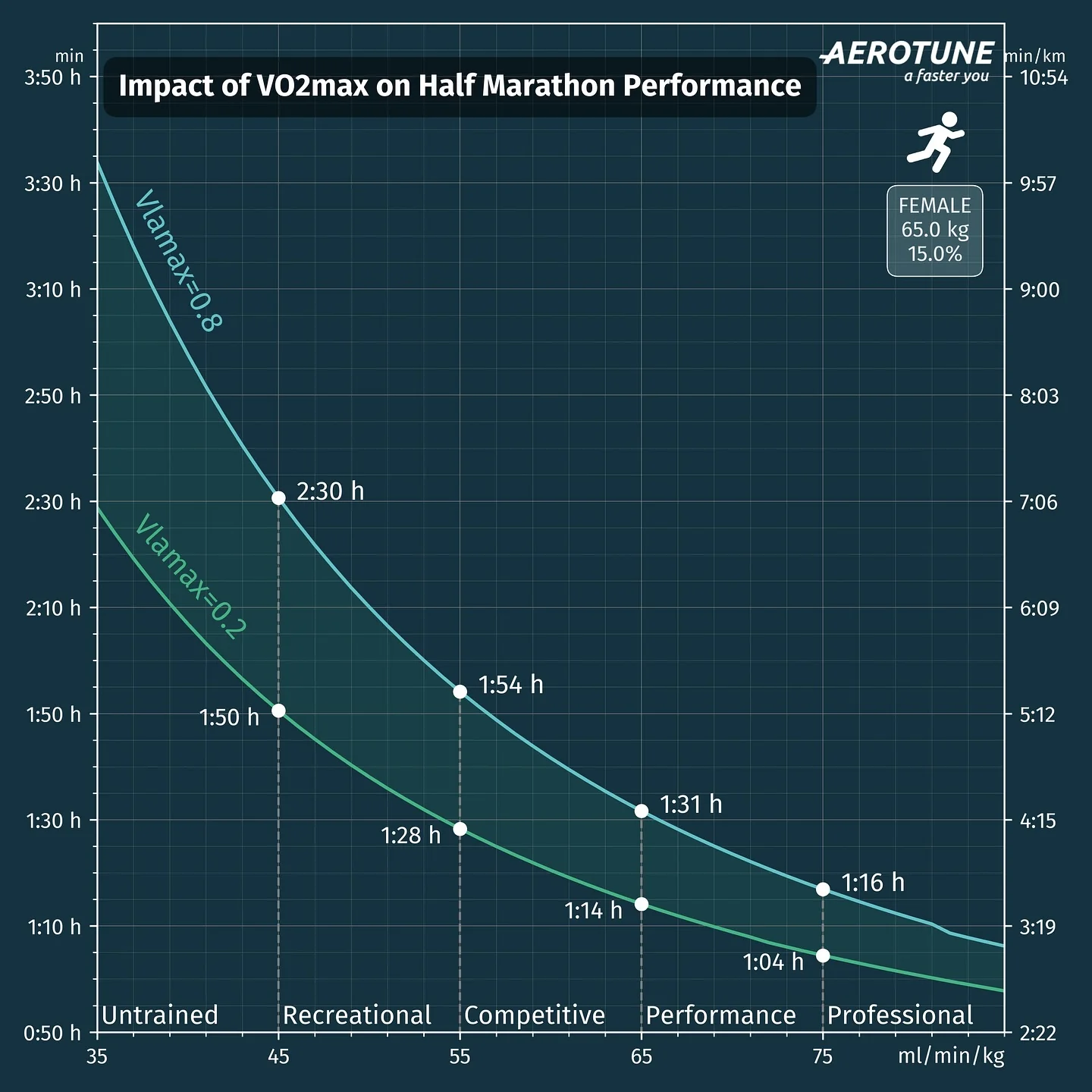
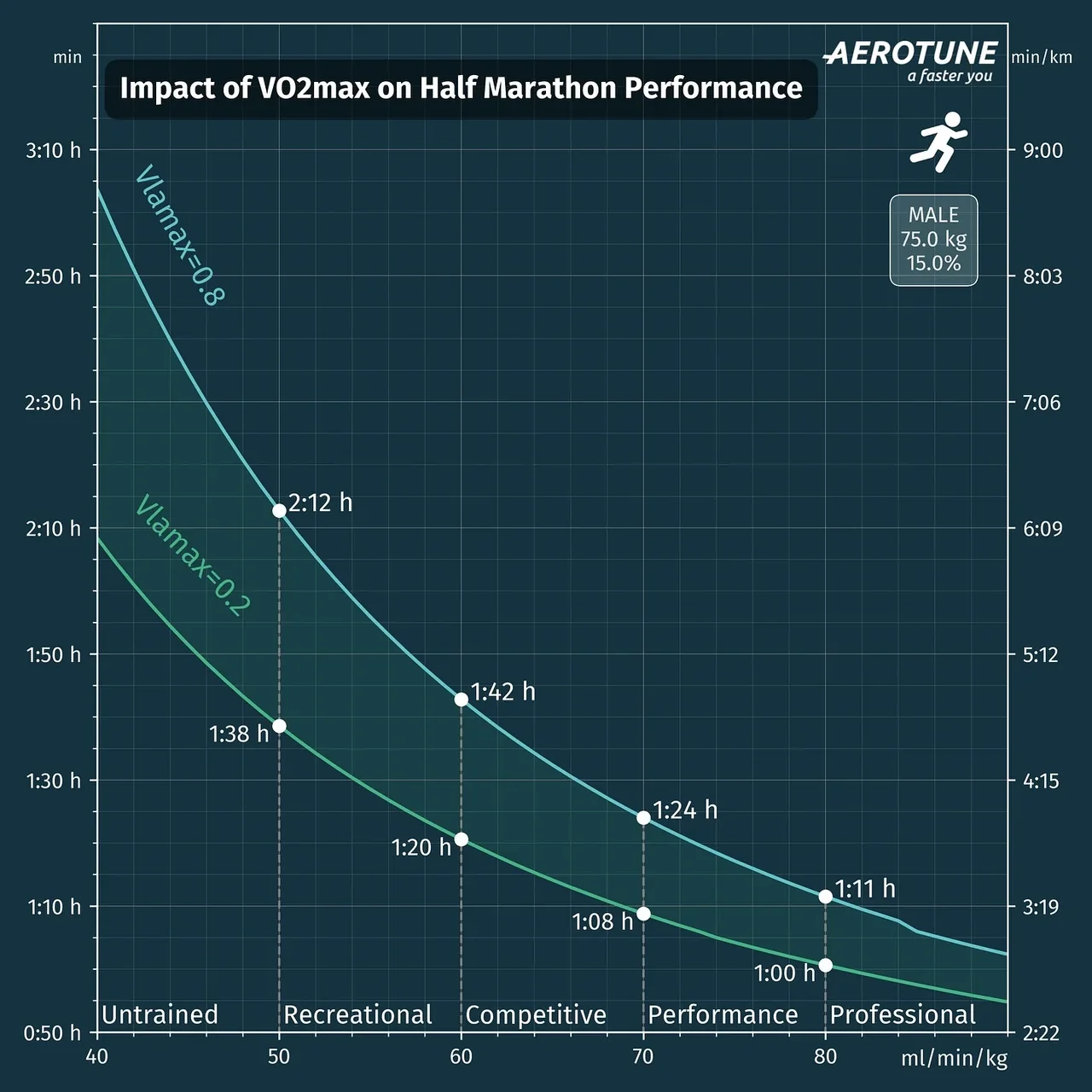
Here's how VO2max translates to half marathon performance. Values are calculated using the Mader model with the Two-Limiter Race Calculator (W' model + carbohydrate depletion), assuming a VLamax of 0.3 mmol/l/s and 40 g/h carbohydrate intake.
Men (~75 kg, 15% body fat):
| Level | Finish Time | VO2max |
|---|---|---|
| Recreational | ~2:25 h | ~40 ml/min/kg |
| Ambitious | ~1:47 h | ~50 ml/min/kg |
| Competitive | ~1:25 h | ~60 ml/min/kg |
| Performance | ~1:12 h | ~70 ml/min/kg |
| Professional | ~1:02 h | 80+ ml/min/kg |
Women (~65 kg, 20% body fat):
| Level | Finish Time | VO2max |
|---|---|---|
| Recreational | ~2:25 h | ~40 ml/min/kg |
| Ambitious | ~1:47 h | ~50 ml/min/kg |
| Competitive | ~1:25 h | ~60 ml/min/kg |
| Performance | ~1:12 h | ~70 ml/min/kg |
| Professional | ~1:03 h | 80+ ml/min/kg |
Want to break sub-1:45? You need a VO2max of at least 50 ml/min/kg. Chasing sub-1:25? You're looking at 60+. These numbers come directly from the Mader metabolic model.
The VLamax Factor: Why It Matters for Half Marathons Too
VO2max gets all the attention, but there's a second number that determines your half marathon performance: VLamax (maximum lactate production rate). It measures your anaerobic energy production — how fast you burn through carbohydrates and produce lactate.
For a half marathon, trained runners typically have a VLamax of 0.25-0.40 mmol/l/s — similar to marathon runners, since the high training volume naturally lowers VLamax.
Here's why VLamax matters:
- Your threshold pace (the pace you can sustain for ~1 hour) is determined by the interaction of VO2max AND VLamax — not VO2max alone
- A lower VLamax means less lactate at any given pace and better fat utilization
- Two runners with the same VO2max but different VLamax can have finish times that differ by 10+ minutes
The Training Paradox: VO2max Up vs. VLamax Down
What we've found from analyzing thousands of athletes: you can't optimize VO2max and VLamax at the same time. They pull in opposite directions.
Heavy VO2max interval training (30/30s, full carb availability) pushes your VO2max up — but also tends to raise your VLamax. Threshold-focused training and carb-restricted sessions lower VLamax — but VO2max typically drops with it.
The solution is intelligent periodization, which the A Faster You AI handles automatically:
- Far from race day: Build VO2max aggressively. Accept a temporary VLamax increase.
- Approaching race day: Shift to lowering VLamax for better running economy. The metabolic efficiency gain outweighs the slight VO2max dip.
- After the race: Rebuild VO2max for the next cycle.
This phase management — knowing when to push which parameter — is what separates good training from generic plans. The A Faster You system tracks both values in real time and adjusts automatically based on your race calendar.
How to Train Your VO2max for a Faster Half Marathon
Running more miles alone won't cut it. To move the needle on VO2max, you need targeted intensity work — and the intensity has to be right.
30/30 Intervals: Maximum VO2max Stimulus, Minimum Fatigue
The 30/30 interval is one of the most time-efficient ways to improve VO2max: 30 seconds at VO2max intensity, 30 seconds easy jog, repeated 10-20 times.
This format works because it maximizes the time your body spends near its oxygen ceiling. Short rest periods mean you start each effort already at an elevated VO2 level, accumulating significantly more "time at VO2max" than traditional long intervals.
The critical factor: intensity. Your VO2max interval pace must match YOUR physiology. A runner with a VO2max of 45 needs a completely different target pace than one with 55. Run too slow and you won't reach the adaptation threshold. Run too fast and you'll rely on anaerobic energy, missing the aerobic stimulus entirely. The right intensity depends on one thing: your individual VO2max.
A Faster You's AI training plan calculates this automatically from your Powertest results or AI-predicted VO2max.
The Body Reserve: Finding the Adaptation Sweet Spot
Through machine learning analysis of thousands of athletes, we've identified a clear pattern between training load and VO2max improvement.
We track accumulated fatigue through what we call Body Reserve (0-100 scale):
- Body Reserve above 60: You're comfortable, but you're not adapting. The training stimulus isn't enough to trigger physiological change.
- Body Reserve 35-50: The sweet spot. Enough consistent load to build new mitochondria, improve capillary density, and increase VO2max. This is where real progress happens.
- Body Reserve below 35: Same stimulus as the sweet spot, but with significantly higher injury risk and no additional adaptation benefit. The system keeps you out of this zone.
This isn't theory — it's backed by data from over 200,000 analyzed training sessions on our platform. The A Faster You training plan dynamically adjusts your weekly load to keep your Body Reserve in the optimal range.
Measure Your VO2max: The Powertest
Generic estimates from your GPS watch give you a rough idea. The A Faster You Powertest gives you precise VO2max and VLamax values using a standardized protocol based on the Mader model.
From these values, your personal training zones are calculated — including the exact pace or power for your VO2max intervals. Test every 6-8 weeks to track progress and keep your zones accurate.
Between tests, our AI prediction updates your VO2max estimate from every training session, so you always know where you stand.
Your Next Step
Know your VO2max. Train at the right intensity. Let the data do the coaching.
Start your free trial on A Faster You — science-based training plans built on the Mader model, not guesswork.
FAQ
What VO2max do I need for a sub-1:25 half marathon? Approximately 60 ml/min/kg with a VLamax of ~0.3 mmol/l/s. Values are calculated using the Mader model with the Two-Limiter Race Calculator.
How long does it take to improve VO2max? With consistent, properly dosed interval training, most runners see measurable VO2max improvements within 4-8 weeks. The rate depends on your starting level and training history.
Is VO2max the only factor for half marathon performance? No — VLamax (lactate production rate), running economy, and fueling strategy all matter. But VO2max is the strongest predictor and the most trainable factor. The A Faster You system tracks both VO2max and VLamax to give you the full picture.
Should I do a Powertest before starting a training plan? It's recommended. A Powertest gives you accurate baseline values for VO2max and VLamax, which allows the AI to set your training zones precisely from day one. Without it, the system uses AI predictions from your activities — still good, but the Powertest is the gold standard.
Performance predictions based on the metabolic model by Prof. Alois Mader (Mader, 2003; Mader & Heck, 1986), European Journal of Applied Physiology and International Journal of Sports Medicine. Calculated via Two-Limiter Race Calculator: W' model + carbohydrate depletion (Brent's method), VLamax=0.3 mmol/l/s, 40 g/h carbohydrate intake.