💡 Empowering Coaches with Precision and Simplicity
💡 Empowering Coaches with Precision and Simplicity

Hey Coach,
At Aerotune, we believe in empowering coaches like you with the best tools to elevate your athletes' performance. This passion drives us to create cutting-edge solutions that not only simplify your work but also enable you to unlock the full potential of your athletes. By focusing on precision, innovation, and simplicity, we ensure that you have everything you need to guide your athletes to success. 💪
🎯 Activity AI: Focus on What Matters Most
This time, we're putting the spotlight on Activity AI—your ultimate tool for daily metabolic analysis, performance predictions, and aerodynamic assessments. This powerful feature is designed to give you real-time insights and help you make data-driven decisions to optimize your athletes' training.
📊 Unlock Your Athletes' Potential with the Dashboard
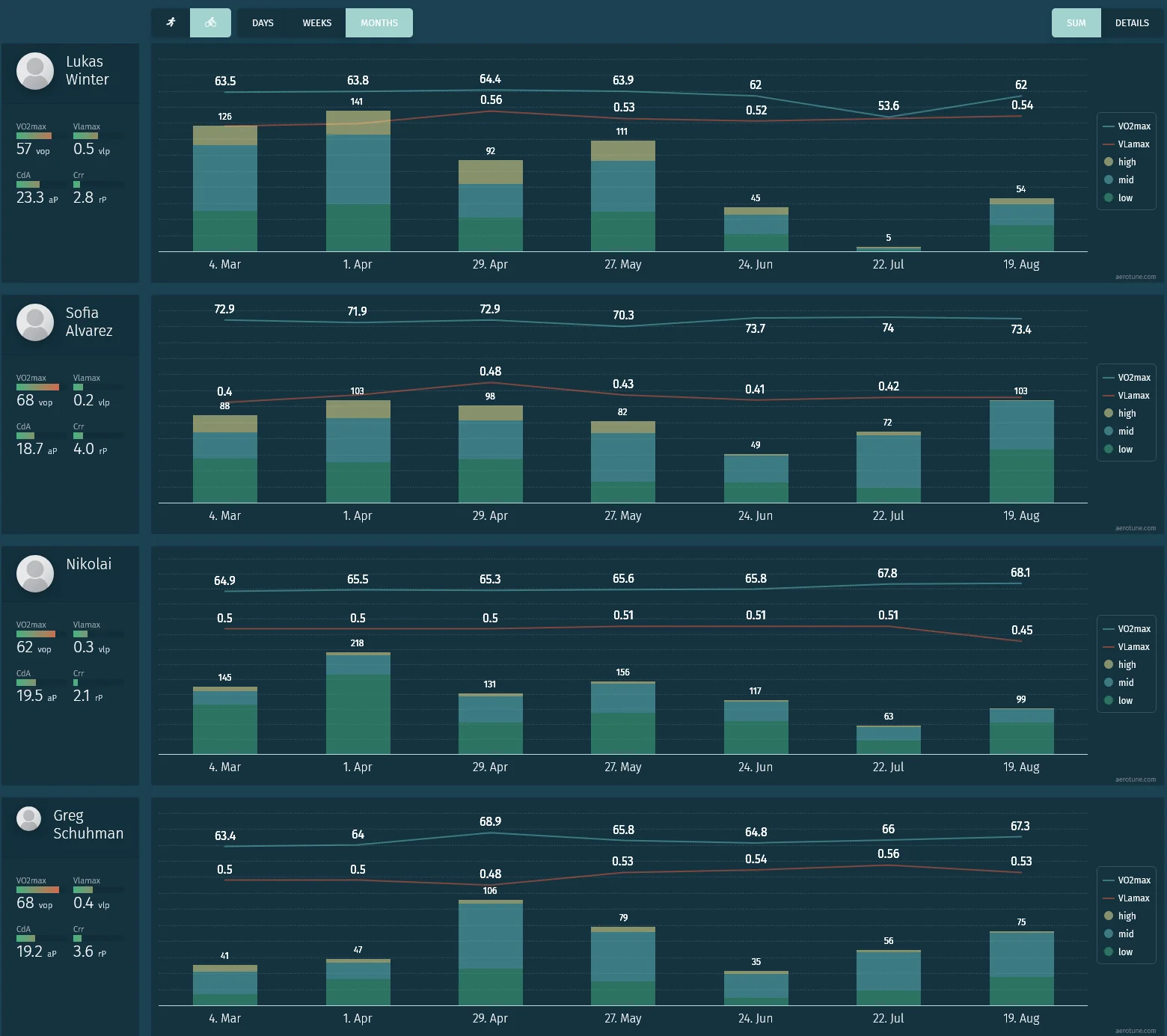
The Dashboard chart above is more than just a visual representation—it's a powerful tool designed to help you monitor and influence your athletes' key metrics over time. At a glance, you can see the development of VO2max, VLamax, and other crucial indicators across different training zones, represented by green, yellow, and red. These zones reflect low, mid, and high-intensity efforts, optimized based on Mader’s Protein Synthesis Model. Switching between the last 7 days and 7 weeks allows you to tailor your view and identify trends early on.
Optimizing Energy Flow
The green and yellow zones are particularly important for building VO2max. An 80:20 distribution between these zones has been shown to be highly effective. Athletes like Greg and Nikolai demonstrate how maintaining an optimal energy flow of 100% per week—equivalent to the ideal energy throughput in kilojoules as defined by Mader—can lead to significant gains in VO2max. This chart is your go-to tool for closely monitoring these metrics and making informed adjustments to your athletes' training.
To access this powerful dashboard, simply navigate to the right-hand Coach Menu, then go to Athletes -> Dashboard. Here, you’ll find all the tools and visualizations you need to effectively monitor and influence your athletes' key performance metrics over time.
🔍 Fine-Tune Performance: Mastering VO2max and VLamax
Buchheit and Laursen (2013) consider the glycolytic component as a secondary, yet essential factor in enhancing VO2max. While a high cardiopulmonary effort is primarily crucial, their review article (part two) shows that the glycolytic contribution plays a significant role, especially during short intervals. VLamax serves as an important lever to strategically steer the development of VO2max and optimally prepare athletes for competition. Aerotune identifies a VLamax value above 0.5 as critical for achieving the high-intensity training effects described by Tabata (Tabata, 1996), enabling significant improvements in VO2max. A higher VLamax not only boosts performance but also extends the duration an athlete can train in the VO2max range, thereby maximizing VO2max gains.
For instance, with a VLamax of 0.2, an athlete may only be able to train for around 20 minutes per week in the V100 zone. However, with a VLamax of 0.6, this can extend to over 40 minutes per week, maximizing VO2max gains.
However, lowering VLamax is equally important, especially for time trials, MTB marathons, or triathlons. Start reducing VLamax around 2-3 months before a key race, but be mindful that it will need to be increased again post-race to ensure continued VO2max development.
Detailed Analysis
Switch to the detailed view within the chart to see the exact percentage breakdown across all zones. This enables even more precise adjustments and insights, ensuring your athletes are training in the right intensity zones for their goals. For more specific information and precise control over these metrics, the Powertest is your go-to tool. It provides in-depth data on VO2max, VLamax, and other critical performance indicators, giving you the insights you need to tailor your athletes' training plans with confidence.
🏋️♂️ Weekly Insights: Performance Analysis Made Easy
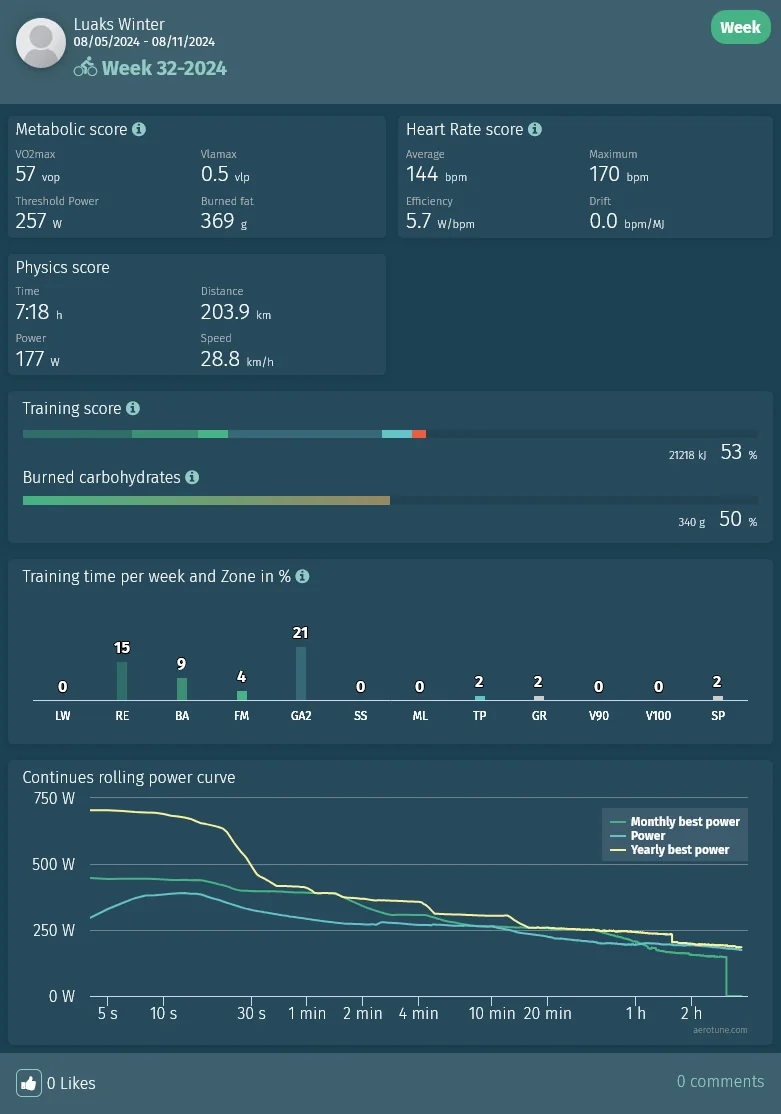
The weekly overview provides a snapshot of your athlete's performance across key metrics, ensuring you have the data you need to make informed coaching decisions. This summary is divided into three core areas: Metabolic Score, Heart Rate Score, and Physics Score.
To view the Activity Week timeline, navigate to your dashboard and apply the filters for "My Athletes" and "Activity Week." This will display the weekly summaries for each athlete across all sports, allowing you to focus on the specific metrics that matter most.
🌡️ Comprehensive Metabolic Insights
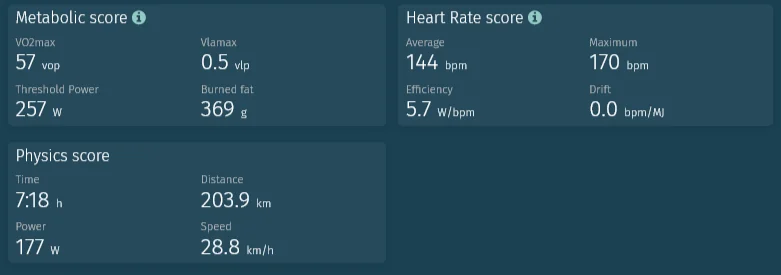
Metabolic Score
- VO2max & VLamax: These are calculated as weekly averages, with outliers filtered out using a two-sigma method. This ensures the data reflects consistent performance levels across the week. The Powertest AI 2.0 further enhances accuracy by leveraging AI-driven analysis.
- Burned Fat: The amount of fat burned is a critical indicator of low-intensity workouts. This metric helps you understand how effectively your athlete is engaging in fat metabolism, particularly during base training sessions.
Heart Rate Score
- Average & Maximum Heart Rate: These values provide an overview of the cardiovascular load throughout the week.
- Efficiency (De Smet Model): This innovative metric indicates how many watts are generated per heartbeat. The higher this value, the greater the athlete's performance capacity. Unlike traditional 60-second averages, the De Smet model offers a more accurate assessment by accounting for varying heart rate response times, which can range from 15 to 100 seconds.
- Drift: This metric measures the increase in heart rate per megajoule (MJ) of energy expended. A lower drift is associated with a lower VLamax, indicating efficient energy use. (De Smet & Francaux, 2016)
Physics Score
- Time, Distance, Power, and Speed: These metrics provide a straightforward summary of the physical outputs achieved during the week. They are essential for understanding the overall training load and its distribution.
⚙️ Master the Metrics: Fueling, Zones, and Recovery
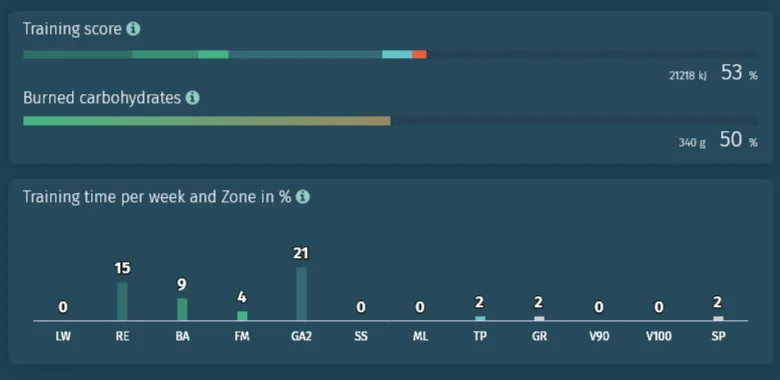
In this section, we dive deeper into the metrics that play a crucial role in optimizing your athletes' performance—Training Score, Burned Carbohydrates, and Training Time per Week in percentage or Training Score. These are the same core metrics reflected in the dashboard, but with an additional focus on carbohydrate consumption, which is essential for effectively managing VLamax.
It's important to note that the Training Score also accounts for the load from the previous week to help prevent overtraining. If more than 100% is trained, the excess (indicated in black: LW for Last Week) is carried over into the following week. This feature ensures that your athletes' training load is managed sustainably, preventing burnout and optimizing recovery.
Training Score & Zone Distribution
The Training Score provides a comprehensive view of how much time your athlete spends in each training zone throughout the week. These zones are color-coded and based on intensity levels—low, mid, and high. The percentage distribution across these zones directly impacts key performance metrics like VO2max and VLamax. Maintaining an optimal training distribution is crucial for maximizing performance gains.