VO2max for Marathon Runners: Times, Training & Performance Data
You're training for a marathon. You're putting in the miles, the long runs, the tempo sessions. But there's one number that determines more about your finish time than almost anything else: your VO2max.
What Is VO2max — and Why Should You Care?
VO2max measures the maximum amount of oxygen your body can use during intense exercise, expressed in ml/min/kg. Think of it as your engine size. A bigger engine can sustain more power — and in running, that means faster pace over longer distances.
The science behind this is well established. A Faster You is built on the metabolic model developed by Prof. Alois Mader, which describes how your body produces energy through two key parameters: VO2max (aerobic capacity) and VLamax (anaerobic lactate production rate). Your marathon performance is essentially defined by the interaction of these two values.
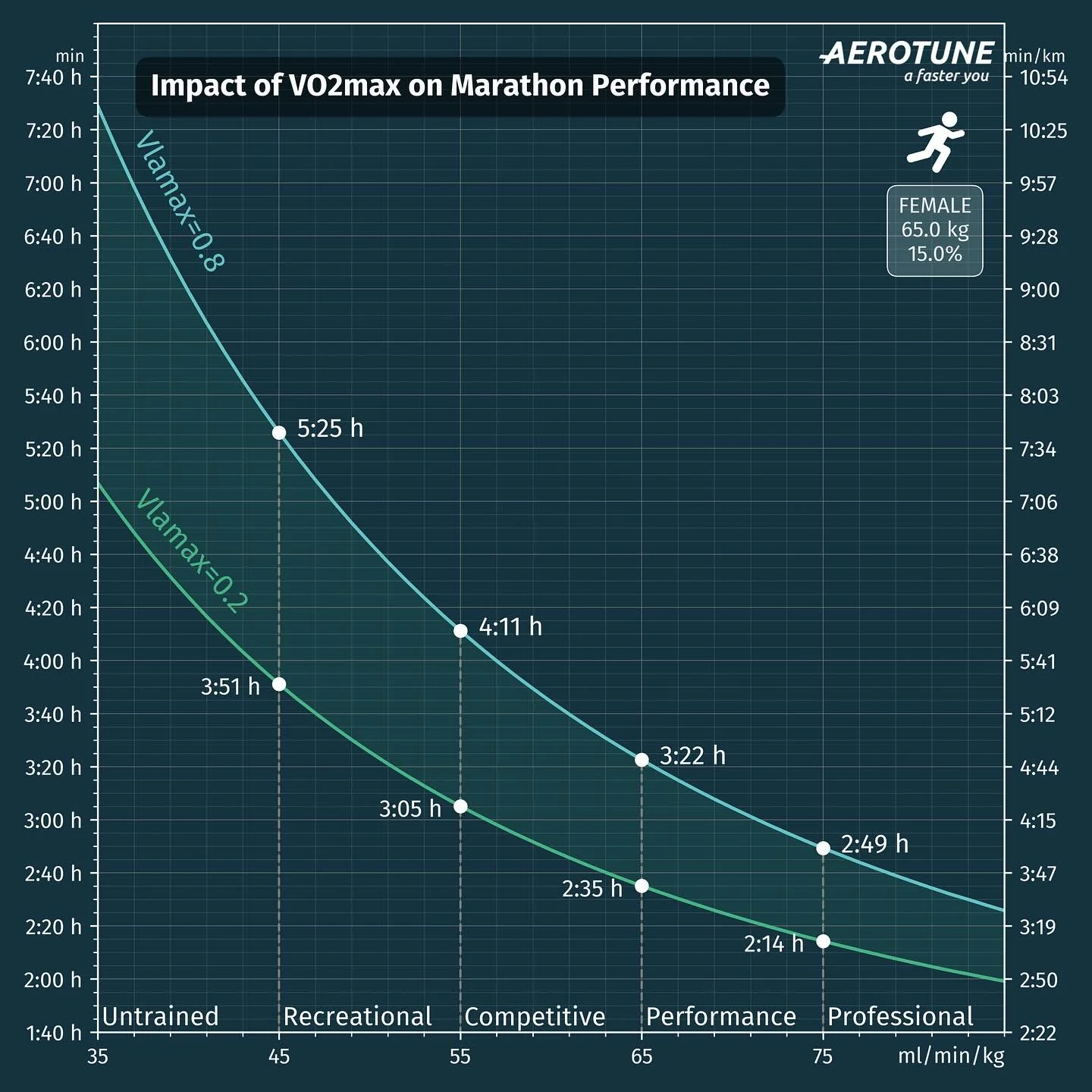
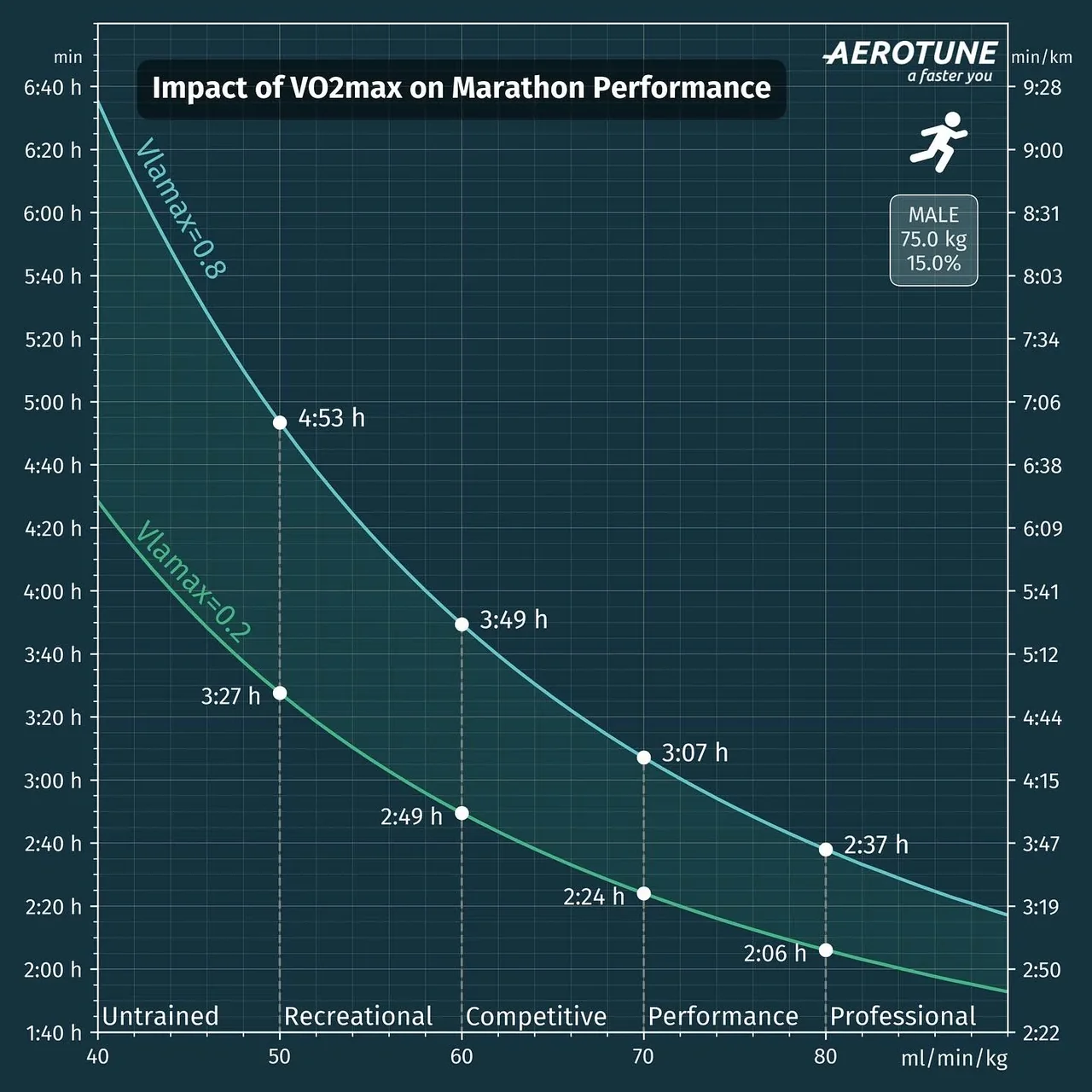
VO2max and Marathon Finish Times
Here's what the data shows. These values are calculated using the Mader model with the Two-Limiter Race Calculator (W' model + carbohydrate depletion), assuming a typical VLamax of 0.3 mmol/l/s for trained marathon runners and 60 g/h carbohydrate intake.
Men (~75 kg, 15% body fat):
| Level | Finish Time | VO2max |
|---|---|---|
| Recreational | ~4:15 h | ~45 ml/min/kg |
| Ambitious | ~3:20 h | ~55 ml/min/kg |
| Competitive | ~2:45 h | ~65 ml/min/kg |
| Performance | ~2:20 h | ~75 ml/min/kg |
| Professional | ~2:10 h | 80+ ml/min/kg |
Women (~65 kg, 20% body fat):
| Level | Finish Time | VO2max |
|---|---|---|
| Recreational | ~4:45 h | ~40 ml/min/kg |
| Ambitious | ~3:40 h | ~50 ml/min/kg |
| Competitive | ~3:00 h | ~60 ml/min/kg |
| Performance | ~2:30 h | ~70 ml/min/kg |
| Professional | ~2:20 h | 75+ ml/min/kg |
The pattern is clear: every 10 ml/min/kg of VO2max improvement translates to roughly 25-55 minutes off your marathon time, with the biggest gains at lower fitness levels.
Why VO2max Alone Isn't Enough: The VLamax Factor
If VO2max is your engine size, then VLamax is your fuel efficiency. VLamax (maximum lactate production rate) measures how much energy your body generates anaerobically — through fast glycolysis. A high VLamax means you burn through carbohydrates quickly and produce a lot of lactate. Great for sprinters. Terrible for marathoners.
For a marathon, you want a low VLamax (0.2-0.35 mmol/l/s). Here's why:
- Lower carb burn rate — you preserve glycogen over 42 km instead of depleting it by km 30
- Less lactate production — you can sustain a higher percentage of your VO2max without accumulating lactate
- Higher fat oxidation — your body shifts to burning more fat, your virtually unlimited fuel source
- Higher threshold — your sustainable race pace increases relative to your VO2max
Your marathon threshold (MLSS) isn't determined by VO2max alone — it's the result of the interaction between VO2max and VLamax. Two runners with identical VO2max can have vastly different marathon times if their VLamax differs.
The Periodization Dilemma: You Can't Optimize Both at Once
Here's what we've discovered from analyzing thousands of athletes: VO2max and VLamax can't be improved simultaneously. They pull in opposite directions.
- When you do heavy VO2max interval training (like 30/30s) with full carbohydrate availability, your VO2max goes up — but your VLamax tends to rise too, because you're training your anaerobic system as well.
- When you focus on lowering VLamax through threshold training or carbohydrate-restricted sessions, your VLamax drops — but your VO2max typically drops with it.
This is the central challenge of marathon training. And it's exactly what the A Faster You AI solves through intelligent periodization:
Phase 1 — Far from race day: Build the engine - Focus on VO2max development (30/30 intervals, high-intensity blocks) - Full carbohydrate availability — no restrictions - Accept that VLamax may rise temporarily - Goal: Push your aerobic ceiling as high as possible
Phase 2 — Approaching race day: Optimize economy - Shift focus to lowering VLamax (threshold work, longer intervals) - Accept that VO2max may dip slightly - The gain in metabolic economy outweighs the small VO2max loss - Goal: Maximize your sustainable race pace
Phase 3 — After the race: Rebuild - Shift back to VO2max development for the next cycle - Timing depends on your competition calendar
The A Faster You training plan handles this periodization fully automatically. It tracks both your VO2max and VLamax trends, knows where you are in your training cycle, and adjusts the training focus accordingly. You don't need to think about when to switch phases — the AI does it based on your data and your race schedule.
This is fundamentally different from generic training plans that treat every week the same. It's the difference between a coach who understands exercise physiology and a pace calculator.
How to Actually Improve Your VO2max
Here's where most runners go wrong. They either run too slow (no stimulus) or too hard (burnout). The key to improving VO2max is training at the right intensity — and that intensity depends on your individual VO2max value.
30/30 Intervals: The Gold Standard
One of the most effective methods for improving VO2max is the 30/30 interval: 30 seconds at VO2max intensity, 30 seconds easy recovery, repeated 10-20 times.
Why 30/30? Because it allows you to accumulate significant time at or near your VO2max without the massive fatigue cost of longer intervals. Your body spends more total time in the "adaptation zone" where VO2max improvements actually happen.
But here's the critical part: The right intensity for your 30-second efforts is determined by your individual VO2max — not by some generic pace chart. Someone with a VO2max of 50 needs a completely different target power or pace than someone with a VO2max of 65. If you go too easy, the stimulus is wasted. Too hard, and you'll burn out before accumulating enough time at the right intensity.
This is exactly what A Faster You's AI training plan does: it calculates your individual VO2max zones from your data and prescribes intervals at precisely the right intensity.
Block Training: More Sessions, Shorter Duration
Our training system sometimes plans 3-4 VO2max sessions on consecutive days. That might sound counterintuitive, but there's solid science behind it.
A single 90-minute VO2max session creates a very high training load that requires 2-3 days of recovery. Four 45-minute sessions spread over consecutive days create the same total training stimulus but with significantly lower recovery costs per day. The result: more total training volume in your week.
This approach is rooted in the concept of Protein Turnover — the continuous breakdown and rebuilding of proteins in your muscles, which is the actual mechanism behind fitness adaptation.
The Body Reserve: When Adaptation Actually Happens
This is something we discovered through machine learning analysis of thousands of athletes on our platform: there's a clear correlation between Body Reserve and VO2max improvement.
Body Reserve is our metric for accumulated training fatigue, scored from 0 to 100:
- Body Reserve 60-100: You're well rested, but no significant adaptation is happening. The training stimulus isn't enough.
- Body Reserve 35-50: This is the sweet spot. Your body is under enough consistent stress to trigger real physiological adaptation — new mitochondria, better oxygen transport, improved VO2max.
- Body Reserve below 35: The adaptation stimulus is the same as at 35-50, but injury risk increases significantly with no additional benefit. This is where overtraining starts.
The A Faster You training plan is designed to keep you in that 35-50 range — pushing hard enough for adaptation, but not so hard that you get injured. This is not guesswork. It's driven by data from over 200,000 analyzed activities.
Know Your Numbers: The Powertest
You can't improve what you don't measure. The A Faster You Powertest determines your exact VO2max and VLamax values using a standardized test protocol based on the Mader model.
From these values, your personal training zones are calculated — including the exact intensity for your VO2max intervals. Do a Powertest every 6-8 weeks to track your progress and recalibrate your training.
Between Powertests, our AI prediction estimates your VO2max from every training session, so you can see your trend develop in real time.
Start Training Smarter
Whether you're aiming for sub-4:00 or sub-3:00, the path is the same: know your VO2max, train at the right intensity, and let the data guide your progress.
Start your free trial on A Faster You and get a training plan that's built on real science — not generic pace tables.
FAQ
What VO2max do I need for a sub-3 marathon? For men (~75 kg), you'll need approximately 60 ml/min/kg with a well-trained VLamax of ~0.3 mmol/l/s. For women (~65 kg), a VO2max of 60 also translates to just under 3:00. These values are calculated using the Mader model with the Two-Limiter Race Calculator.
Can I improve my VO2max at any age? Yes. VO2max is trainable at any age through targeted interval training. The rate of improvement may vary, but the physiological mechanisms remain the same.
How often should I do VO2max intervals? Typically 2-4 sessions per week during a VO2max training block, depending on your recovery capacity and total training load. The A Faster You training plan adjusts this automatically based on your Body Reserve.
What's the difference between VO2max from my Garmin and the Powertest? Garmin estimates VO2max from pace and heart rate using a generic algorithm. The A Faster You Powertest uses the Mader model with actual performance data from a standardized test — it's significantly more accurate, especially for trained athletes.
Performance predictions based on the metabolic model by Prof. Alois Mader (Mader, 2003; Mader & Heck, 1986), published in the European Journal of Applied Physiology and the International Journal of Sports Medicine. Calculated via Two-Limiter Race Calculator: W' model + carbohydrate depletion (Brent's method), VLamax=0.3 mmol/l/s, 60 g/h carbohydrate intake.