The Virtual Coach: How We Built an AI That Actually Understands Your Training
Most AI coaching apps slap a ChatGPT wrapper on generic training advice and call it innovation. We took three years, a metabolic model from the 1980s, and 60 custom tools to build something fundamentally different.
This is the story of how a small German sports tech team turned a simple chatbot into a virtual coach that reads your data, adjusts your plan, and talks to you on WhatsApp — like a real coach would.
It Started With an Email Problem
Before the virtual coach existed, every athlete question landed in an inbox. "Why is my VO2max dropping?" "Can I move Thursday's interval to Saturday?" "What should I eat before my marathon?"
Good questions. Important questions. But answering them takes time — and a coach who knows your data. For a platform serving over a thousand athletes, email doesn't scale.
Then, in November 2022, ChatGPT launched. Within days, we had a prototype running inside the Afasteryou platform: a chatbot fed with our sports science knowledge, available 24/7. By July 2023, the first RAG system went live — using FAISS vector search to find relevant answers from our knowledge base.
It worked. Athletes got instant answers about training zones, recovery, nutrition. But it had a fundamental limitation: it could talk about training, but it couldn't see yours.
From Chatbot to Coach: The Three Generations
Generation 1 (2023): The Knowledge Bot A retrieval-augmented chatbot with our sports science library. It could explain what VLamax means or why recovery matters. Useful — but generic. It didn't know if your VLamax was 0.35 or 0.55, and it certainly couldn't change your plan.
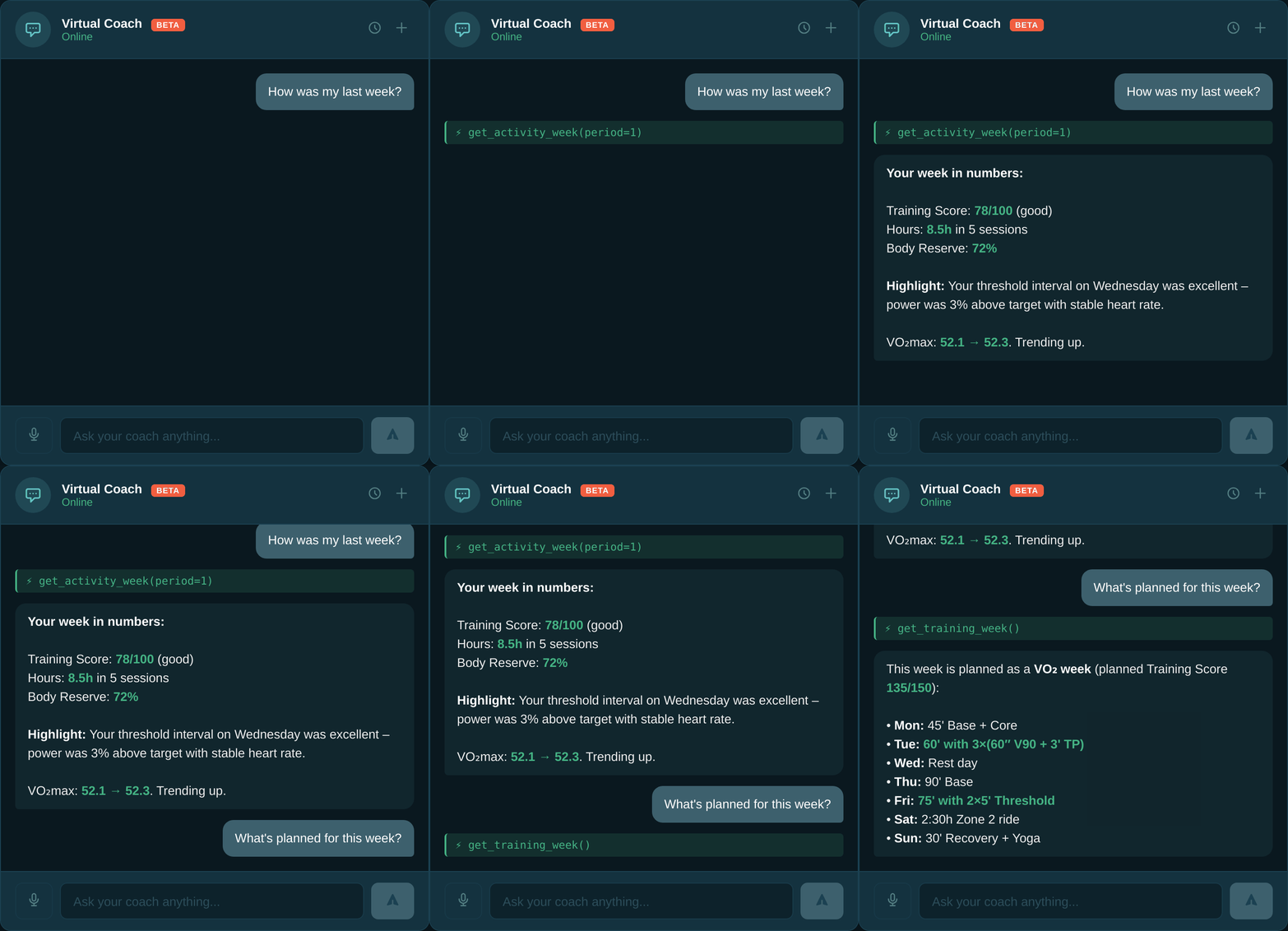
Generation 2 (2024): The Data Reader We gave the chatbot eyes. It could now query the athlete's actual training database — VO2max, threshold power, weekly load, sleep data, HRV. When you asked "How was my week?", it answered with your numbers. A real improvement, but still read-only.
Generation 3 (2025-2026): The Tool-Calling Coach This is where everything changed. Inspired by how Claude and other LLMs learned to use tools, we built a system where the coach doesn't just read data — it acts. Sixty tools, from marking sick days to adding races to scheduling power tests. The coach became an interface to the entire platform.
The moment the coach successfully adjusted an athlete's training plan for the first time — watching the tool calls cascade in the chat: get_day_plan → mark_day_as_sick → plan recalculates — that was the "aha" moment. This wasn't a chatbot anymore. This was a coach.
How the Coach Actually Thinks
Let's be clear about what the virtual coach is — and what it isn't.
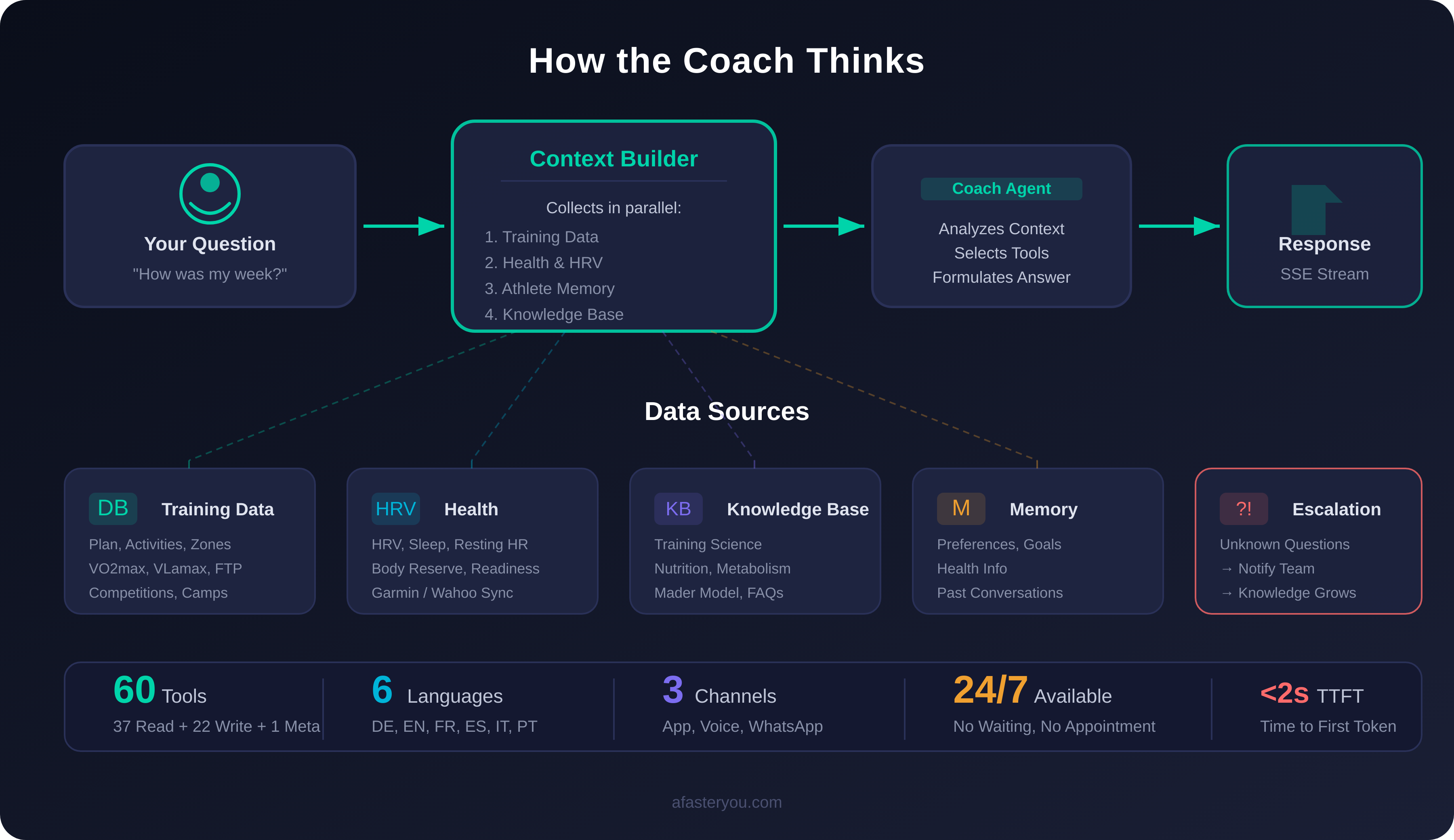
It is not a large language model generating training plans. It doesn't hallucinate workout structures or make up physiological data. The training intelligence — the algorithms that build your plan, calculate your zones, predict your race times — those are our own systems. Real neural networks. Real sports science. Built over years.
The coach is the interface. Think of it as a highly skilled translator between you and a complex training platform. You speak naturally — "I'm sick", "move tomorrow's ride to Friday", "what's a good VLamax for marathon?" — and the coach translates that into precise database queries and platform actions.
Here's what happens when you send a message:
You: "I've been sick since Monday, mark those days"


Coach thinks:
  1. Which days? Monday to today → 2026-03-17 to 2026-03-20
  2. Tool needed: mark_day_as_sick
  3. Execute for each day
  4. Plan recalculates automatically


Coach: "Done. I've marked Monday through today as sick days.
        Your plan is adjusting — this week's Training Score
        target dropped from 135 to 45. Rest up."
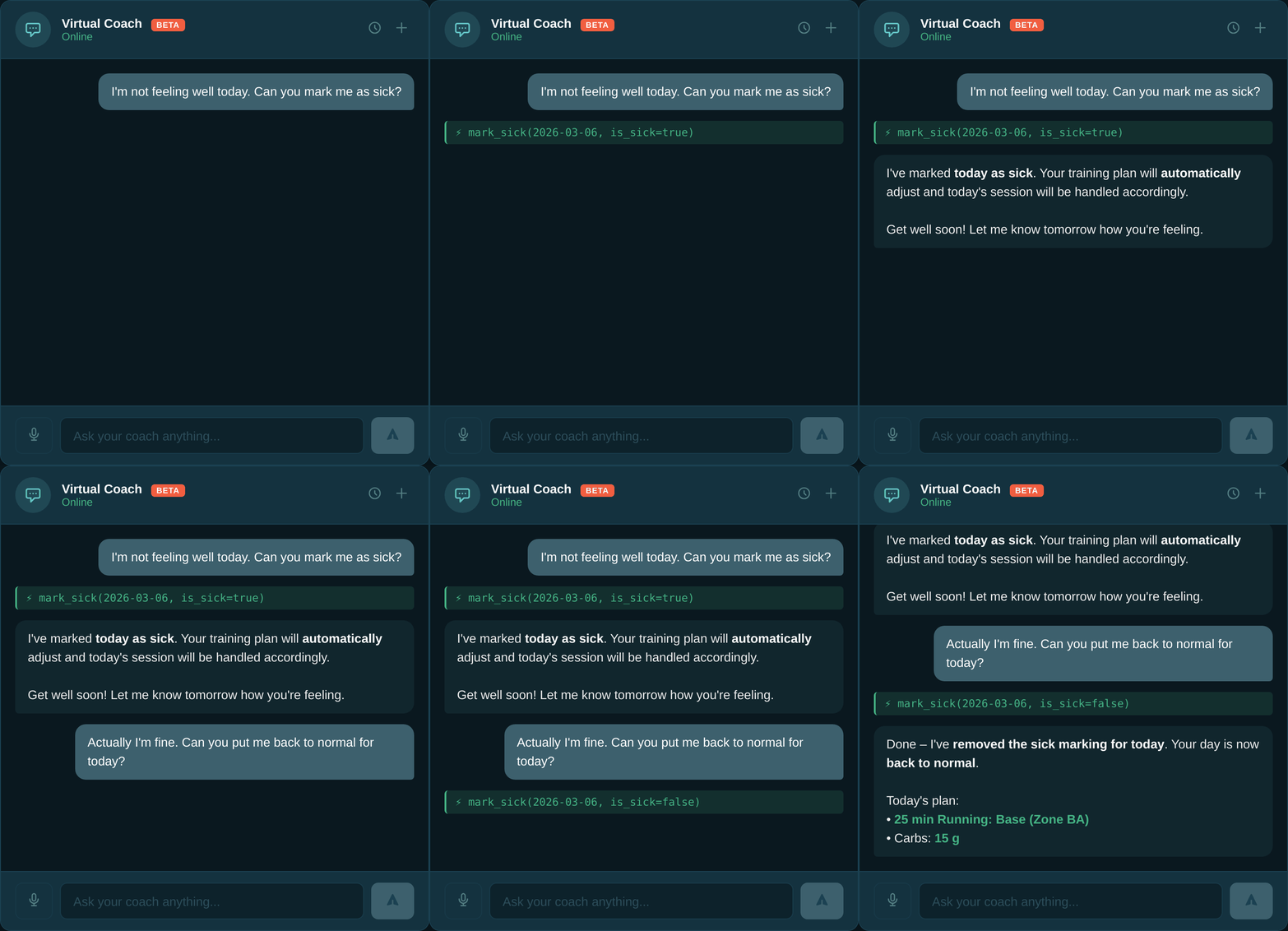
No forms. No settings pages. No five taps to find the right menu. Just tell the coach what happened.
60 Tools — What the Coach Can Actually Do
The coach has 60 tools organized into categories. Not all are loaded at once — it discovers what it needs, like a professional reaching for the right instrument.
Always Available (Core Tools)
The essentials the coach needs in every conversation:
- get_day_plan — Shows today's workouts, health scores, and readiness
- get_week_summary — Weekly overview with Training Score, load, recovery, and nutrition
- get_training_plan — The full multi-week plan with periodization
- get_recent_activities — Your latest sessions with performance analysis
- search_knowledge — Searches our sports science knowledge base
- mark_day_as_sick — Marks days as sick, plan adjusts automatically
- take_rest_day — Voluntary rest day — sometimes you just need one
- swap_training_days — Swaps all sessions between two days
- set_training_intensity — Adjusts plan intensity (90–110%)
- navigate_to — Guides you to specific pages in the app
On-Demand Categories (48 more tools)
When the conversation goes deeper, the coach loads specialized tools:
Activities & Scheduling — Set training times for specific days or weekdays, move individual sessions, add extra sessions, log RPE and subjective feedback after workouts.
Competitions — Add races (A/B/C priority), tapering adjusts automatically. Get race predictions powered by the Mader model — not generic pace tables, but your metabolic profile translated into a race strategy.
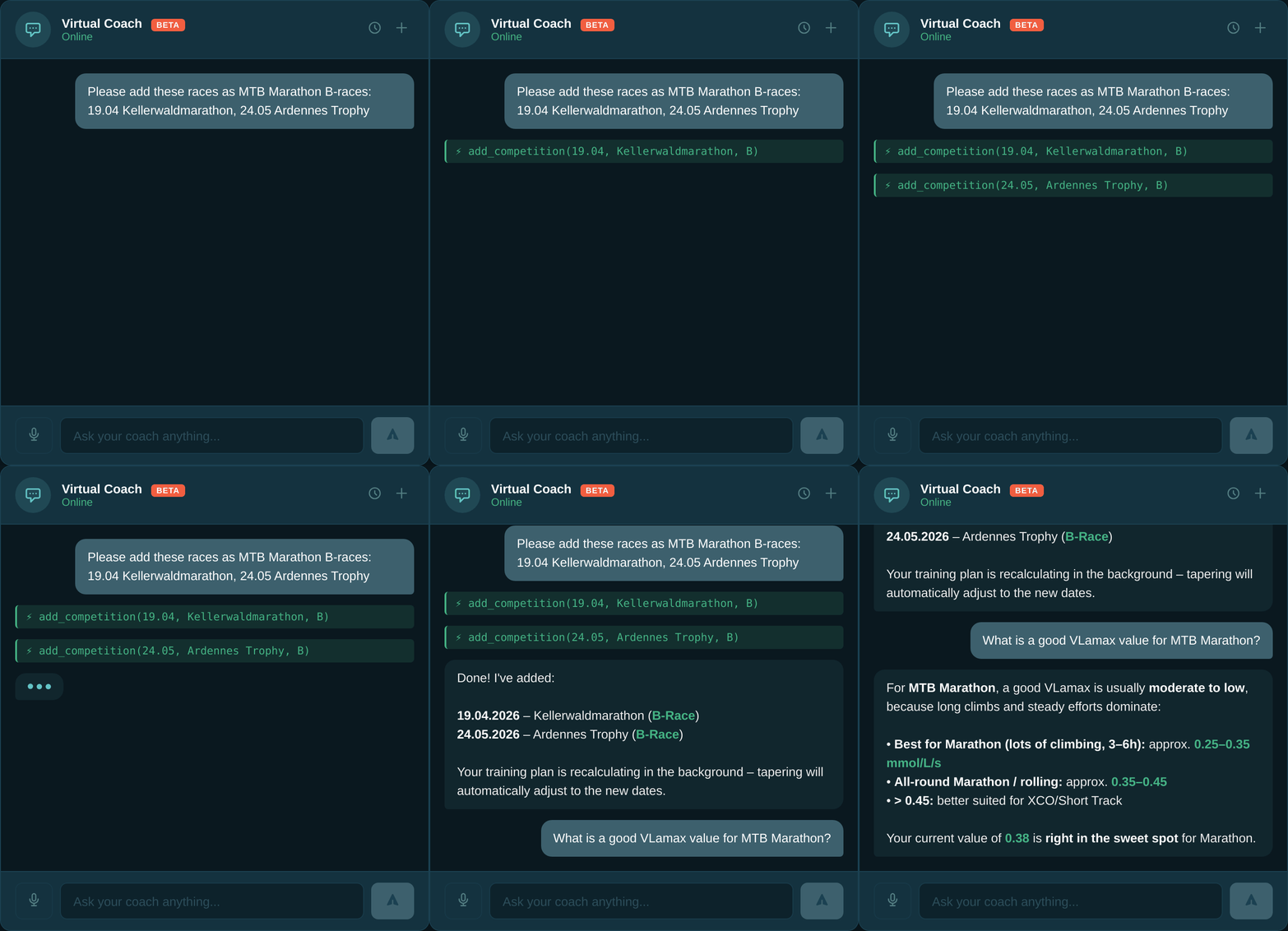
Health & Recovery — View HRV trends, sleep quality, resting heart rate history. Undo rest days when you feel better. Set vacation periods.
Plan Configuration — Change your main discipline, adjust ambition level, configure warm-up/cool-down, toggle supplementary training, switch between PowerTest and AI-derived training zones.
Diagnostics — View power test results with VO2max and VLamax history, training zones with exact power ranges, even aerodynamics data for cyclists.
Training Camps — Plan camps with custom daily training hours.
Platform — Check subscription status, search our blog and knowledge base, file feature requests or bug reports, connect Garmin devices, and — when the coach doesn't know the answer — escalate directly to our team.
That last one matters. When the coach doesn't know, it doesn't make things up. It escalates to Sebastian or Björn, and the answer flows back into the knowledge base. The coach gets smarter with every question it can't answer.
The Knowledge Hierarchy: Not All Information Is Equal
The coach's knowledge base isn't a flat dump of training articles. It's structured by reliability:
Our own research (highest priority) — Data-driven findings from our platform: a million+ activities, validated performance models, real-world training outcomes.
The Mader model & simulations — The metabolic model that underpins everything (more on this below), plus our simulation models for race predictions and training load.
Sports science literature — Peer-reviewed research on training, nutrition, recovery, and periodization.
Expert knowledge — Years of coaching experience from Björn, who works with professional cyclists including the World Tour team UNOX, and Sebastian's data science insights.
Support insights — Common questions and edge cases discovered through real athlete interactions.
When the coach answers a question, it prioritizes higher-tier sources. Our own validated research outweighs a generic textbook recommendation. This is how you avoid the "confident but wrong" problem that plagues generic AI assistants.
The Mader Model: Why We Don't Just Use FTP
Most training platforms reduce your fitness to a single number — FTP (Functional Threshold Power) or a similar metric. The problem: one number can't describe three energy systems.
The Mader model, developed by the German physiologist Alois Mader, describes human energy production through three interconnected systems:
- The PCr system — Your sprint fuel. 5-10 seconds of maximum power.
- The glycolytic system (VLamax) — Lactate-producing energy. Fast but costly in carbohydrates.
- The aerobic system (VO2max) — Oxygen-based endurance. The backbone of long-distance performance.
What makes this powerful for coaching: these systems interact. A high VLamax means you produce lactate faster — great for sprints, terrible for marathons. Our data shows that when athletes try to lower their VLamax (which time trialists want for efficiency), they often inadvertently lower their VO2max too. The Mader model explains why — and our algorithms account for it.
We validated our implementation with the Medical School Hamburg. Our PowerTest-derived VO2max values match lab measurements with less than 2% error. Our VLamax predictions are equally precise.
This is what the coach draws from when it answers your questions. When you ask "What's a good VLamax for marathon?", the coach doesn't just give a generic range — it shows you your current value and explains where you sit relative to the optimal range for your discipline.
WhatsApp: Because That's How Athletes Actually Talk to Coaches
Here's something we noticed: in Europe, most athletes communicate with their coaches via WhatsApp. Not through apps. Not through dashboards. WhatsApp voice messages while cooling down after a ride.
So we brought the virtual coach to WhatsApp.
Same intelligence. Same tools. Same data access. You can send a voice message saying "Hey, I only have 45 minutes tomorrow, can you shorten the session?" — and the coach adjusts your plan. From WhatsApp.
This isn't about technology for technology's sake. It's about meeting athletes where they already are. The best UI is the one you're already using.
Seven languages supported: German, English, French, Dutch, Spanish, Italian, Portuguese. Speak in any of them — the coach responds in kind.
The Proactive Coach: It Reaches Out to You
The latest evolution: the coach doesn't just wait for questions. It initiates conversations.
Morning Briefing — Your daily readiness score, today's planned workout, and an explanation if your training load was reduced (e.g., "Your HRV dropped 15% — we've dialed back intensity today").
Activity Feedback — After you sync a workout, the coach sends a message: "Nice threshold session! Your power was 3% above target with stable heart rate. How did it feel?"
This is still early — WhatsApp's 24-hour messaging window means the athlete needs to have messaged recently. But the direction is clear: a coach that actively monitors and communicates, not one that sits in a corner waiting to be asked.
What's Next: From Machine Learning to Neural Network Training Plans
The virtual coach is the interface. The real revolution is happening in the engine room.
PowerTest AI 2.0 — We're dramatically improving the precision of our performance predictions. Better VO2max and VLamax predictions mean better training plans — because these values are the input to everything else.
Neural Network Training Plans — Today, our training plans use machine learning to determine how much energy an athlete should spend in each training zone to drive adaptation. That's already data-driven, based on our database of over a million activities.
But the goal is bigger: supervised learning to predict how VO2max and VLamax will change based on a given training stimulus. Week by week, like a weather forecast for your fitness.
After that: reinforcement learning to find the optimal training — the plan that produces the best adaptation for each individual athlete. We have athletes with five years of continuous data. That's five years of labeled training-to-outcome pairs for the neural network to learn from.
To be clear: this won't produce magical workout structures from day one. It will predict energy distribution across zones, rest day placement, training frequency. The gap between "how much energy in which zones" and "here's your perfectly structured interval session" is still significant. But this is the path — and it's a path built on real physiology, not marketing claims.
What the Coach Can't Do (Yet)
Honesty matters:
- It can't analyze training videos or do movement analysis
- It doesn't replace a doctor for injuries or medical questions
- It can't import data from other platforms (yet)
- Race predictions work for running disciplines — cycling race predictions are coming
- It's good, but it's not perfect. Sometimes it asks one too many confirmation questions. Sometimes it picks the wrong tool on the first try. We're improving every day.
The Team Behind It
Sebastian Schluricke — Data scientist and developer. Builds the algorithms, the platform, and the AI systems. Started coding the first chatbot prototype in November 2022, the week ChatGPT launched.
Björn Kafka — Exercise physiologist, author, and professional cycling coach (World Tour team UNOX). The scientific brain behind the metabolic models. When the coach explains why your VLamax matters, that knowledge comes from Björn.
Dennis Nadolny — Product testing and the athlete's perspective. Ironman finisher who makes sure the coach actually helps real athletes, not just looks good in demos.
Alyona Blagikh — Marketing and brand strategy. Translates complex sports science into communication that athletes understand.
Try It
- In the app: Tap the coach icon and ask your first question
- By voice: Hold the microphone button and speak
- Via WhatsApp: Save the number and start messaging
No setup. No onboarding. Just ask.
The virtual coach is available to all Afasteryou users with an active training plan. And it's getting better every day — because every question you ask, every tool it uses, every escalation to our team makes it smarter.
The virtual coach is free for all Afasteryou subscribers. Try asking: "How was my last week?" — and see what happens when AI meets real sports science.