VO2max Chart: Normal Values by Age, Gender & Fitness Level
Your Garmin shows 48 ml/min/kg. Your training buddy has 55. But what do these numbers actually mean — and where do you stand?
VO2max is the single most important metric for endurance performance. It measures the maximum amount of oxygen your body can use during intense exercise, expressed in ml/min/kg. The higher your VO2max, the more power you can sustain over time.
But "good" or "bad" depends on your age, gender, and training background. Here are the reference values.
VO2max Norms: Men by Age
The following values are based on classifications from the American College of Sports Medicine (ACSM) and Cooper Institute research.
| Age | Poor | Below Average | Average | Above Average | Good | Excellent |
|---|---|---|---|---|---|---|
| 20–29 | <33 | 33–36 | 37–41 | 42–45 | 46–52 | >52 |
| 30–39 | <31 | 31–34 | 35–39 | 40–43 | 44–50 | >50 |
| 40–49 | <28 | 28–32 | 33–36 | 37–40 | 41–47 | >47 |
| 50–59 | <25 | 25–28 | 29–33 | 34–37 | 38–44 | >44 |
| 60–69 | <22 | 22–25 | 26–30 | 31–34 | 35–41 | >41 |
| 70+ | <19 | 19–22 | 23–27 | 28–31 | 32–38 | >38 |
Values in ml/min/kg
VO2max Norms: Women by Age
| Age | Poor | Below Average | Average | Above Average | Good | Excellent |
|---|---|---|---|---|---|---|
| 20–29 | <24 | 24–28 | 29–32 | 33–36 | 37–41 | >41 |
| 30–39 | <22 | 22–26 | 27–30 | 31–34 | 35–39 | >39 |
| 40–49 | <20 | 20–24 | 25–28 | 29–32 | 33–37 | >37 |
| 50–59 | <18 | 18–21 | 22–25 | 26–29 | 30–34 | >34 |
| 60–69 | <16 | 16–18 | 19–22 | 23–26 | 27–31 | >31 |
| 70+ | <14 | 14–16 | 17–20 | 21–24 | 25–29 | >29 |
Values in ml/min/kg
How to Read the Chart
Find your age group in the left column and see which category your VO2max falls into. "Average" refers to the general population — if you train regularly, you should be aiming for at least "Above Average."
Important: These charts represent the general population. Dedicated endurance athletes typically fall in the "Good" to "Excellent" range — and professionals are well beyond that.
What Your VO2max Means for Performance
Norm tables tell you where you stand compared to the general population. But as an athlete, you want to know: What can I actually do with my VO2max?
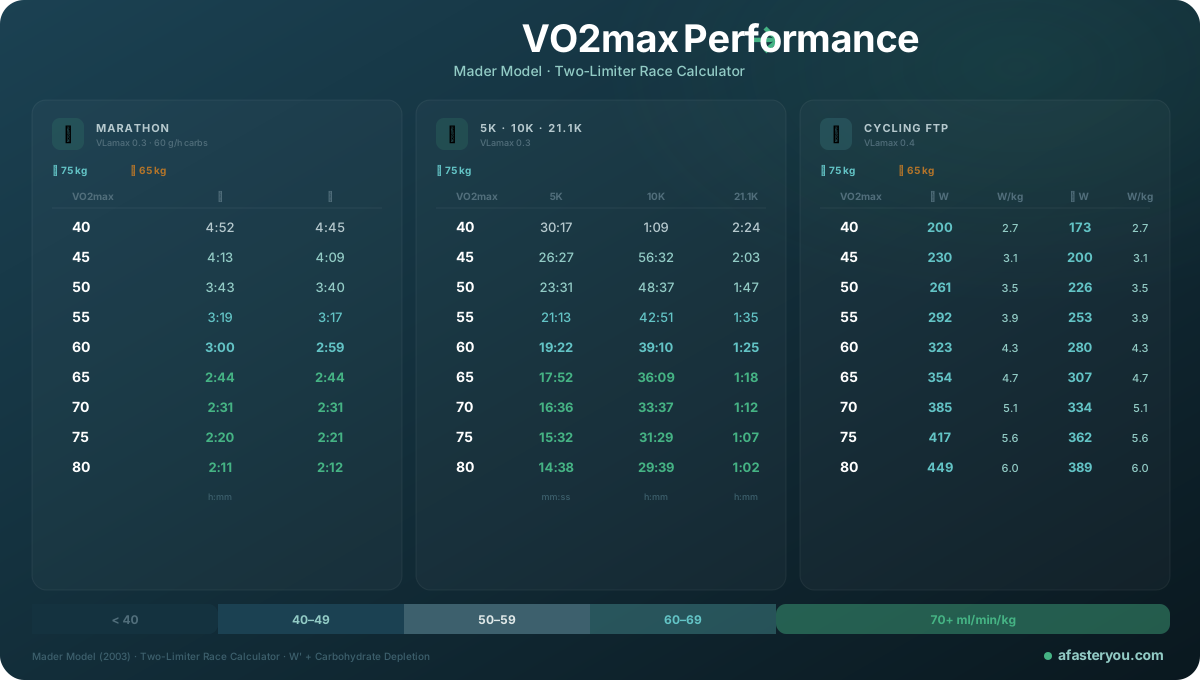
The following tables are calculated using the Mader metabolic model with the Two-Limiter Race Calculator (W' model + carbohydrate depletion). Running times assume a VLamax of 0.3 mmol/l/s and 60 g/h carbohydrate intake — typical values for trained endurance runners.
Running Times by VO2max
Men (~75 kg, 15% body fat):
| VO2max | 5K | 10K | Half Marathon | Marathon |
|---|---|---|---|---|
| 40 | ~30:15 | ~1:09 | ~2:25 | ~4:50 |
| 45 | ~26:30 | ~56:30 | ~2:03 | ~4:13 |
| 50 | ~23:30 | ~48:35 | ~1:47 | ~3:43 |
| 55 | ~21:15 | ~42:50 | ~1:35 | ~3:19 |
| 60 | ~19:20 | ~39:10 | ~1:25 | ~3:00 |
| 65 | ~17:50 | ~36:10 | ~1:18 | ~2:44 |
| 70 | ~16:35 | ~33:35 | ~1:12 | ~2:31 |
Women (~65 kg, 20% body fat):
| VO2max | 5K | 10K | Half Marathon | Marathon |
|---|---|---|---|---|
| 40 | ~30:15 | ~1:09 | ~2:22 | ~4:45 |
| 45 | ~26:30 | ~56:55 | ~2:02 | ~4:09 |
| 50 | ~23:30 | ~48:55 | ~1:46 | ~3:40 |
| 55 | ~21:15 | ~42:55 | ~1:35 | ~3:17 |
| 60 | ~19:25 | ~39:15 | ~1:25 | ~2:59 |
| 65 | ~17:55 | ~36:15 | ~1:18 | ~2:44 |
| 70 | ~16:40 | ~33:40 | ~1:12 | ~2:31 |
Times calculated using the Two-Limiter Race Calculator (Mader model): W' model + carbohydrate depletion. VLamax=0.3 mmol/l/s, 60 g/h carbohydrate intake. Individual results vary based on VLamax, running economy, and race strategy.
Cycling Threshold Power (FTP) by VO2max
Men (~75 kg, VLamax=0.4):
| VO2max | FTP (Watts) | FTP (W/kg) |
|---|---|---|
| 45 | ~230 W | ~3.1 W/kg |
| 50 | ~261 W | ~3.5 W/kg |
| 55 | ~292 W | ~3.9 W/kg |
| 60 | ~323 W | ~4.3 W/kg |
| 65 | ~354 W | ~4.7 W/kg |
| 70 | ~385 W | ~5.1 W/kg |
Women (~65 kg, VLamax=0.4):
| VO2max | FTP (Watts) | FTP (W/kg) |
|---|---|---|
| 40 | ~173 W | ~2.7 W/kg |
| 45 | ~200 W | ~3.1 W/kg |
| 50 | ~226 W | ~3.5 W/kg |
| 55 | ~253 W | ~3.9 W/kg |
| 60 | ~280 W | ~4.3 W/kg |
| 65 | ~307 W | ~4.7 W/kg |
FTP calculated using the Mader model at VLamax=0.4 mmol/l/s (typical for endurance cyclists).
Why VO2max Alone Doesn't Tell the Full Story
VO2max is the most important single metric — but not the only one. Two athletes with identical VO2max can have completely different race times. The reason: VLamax (maximum lactate production rate).
VLamax determines: - How much lactate you produce at a given pace - How efficiently you use fat as fuel - Where exactly your threshold sits — the pace you can sustain for extended periods
Example: Two runners, both VO2max 55 ml/min/kg. - Runner A has a VLamax of 0.5 mmol/l/s → Marathon ~3:29 - Runner B has a VLamax of 0.2 mmol/l/s → Marathon ~3:05
Same VO2max, 24 minutes difference on the marathon. That's why aFasterYou measures both values.
How Accurate Is Your Sports Watch's VO2max?
Garmin, Apple Watch, COROS, and other sports watches estimate VO2max from heart rate and pace (or power). These estimates are a useful indicator but come with limitations:
- Systematic overestimation in trained athletes — studies show deviations of 5-15%
- No VLamax consideration — the watch knows only one of two critical values
- Day-to-day variation — heat, fatigue, and terrain significantly affect the estimate
- Calibration errors — incorrect HRmax in your profile skews all calculations
For a rough check ("Am I in a reasonable range?"), your watch is fine. For precise training zones and race predictions, you need better data.
Measure Your VO2max Accurately: The Powertest
The aFasterYou Powertest determines your exact VO2max and VLamax values using a standardized protocol based on the Mader model. No lab required — just your regular training equipment and a heart rate monitor.
From your Powertest, you get: - Your exact VO2max and VLamax - Individual training zones — including the right intensity for VO2max intervals - Performance predictions for various distances
Between Powertests, our AI Prediction estimates your VO2max from every training session, so you can track your trend in real time.
How to Improve Your VO2max
VO2max is trainable at any age. The most effective methods:
1. VO2max Intervals (30/30)
30 seconds at VO2max intensity, 30 seconds easy recovery, repeated 10-20 times. This format maximizes time near your oxygen ceiling with relatively low fatigue cost.
The critical factor: intensity must match your individual VO2max. A runner with VO2max 45 needs a completely different pace than one with 60. Too easy → no stimulus. Too hard → you burn out before accumulating enough training time.
2. Consistency Over Intensity
Research shows: consistency beats isolated extreme efforts. 3-4 moderate VO2max sessions per week deliver more than one killer workout followed by days of recovery.
3. Find the Load Sweet Spot
Through machine learning analysis of over 200,000 training sessions, we've identified a clear pattern: VO2max improvements happen at a Body Reserve of 35-50 (our metric for accumulated training fatigue). Above that, the stimulus is too low. Below that, only injury risk increases with no additional benefit.
4. Slow Age-Related VO2max Decline
VO2max drops by roughly 1% per year after age 30. But this decline is significantly slower in trained individuals compared to sedentary people. Regular interval training can reduce the age-related decline by up to 50%.
Train Based on Your Data
Whether you want to know where you stand or actively get faster — the path starts with your numbers.
Start your free trial on aFasterYou and get a training plan built on your individual VO2max and VLamax — not generic charts.
FAQ
Is a VO2max of 50 good? For a man aged 30-39, 50 ml/min/kg falls in the "Excellent" range according to ACSM classification. For a woman of the same age, it would also be excellent. For competitive endurance athletes, it's a solid starting point with room to grow.
What VO2max do professional athletes have? Male professional endurance athletes typically range from 70-85 ml/min/kg, females from 60-75 ml/min/kg. The highest ever recorded is 97.5 ml/min/kg (Oskar Svendsen, cyclist).
Can I improve my VO2max at any age? Yes. VO2max is improvable at any age through targeted interval training. The rate of improvement varies, but even in people over 60, research shows significant gains from structured training.
Why does my Garmin show a different VO2max than the Powertest? Garmin estimates VO2max from pace and heart rate using a generic algorithm. The aFasterYou Powertest uses the Mader metabolic model with actual performance data — significantly more accurate, especially for trained athletes. Deviations of 5-15% between watch estimates and lab values are normal.
What does 5 ml/min/kg more VO2max give me? On the marathon: ~20-30 minutes faster (depending on starting level). On the half marathon: ~10-15 minutes. On 10K: ~5-7 minutes. The exact improvement depends on your starting level and VLamax.
What matters more — VO2max or VLamax? Both are critical and can't be viewed in isolation. VO2max determines your maximum aerobic capacity, VLamax your metabolic efficiency. Your sustainable race pace is the result of both values working together.
VO2max norms based on data from the American College of Sports Medicine (ACSM) and Cooper Institute. Performance predictions based on the metabolic model by Prof. Alois Mader (Mader, 2003; Mader & Heck, 1986), published in the European Journal of Applied Physiology. Calculated via Two-Limiter Race Calculator: W' model + carbohydrate depletion (Brent's method).