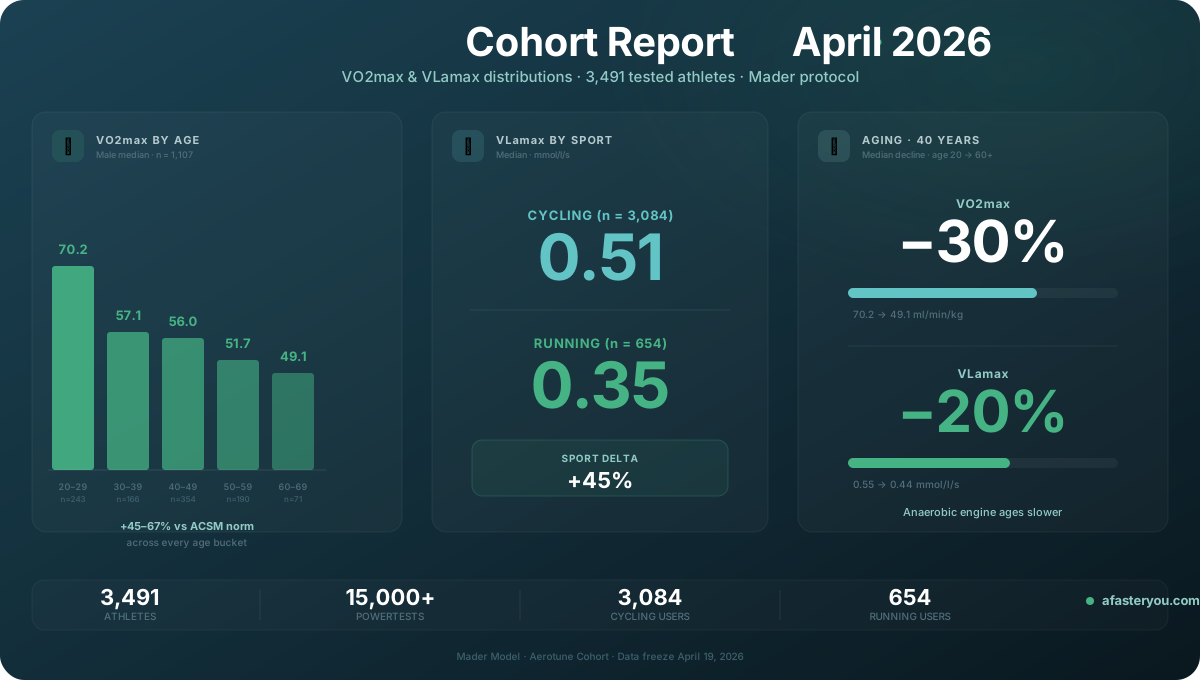
Cohort Report: VO2max & VLamax in 3,491 Tested Endurance Athletes
This is a data report. No training advice, no product pitch — just what the numbers look like when you measure 3,491 endurance athletes with the same Mader-model protocol and compare them against ACSM's general-population norms.
The headline finding: trained endurance athletes sit 45–67 % above the median VO2max of the general population across every age bucket we tested. A 60-year-old on our platform has the aerobic capacity of a typical 25-year-old. That's not a marketing number — it's what structured training over years produces, measured across a cohort that agreed to have their Powertests counted.
We publish this report because the question "is my VO2max any good?" has no honest answer without a comparison group. ACSM norms give you one reference. This cohort gives you another — the one that matters if you're training seriously.
At a glance
- 3,491 athletes with at least one valid Powertest
- Males publication-ready across all age groups (n ≥ 70 per bucket)
- Females preliminary (n < 30 per bucket above age 40 — ongoing data recovery)
- Cycling cohort 3,084 athletes · Cycling median VLamax 0.51 mmol/l/s
- Running cohort 654 athletes · Running median VLamax 0.35 mmol/l/s
- Against ACSM norms for the general population: +45 % to +67 % across every age
VO2max by age and gender
Values are the median (P50) for each age bucket, in ml/min/kg.
Male cohort (n = 1,107)
| Age group | n | P10 | P25 | P50 | P75 | P90 |
|---|---|---|---|---|---|---|
| Under 20 | 73 | 55.4 | 61.7 | 67.8 | 70.9 | 75.9 |
| 20–29 | 243 | 53.7 | 61.2 | 70.2 | 75.8 | 78.9 |
| 30–39 | 166 | 47.0 | 52.0 | 57.1 | 64.1 | 68.7 |
| 40–49 | 354 | 42.9 | 50.0 | 56.0 | 61.8 | 66.9 |
| 50–59 | 190 | 41.0 | 46.3 | 51.7 | 57.4 | 62.0 |
| 60–69 | 71 | 38.1 | 44.3 | 49.1 | 52.9 | 61.1 |
| 70+ | 10 | 44.7 | 47.1 | 52.2 | 58.9 | 60.8 |
Female cohort (n = 95, preliminary)
| Age group | n | P10 | P25 | P50 | P75 | P90 |
|---|---|---|---|---|---|---|
| Under 20 | 6 | 46.7 | 48.8 | 53.1 | 56.0 | 59.2 |
| 20–29 | 33 | 45.9 | 50.3 | 56.9 | 60.0 | 63.4 |
| 30–39 | 20 | 37.5 | 44.4 | 50.9 | 58.0 | 62.6 |
| 40–49 | 22 | 40.9 | 45.5 | 51.3 | 54.4 | 57.9 |
| 50–59 | 8 | 39.8 | 45.8 | 50.6 | 56.5 | 61.3 |
Note on the female cohort: Buckets aged 50+ currently hold n < 10. Values here are shown for transparency but are not yet publication-stable. We will update them once the ongoing profile-completion effort closes.
Against ACSM general-population norms
The most reliable public reference for VO2max is ACSM's Guidelines for Exercise Testing and Prescription (11th Edition) — population-level norms derived from a broad adult sample. Here's how our male median compares:
| Age group | Aerotune P50 ♂ | ACSM P50 (general) ♂ | Delta |
|---|---|---|---|
| 20–29 | 70.2 | ~42 | +67 % |
| 30–39 | 57.1 | ~41 | +39 % |
| 40–49 | 56.0 | ~38 | +47 % |
| 50–59 | 51.7 | ~35 | +48 % |
| 60–69 | 49.1 | ~31 | +58 % |
The pattern across every age bucket: an Aerotune-tested male is 45–67 % above the general-population median. A typical 60-year-old on our platform hits VO2max values that the general population reaches only in the early 20s — and only in the top tail of that age group.
This isn't because testing on the platform makes you fit. It's the population that shows up for a Powertest: people who already train structured, who look at their numbers, who come back for the retest six weeks later.
VLamax by sport and age
VLamax — the maximum glycolytic lactate production rate — differs radically between disciplines. Cycling produces systematic short power-peaks (attacks, climbs, position changes). Running is more uniformly aerobic. The cohort data confirms it:
Cycling (n = 3,084 athletes)
| Age group | n | P10 | P25 | P50 | P75 | P90 |
|---|---|---|---|---|---|---|
| Under 20 | 79 | 0.26 | 0.45 | 0.55 | 0.64 | 0.82 |
| 20–29 | 277 | 0.28 | 0.45 | 0.54 | 0.68 | 0.82 |
| 30–39 | 179 | 0.28 | 0.38 | 0.48 | 0.62 | 0.81 |
| 40–49 | 365 | 0.29 | 0.40 | 0.49 | 0.59 | 0.73 |
| 50–59 | 191 | 0.25 | 0.33 | 0.46 | 0.54 | 0.71 |
| 60–69 | 74 | 0.23 | 0.33 | 0.44 | 0.54 | 0.72 |
| Overall | 3,084 | 0.28 | 0.40 | 0.51 | 0.64 | 0.82 |
Running (n = 654 athletes)
| Age group | n | P10 | P25 | P50 | P75 | P90 |
|---|---|---|---|---|---|---|
| 30–39 | 30 | 0.17 | 0.23 | 0.35 | 0.41 | 0.51 |
| 40–49 | 49 | 0.20 | 0.31 | 0.39 | 0.44 | 0.52 |
| 50–59 | 25 | 0.17 | 0.22 | 0.30 | 0.38 | 0.42 |
| 60–69 | 7 | 0.19 | 0.20 | 0.25 | 0.28 | 0.32 |
| Overall | 654 | 0.18 | 0.26 | 0.35 | 0.44 | 0.56 |
Cycling median VLamax 0.51 vs. running median 0.35 — a +45 % gap. Same methodology, same platform. The discipline alone moves the number.
VLamax distributions — all Powertests
Aggregated across every valid Powertest (not just latest-per-athlete), the histogram shows two clean peaks:
Cycling (n = 10,254 Powertests)
| VLamax bin | # tests |
|---|---|
| 0.10–0.19 | 397 |
| 0.20–0.29 | 768 |
| 0.30–0.39 | 1,264 |
| 0.40–0.49 | 2,232 |
| 0.50–0.59 | 2,521 (mode) |
| 0.60–0.69 | 1,218 |
| 0.70–0.79 | 725 |
| 0.80–0.89 | 432 |
| 0.90–0.99 | 250 |
| 1.00–1.09 | 150 |
| 1.10+ | 297 |
Running (n = 1,424 Powertests)
| VLamax bin | # tests |
|---|---|
| 0.10–0.19 | 211 |
| 0.20–0.29 | 291 |
| 0.30–0.39 | 431 (mode) |
| 0.40–0.49 | 253 |
| 0.50–0.59 | 101 |
| 0.60–0.69 | 45 |
| 0.70–0.79 | 42 |
| 0.80–0.89 | 10 |
| 0.90–0.99 | 9 |
| 1.00–1.09 | 6 |
| 1.10+ | 25 |
The cycling tail at VLamax ≥ 1.1 (297 tests) captures track sprinters, BMX riders, criterium specialists. The running tail is tiny (25 tests) — Aerotune runners skew endurance, not middle-distance sprint.
Four findings from the data
1. Sport matters more than age for VLamax. Cycling median is 45 % higher than running median across every age bucket. The physiological profile is shaped by the demands of the sport — years of short power-peaks in cycling, years of steady-state aerobic running. You don't get to pick one without committing to the training that creates it.
2. VLamax ages more slowly than VO2max. Cycling VLamax drops from P50 0.55 (20–29) to P50 0.44 (60–69) — roughly a 20 % decline across 40 years. VO2max drops ~30 % in the same window. The anaerobic engine holds longer than the aerobic one. For masters athletes choosing where to defend, this is useful context: VO2max loss is steeper and less preventable, sprint capacity is more defendable.
3. Cycling has a real sprint tail; running doesn't. The shape of the VLamax distribution is categorically different between disciplines. Cycling: long tail out past 1.1 mmol/l/s (track, crit, BMX). Running: essentially nothing above 1.0 — even our Mittelstreckler-leaning athletes are mostly below 0.8. If you're a middle-distance runner (800m / 1500m) moving into our cohort, you're joining a small subgroup.
4. Aerotune masters hold elite-adjacent numbers. The top 10 % of our 60–69 male cohort (P90 = 61.1 ml/min/kg) hits VO2max values the general population only reaches as young adults — and then only at the top of that range. Structured training plus continuous data feedback delays the aerobic decline substantially.
Limitations and caveats
- Self-selection bias: These are athletes who chose to buy a Powertest. They train harder and test more consistently than the general population — and than the general endurance population. This is not a random sample.
- Female buckets ≥ 50: n < 10 in the oldest female groups. Medians there are indicative, not stable.
- Cohort ranges are medians, not guidance: Your personal optimum depends on your discipline, goals, and body composition. Use these numbers as a reference scale, not a target.
- Single snapshot: This report is the state as of April 2026. We retest the cohort quarterly — figures will evolve.
Sources and methodology
- Cohort: All users with at least one valid Powertest (valid = true in our processing pipeline, plausibility-filtered for VO2max 20–100 and VLamax 0.1–1.3)
- Aggregation: One record per user per sport (latest valid Powertest), so multi-tested athletes don't weight the median upward
- Exclusions: 24 users from a non-organic senior study dataset
- Reference: American College of Sports Medicine — Guidelines for Exercise Testing and Prescription, 11th Edition (2021)
- Model: Metabolic testing based on Prof. Alois Mader's two-limiter model (Mader 2003, European Journal of Applied Physiology 88:317–338; Mader & Heck 1986, International Journal of Sports Medicine 7 Suppl 1:45–65)
- Data date: Aggregated on 19 April 2026
For interpretation of VO2max in race context: see Half Marathon VO2max, Marathon VO2max, VLamax vs VO2max. For how these two metrics translate to race times: VO2max chart by age and gender. For the efficiency layer on top: Running Economy.