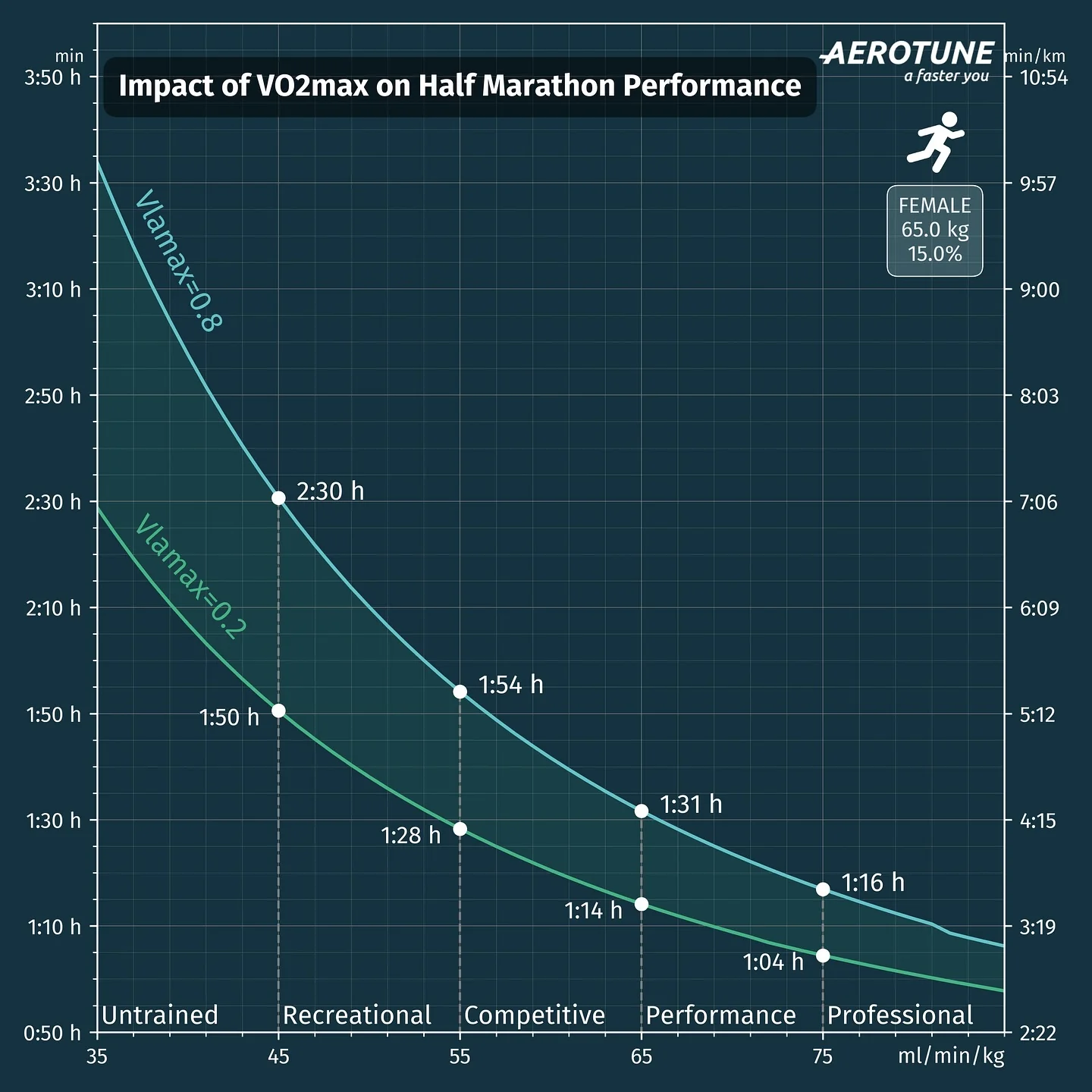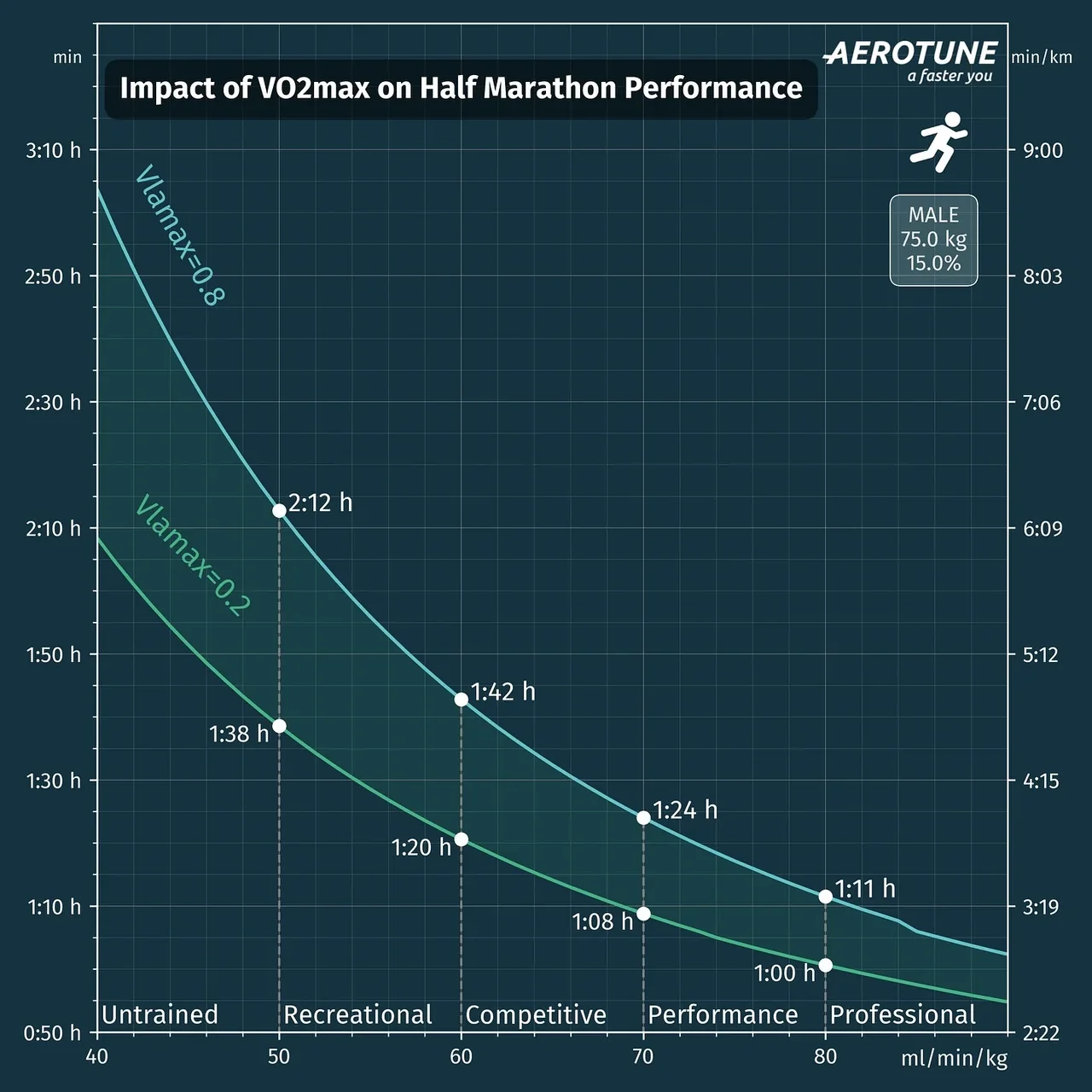
Half Marathon VO2max Guide: What You Need for Sub-1:30 to Sub-2:00
You've signed up for a half marathon. Or you've run a few, and the next one needs to be faster. Somewhere in training, the same wall always shows up: the miles are there, the weeks are consistent, the times won't move. The question most athletes never answer directly is the simplest one — what actually decides how fast you can run twenty-one kilometers?
The answer is one number: VO2max. Everything else — pacing, fueling, intervals — orbits around it.
Why the half marathon is VO2max's purest test
VO2max measures how much oxygen your body can use at maximum effort, expressed in ml/min/kg. It's the ceiling on your sustainable pace. On our platform, we've measured this on more than 1,000 athletes, drawing on 1 million+ training sessions, and the half marathon shows a cleaner VO2max-to-time relationship than any other running distance.
Here's why. A trained runner holds roughly 85–90% of VO2max across the half marathon. That's the highest sustained percentage of any race between 10K and marathon. Shorter, and anaerobic kick distorts the signal. Longer, and fuel economy starts to dominate. The half marathon sits in the sweet spot where your aerobic engine is the rate limiter almost from start to finish.
That makes the benchmarks below unusually reliable.
Half marathon VO2max benchmarks — by goal time
Finish times calculated with the Mader metabolic model at typical trained-athlete parameters (15% body fat, VLamax around 0.4 mmol/l/s, well-executed pacing). Cross-checked against our 1,000+-athlete Powertest cohort.
| Goal time | VO2max (ml/min/kg) | Avg pace (min/km) | Athlete profile |
|---|---|---|---|
| 2:15 h | ~44 | 6:24 | Untrained / first-timer |
| 2:00 h | ~48 | 5:41 | Recreational, 2–3 runs/week |
| 1:45 h | ~53 | 4:59 | Consistent hobby runner |
| 1:30 h | ~60 | 4:16 | Serious, 4–5 sessions/week |
| 1:20 h | ~68 | 3:47 | Competitive age-grouper |
| 1:10 h | 75+ | 3:19 | Elite |
A note on men vs. women. At identical VO2max and body composition, men (~75 kg) and women (~65 kg) run almost the same half marathon time — the Mader model and our cohort data both confirm this. The visible gender gap in race times comes from different typical VO2max ranges, not different running economy. Trained male runners typically test in the 50–65 band; trained female runners 45–58. A woman at VO2max 55 runs close to the same half marathon time as a man at VO2max 55.
Two things to read from this.
First, five points matter — and the lower your starting point, the more they matter. A jump from VO2max 55 to 60 buys you about 10 minutes on the half marathon. From 50 to 55, roughly 13 minutes. From 45 to 50, almost 18 minutes. The return per point compresses as you get fitter.
Second, you can't close a 10-point gap with mileage alone. Recreational runners who stall at 1:55 typically sit around VO2max 48 and assume more easy miles will fix it. They won't. The adaptation curve for VO2max requires a specific stimulus — see the training section below.
VO2max chart by age and gender →
Reverse lookup — what's my half marathon time for a given VO2max?
If you already know your VO2max (from a Powertest, a recent lab test, or even a GPS-watch estimate), here's the reverse map.
| Your VO2max | Predicted HM time | Avg pace (min/km) |
|---|---|---|
| 40 | 2:36 | 7:23 |
| 45 | 2:11 | 6:13 |
| 48 | 2:00 | 5:40 |
| 50 | 1:53 | 5:22 |
| 53 | 1:45 | 4:57 |
| 55 | 1:40 | 4:43 |
| 58 | 1:33 | 4:25 |
| 60 | 1:29 | 4:14 |
| 65 | 1:21 | 3:50 |
| 68 | 1:17 | 3:39 |
| 70 | 1:15 | 3:32 |
| 75 | 1:09 | 3:16 |
Values are model-based. A poorly paced race can cost 3–6 minutes against these targets; a reactive VLamax (too high or too low for the distance) shifts them by ±5 minutes. Hot days, hills, or cumulative fatigue push times further.
How to pace sub-1:30, 1:45, and 2:00 — the three-third rule
You can have the VO2max for a goal time and still miss it. Pacing wastes more finish-time potential than any other factor on race day.
The rule that survives every cohort we've analyzed is simple: run the first third five to ten seconds per kilometer slower than goal pace, run the middle third at goal pace, earn the final third with whatever you have left. Ideally the final 7 km matches or beats the first 7 km. Athletes who run negative splits finish closer to their physiological ceiling than athletes who go out hot — by several minutes, consistently.
Sub-1:30 example (4:16/km avg): - km 1–7: 4:21–4:25/km - km 7–14: 4:16/km - km 14–21.1: 4:10–4:15/km
Sub-1:45 (4:59/km): - km 1–7: 5:05–5:10/km - km 7–14: 4:59/km - km 14–21.1: 4:50–4:55/km
Sub-2:00 (5:41/km): - km 1–7: 5:50–5:55/km - km 7–14: 5:41/km - km 14–21.1: 5:30–5:38/km
Why this works physiologically: the first 5–7 km are run on roughly-full glycogen and a cool core. Going 5–10 seconds easier here costs you under a minute on the clock but preserves 10–15% more late-race fuel and keeps lactate below the slow-component inflection point. Athletes who go out on pace from km 1 run the back half 20–40 seconds per kilometer slower than goal — a net loss of 3–7 minutes.
Boring first 5 km. Earn the right to push.
How to actually raise your VO2max
Running more easy miles alone won't move VO2max. The adaptation requires time spent near your oxygen ceiling — and that requires targeted intervals at the right intensity.
30/30 intervals: the most efficient VO2max stimulus
The research here is settled. Véronique Billat's work showed that 30 seconds at VO2max pace, 30 seconds easy jog, repeated 10–20 times produces more cumulative "time at VO2max" per session than traditional long intervals (4 × 4 min, 5 × 3 min), with meaningfully less neuromuscular cost. Izumi Tabata's 20/10 protocol is a similar family — shorter rest, higher anaerobic cost.
Both work. Both require one thing to be right: intensity must match your individual VO2max. A runner at VO2max 48 needs a completely different target pace than a runner at 60. Too easy — no stimulus at the mitochondrial level. Too hard — you stop before accumulating enough time in the zone.
The A Faster You AI training plan calculates your exact interval pace from your Powertest results (or from AI-predicted VO2max between tests). This is the single biggest reason recreational runners plateau: generic "5K pace" recommendations miss the target intensity for two-thirds of athletes.
Fueling — the silent VO2max killer
Across more than a million training sessions on our platform, one pattern is consistent and brutal: athletes who chronically under-fuel their hard sessions stall. VO2max interval sessions demand carbohydrates in real time.
- Before training: 60–120 g carbs, 1–2 hours out
- During training: 60–90 g carbs/hour for sessions longer than 60 min
- After training: replace within 60 min — roughly 1 g/kg bodyweight
In-race fueling is a different profile. Most recreational half-marathoners do fine on 30–50 g/h because the duration is short enough that glycogen depletion isn't the limiter. Pros often push to 80–100 g/h for sub-1:10 efforts. The 60–90 g/h above is for the training sessions that build VO2max, not for the race itself.
If your VO2max has been stuck for months and your easy days are low-carb, that is almost certainly why. Low-carb on easy days is defensible. Low-carb on VO2max days leaves the adaptation on the table.
Body Reserve — the adaptation sweet spot
Machine-learning analysis of more than a million training sessions on our platform gave us a clear load-response pattern. We track accumulated fatigue through Body Reserve (0–100):
- Above 60: you're comfortable, but the stimulus is below the adaptation threshold
- 35–50: the sweet spot — enough load to build mitochondria and capillary density, low enough injury risk to stay there for weeks
- Below 35: same stimulus as the sweet spot, but injury risk climbs sharply with no additional adaptation
Most recreational runners live above 60 and wonder why progress is slow. Most ambitious runners dip below 35 before races and blow up. The 35–50 band is where the real work lives, and the plan dynamically keeps you there.
Measure your VO2max — the Powertest
Generic estimates from your GPS watch give a rough number. Garmin and Apple Watch VO2max estimates typically deviate 5–15% from lab values in trained athletes. That's not good enough when five points equals ten minutes.
The A Faster You Powertest gives precise VO2max and VLamax using a standardized protocol based on the Mader metabolic model. You run it from your normal training setup (heart-rate monitor, bike or treadmill) — no lab, no mask. Test every 6–8 weeks. Between tests, AI prediction updates your VO2max from each training session so you always know where you stand.
Your next step
Know the target. Train at the right intensity. Pace the race. Let the data do the coaching.
Start your free trial on A Faster You → — science-based training plans built on the Mader model, not guesswork.
One more thing — VLamax
Two runners with the exact same VO2max can finish a half marathon 8 minutes apart. Same engine, very different race.
That's because there's a second number — VLamax — your maximum lactate production rate. For the half marathon, the optimal VLamax is nuanced: a little higher than for the marathon (0.35–0.45 mmol/l/s) is actually useful, because the shorter distance runs closer to threshold. Too high, and your fuel economy collapses in the final 5 km. Too low, and you lack the anaerobic snap for pace surges and finishing kicks.
Periodizing VO2max and VLamax across a season is what separates structured training from generic plans — but that's a deep topic of its own. The A Faster You system tracks both in real time and shifts emphasis automatically based on your race calendar.
FAQ
What VO2max do I need for a sub-1:30 half marathon? Approximately 60 ml/min/kg — the same target applies to trained men (~75 kg) and women (~65 kg) at similar body composition. Values are from the Mader metabolic model, cross-checked against our 1,000+-athlete cohort.
What VO2max for sub-1:45 or sub-2:00? Sub-1:45 requires roughly VO2max 53. Sub-2:00 requires about 48. These are Mader-model values and match the interactive calculator on this page exactly.
Is VDOT the same as VO2max? No. VDOT is a performance-derived pseudo-VO2max developed by Jack Daniels — a number that predicts race time but doesn't measure your actual metabolic ceiling. VO2max (from a Powertest or lab spirometry) measures true oxygen utilization. VDOT is useful for pacing zones; VO2max is useful for tracking the adaptation. Don't confuse them.
Do women really need the same VO2max as men for the same time? Yes — at the same body composition, the Mader model predicts nearly identical half marathon times. The visible race-time gap between genders comes from different typical VO2max ranges (trained men 50–65, trained women 45–58), not different running economy. A woman at VO2max 55 runs the same HM time as a man at VO2max 55.
Can I run a half marathon with a VO2max of 45? Yes — at around 2:11. If you want to break 2:00, you need to move that number to roughly 48. To break 1:45, 53. Targeted interval work plus proper fueling typically adds 3–5 VO2max points per 12-week block in trained athletes.
How long does it take to improve VO2max? With consistent, properly dosed interval training (2× weekly), most runners see measurable VO2max improvements within 4–8 weeks. Untrained athletes improve faster in the first block (5–10% gains), trained athletes slower (2–5%).
Is VO2max the only factor for half marathon performance? No — VLamax, running economy, and fueling all matter. But VO2max is the strongest single predictor and the most trainable factor. The A Faster You system tracks both VO2max and VLamax to give you the full picture.
Should I do a Powertest before starting a training plan? Strongly recommended. A Powertest gives accurate baseline values for VO2max and VLamax, which lets the AI set your training zones precisely from day one. Without it, the system uses AI predictions from your activities — still good, but a Powertest is the gold standard.
Why does my Garmin VO2max differ from my Powertest value? Garmin estimates VO2max from pace and heart rate using a generic algorithm that doesn't account for your individual metabolic profile. Deviations of 5–15% from Powertest values are normal, especially in trained athletes. The Powertest uses the Mader metabolic model with actual performance data — significantly more accurate.
Based on the metabolic model by Prof. Alois Mader (Mader, 2003; Mader & Heck, 1986), European Journal of Applied Physiology and International Journal of Sports Medicine. Interval protocols: Billat et al. (2000), Medicine & Science in Sports & Exercise; Tabata et al. (1996), Medicine & Science in Sports & Exercise.