VLamax vs VO2max: Sprint-Endurance Trade-off Explained
Two runners with the exact same VO2max. Same age, same weight, same training history. One finishes the marathon in two-fifty-five. The other crosses the line in three-fifty. That's fifty-five minutes. Same engine. Completely different race.
How? One word: VLamax — your maximum lactate production rate. The second metabolic number most athletes have never heard of, and the one that probably decides your next race more than anything else.
What VLamax actually is
VLamax measures how fast your body can produce lactate at maximum effort — how aggressively your glycolysis runs when you push hard. The unit is millimoles per liter per second (mmol/l/s).
VO2max is your aerobic ceiling — how much oxygen you can use. VLamax is the other engine — how fast you can burn carbohydrates without oxygen.
Here's the part nobody tells you clearly: VLamax cuts both ways. A high VLamax means you can sprint, kick, cover attacks, and accelerate hard. A low VLamax means you burn carbs slowly, spare glycogen for hours, and hold marathon pace without hitting the wall.
The number you want depends entirely on what you're trying to win.
The archetypes — from real cohort data
Across our platform, 3,400+ athletes with valid Powertests test into three clean archetypes — 3,084 cyclists and 654 runners, all measured with the Mader protocol.
| Archetype | VLamax range | Who lives here |
|---|---|---|
| Endurance | 0.20–0.35 | Marathoners, Ironman, ultra, GC cyclists |
| All-rounder | 0.40–0.55 | 10K runners, road-race cyclists |
| Sprinter | 0.60–1.00 | Track cyclists, criterium riders, 400/800/1500m |
Our cohort medians split the sport neatly: - Cycling median 0.51 mmol/l/s (n = 3,084) — sits in the all-rounder band - Running median 0.35 mmol/l/s (n = 654) — sits at the endurance/all-rounder boundary
That's a 45% higher median VLamax in cyclists than runners. Same methodology, same platform. The discipline alone creates the gap. Cycling produces short power-peaks (attacks, climbs, position-changes). Running is more uniformly aerobic. Your sport shapes your metabolism over time.
The trade-off — same cyclist, different VLamax
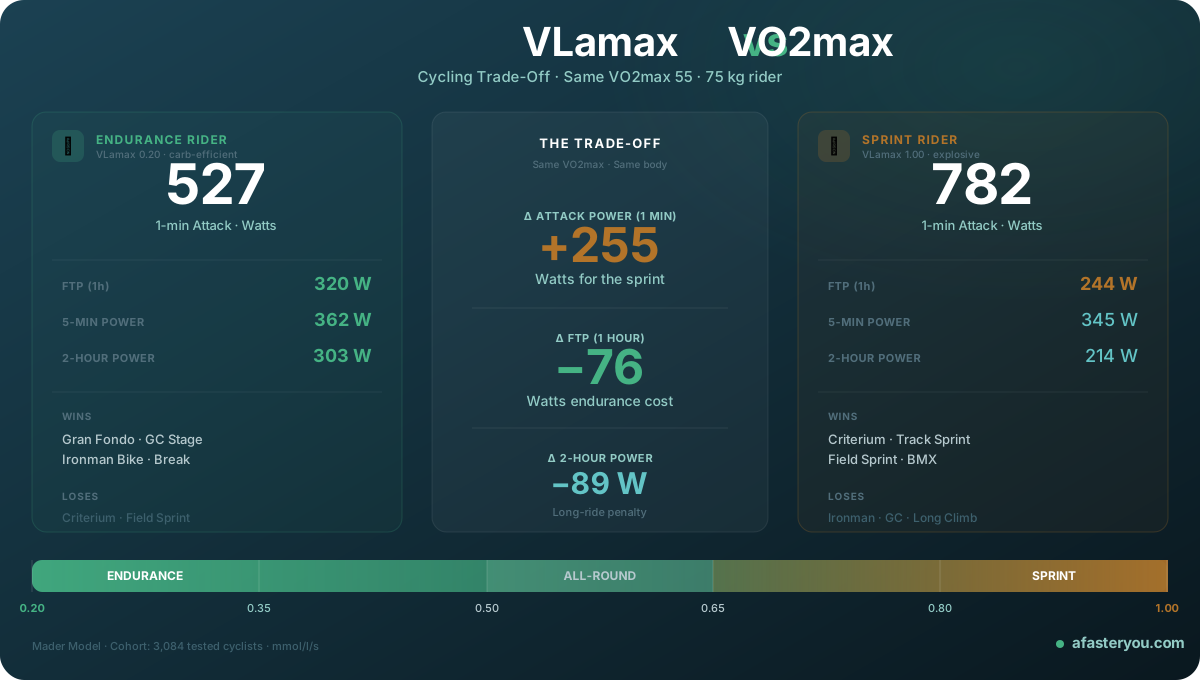
Here's where the numbers get sharp. A 75 kg male cyclist at VO2max 55 — fix everything except VLamax. The Mader metabolic model predicts these outcomes:
| VLamax | 1h FTP (cycling) | 1-minute attack power | 2h power |
|---|---|---|---|
| 0.20 | 320 W | 527 W (7.0 W/kg) | 303 W |
| 0.35 | 303 W | 594 W (7.9 W/kg) | 279 W |
| 0.50 | 286 W | 647 W (8.6 W/kg) | 260 W |
| 0.65 | 272 W | 693 W (9.2 W/kg) | 244 W |
| 0.80 | 259 W | 734 W (9.8 W/kg) | 230 W |
| 1.00 | 244 W | 782 W (10.4 W/kg) | 214 W |
Male, 75 kg, 15 % body fat, VO2max 55. Female values at same VLamax are very close (within ~1 %) at equivalent body composition.
Read it carefully. Pushing VLamax from 0.20 to 1.00 — same VO2max, same body — buys you 255 W more 1-minute attack power. The cost: 76 W lower FTP, 89 W lower 2-hour endurance power. That's not a rounding-error trade-off. That's two different athletes.
The low-VLamax cyclist wins the Gran Fondo, rides a solid 3-hour break, and suffers every time the race goes single-file in a crit.
The high-VLamax cyclist covers every attack in the criterium, wins the bunch sprint, and gets dropped on the first sustained climb.
Neither is better. Both are tools. The mistake is using the wrong one for your discipline.
The criterium versus the Gran Fondo — why this matters in practice
A criterium cyclist with VLamax 0.30 can't win a crit. Not because he's unfit — but because he can't accelerate hard enough to follow a break. Attack goes, everyone surges, and he's gapped by meter thirty. He's too efficient to sprint.
The same guy on a 5-hour Gran Fondo? Four hours in, he's cruising while everyone around him is falling apart. The efficiency that killed his crit chances is exactly what wins him the long race.
The hard rule: match your VLamax to your discipline. - A criterium racer needs at least 0.50 to bridge breaks - A Gran Fondo / GC rider wants to be in the endurance band (0.25–0.40) — lower the VLamax, longer the glycogen lasts - A road-race all-rounder sits in the 0.40–0.55 sweet spot
Note the interaction with VO2max: the higher your VO2max, the more forgiving your VLamax can be. VLamax doesn't work in isolation — it always combines with your aerobic ceiling.
Most athletes are training the wrong direction without knowing it.
Cycling archetypes in more detail
Because our cohort leans heavily on cyclists (n = 3,084), the VLamax-by-discipline split shows up cleanly:
- Track sprinter / BMX — VLamax 0.80–1.10. Wins 15-second battles. Has no business in a Gran Fondo.
- Criterium / elite road sprinter — 0.55–0.80. Can bridge, kick, and win field sprints. Struggles in multi-hour mountainous events.
- All-round road racer — 0.40–0.55. The cohort median sits here (0.51). Good at everything, dominant at nothing.
- Gran Fondo / Climber / GC rider — 0.25–0.40. Wins the long break. Can't follow a flat attack.
- Ultra-endurance / RAAM / 24h — 0.20–0.30. Stays in fat oxidation for 12+ hours. Not trying to out-kick anyone.
A criterium racer targeting VLamax 0.65 and a GC climber targeting 0.30 are running almost opposite training programs. Same sport. Different metabolic profile.
Running: where VLamax actually matters — and where it doesn't
For distance runners — 5K up through ultra — the rule is clean: lower VLamax is always better. Marathon at VLamax 0.25 beats marathon at 0.50 by half an hour, every time. If you race anything 5K and above, treat VLamax as a liability to manage down.
But below 5K, the picture flips. Sprint-event running is anaerobic-dominant, and VLamax is the engine. High VLamax is the whole point.
| Event | Typical VLamax | Aerobic share | Why |
|---|---|---|---|
| 100 m | 0.90–1.10+ | <10 % | Pure glycolytic explosion. No time for oxygen. |
| 200 m | 0.80–1.00 | ~25 % | Still mostly glycolytic, oxygen debt catches up. |
| 400 m | 0.65–0.90 | ~40 % | Lactate tolerance duel. Pace collapses the wrong way if VLamax is too low. |
| 800 m | 0.50–0.75 | ~55 % | The purest VO2max × VLamax duel — both engines matter roughly equally. |
| 1500 m | 0.45–0.65 | ~75 % | Aerobic dominates, but the final-lap kick still needs glycolytic power. |
| 5K and up | 0.30–0.45 | >85 % | Aerobic wins. VLamax becomes a liability — burns glycogen faster than you can replace it. |
Coming from a marathon background and wondering why you can't break 60 seconds in a 400 m? That's VLamax. A 400 m runner with VLamax 0.55 has no way to contest a peer at 0.85 — the event is too short for aerobic capacity to matter.
The reverse is also true. A former 800 m runner moving up to marathon will struggle until VLamax drops — the same glycolytic machinery that won them national youth titles now costs them 30 minutes on marathon day. Event transitions take 18–24 months of metabolic rebuilding, not just training volume.
This is why most runners who read this article are cyclists looking to understand their discipline. For a road-racing cyclist, the whole VLamax range matters because races span from field sprints to 6-hour Gran Fondos. For a runner, VLamax really only matters if you're racing 1500 m or shorter — or if you're racing long and want to nudge your VLamax down toward the optimum.
VLamax ages slower than VO2max — a cohort finding
Here's something that shows up nowhere else. Across our tested athletes, from 20-year-olds to 60+:
- VO2max drops roughly 30 % over 40 years of aging (male P50: 70 at age 20–29 → 49 at 60–69)
- VLamax drops roughly 20 % over 40 years (cycling P50: 0.55 at 20–29 → 0.44 at 60–69)
The anaerobic engine ages slower than the aerobic one. That reframes masters training. The sprint capacity you built in your twenties sticks with you longer than the ceiling. If you're a masters racer choosing between "defend VO2max" and "defend sprint", the data says: the VO2max drop is inevitable and bigger, the sprint loss is smaller and more preventable.
The trap — lowering VLamax is not free
Now the uncomfortable part. Lowering VLamax works. The methods are well-known: long zone-2 rides, fasted long runs, carb-restricted sessions, depletion intervals. Done right, over weeks, VLamax drops — fat oxidation climbs — your race pace improves.
Done wrong, you crash.
Here's the rule that matters: VLamax-lowering adaptation only happens when carb intake is roughly balanced to training load — or slightly reduced. Not gone. Not chronically low. Balanced to volume.
Go too low on carbs, and three things happen: 1. Your VLamax drops — yes 2. Your VO2max drops with it — in our data, these two values track each other 3. You slide into overtraining — irritability, sleep issues, elevated resting heart rate, illness
Across our cohort of athletes with multiple Powertests over months and years, the empirical pattern is consistent: when VLamax rises, VO2max usually rises too. When VLamax falls, VO2max often falls with it. That's a correlation in our Powertest longitudinal data — not a Mader-model prediction — but it's what we observe in over 10,000 paired retests.
The fix is clever training, not starvation. The A Faster You system calculates exact carb targets per session — enough to fuel the workout, restricted enough to drive the adaptation, never below the threshold that triggers overtraining.
Lower VLamax with intent. Fuel it with math, not vibes.
How VLamax is measured — the 15-second sprint
You can't train what you can't measure. VLamax is determined by a 15-second all-out sprint — that's how Mader's protocol extracts the maximum glycolytic rate. Combined with a ramp test for VO2max, that's the Powertest.
From your normal training setup — no lab, no mask. Test every 6–8 weeks. Between tests, the A Faster You AI predicts your VLamax from each training session using a machine-learning model trained on 15,000+ Powertest sessions.
Read more about the Powertest →
VLamax calculator — play with the trade-off
On this page, you can move a slider between VLamax 0.20 and 1.00, with VO2max held at 55 (the band where most of our cohort lives), and see the FTP, attack-power, and endurance-power outcomes update in real time. Run the slider from 0.20 to 1.00 and watch the 1-minute attack power climb by 255 W — while FTP drops 76 W. That's the full cycling trade-off in one interaction.
Your next step
Know your VLamax — not just your VO2max. Know your goal — criterium, Gran Fondo, or somewhere between. Know whether you're training toward your target or accidentally away from it.
Start your free trial on A Faster You → — science-based training plans that track both VO2max and VLamax in real time and adjust the training focus based on your race calendar.
One more thing — running economy
One last thing, for the curious.
We've covered VO2max (the ceiling) and VLamax (the fuel-style). The next piece of the puzzle is running economy — how much oxygen you actually burn per kilometer at a given pace. That's what decides how much of your VO2max + VLamax combination shows up on race day.
Two athletes with the same VO2max and the same VLamax can still finish 8 minutes apart on the marathon. Economy explains it.
That's a topic of its own. Next article.
FAQ
What is the difference between VLamax and VO2max? VO2max measures your aerobic ceiling — how much oxygen you can use at maximum effort (ml/min/kg). VLamax measures your anaerobic ceiling — how fast you can produce lactate through glycolysis at maximum effort (mmol/l/s). VO2max sets the sustainable pace; VLamax sets your sprint, kick and attack capacity. They are measured in the same Powertest but tell different stories.
Is VLamax the same as lactate threshold? No. Lactate threshold is a derived intensity — the power or pace at which blood lactate starts accumulating. VLamax is the underlying maximum rate at which your muscle cells can produce lactate. Your threshold is the balance point between lactate production (influenced by VLamax) and lactate clearance (influenced by VO2max and capillary density).
What is a good VLamax value? It depends entirely on your discipline. Distance running (5K+): 0.30–0.45. 1500 m: 0.45–0.65. 400–800 m: 0.55–0.90. Criterium / track cycling: 0.55–1.00. Gran Fondo / GC cycling: 0.25–0.40. The "best" value is the one that matches your race demands.
Does VLamax matter for marathon or half-marathon runners? Yes — always try to keep it low (0.20–0.35). For distance running, VLamax is a liability: higher values burn glycogen faster and shift the wall earlier. Below 1500 m the opposite is true — VLamax is the engine. This article is mostly about the cycling trade-off, because for distance runners the rule is simply "lower is better".
What VLamax do sprinters need (100, 200, 400 m)? 100 m sprinters test 0.90–1.10+, 200 m runners 0.80–1.00, 400 m runners 0.65–0.90. The shorter the event, the more glycolytic the demand. Below 400 m, aerobic contribution is under 40 % and VLamax becomes the dominant performance metric.
Can Garmin or other watches measure VLamax? No. VLamax requires an all-out maximal sprint (typically 15 seconds) with metabolic data to calculate. Consumer watches and power meters don't measure this directly. The Powertest protocol, based on the Mader model, is the standard field method — from your normal training setup.
How do I lower my VLamax for endurance training? Zone-2 endurance rides (long, easy, fat-oxidation focused), fasted long runs, carb-aware depletion sessions, and threshold work. Crucially: carb intake must be balanced to training load — neither fully fueled (blocks the adaptation) nor chronically low (causes overtraining and VO2max loss). Typical adaptation window: 8–12 weeks of structured training.
How do I raise my VLamax for criterium, track, or sprint events? Short all-out sprints (10–30 seconds), with full carbohydrate availability, plus strength training and high-intensity interval work. Sprint-focused blocks typically add 0.05–0.15 VLamax points in 6–8 weeks — but come at the cost of some VO2max, so they are periodized near race seasons.
Do men and women have different VLamax optimums? The discipline-specific optimum is the same for both genders — the Mader model normalizes through VO2max and body-composition inputs, so a female and male criterium racer benefit from the same VLamax band. What typically differs is the starting VLamax: trained male athletes in our cohort tend to test slightly higher at the same age and training status, mainly because cycling (our majority sport) skews male and cyclists carry higher baseline VLamax than runners.
Does VLamax matter for Ironman or ultra distance? Yes — even more than for the marathon. Ultra-distance racing rewards extremely low VLamax (0.20–0.30) because glycogen is the limiting fuel over 6+ hours. High-VLamax athletes bonk catastrophically in ultras. Elite Ironman and ultra athletes consistently test below 0.30.
Should I do a Powertest before I start VLamax-focused training? Strongly recommended. Without a baseline, you're guessing whether you need to raise or lower. A Powertest gives you both VO2max and VLamax plus the derived thresholds — which tells the AI training plan exactly which direction to push, and how aggressively.
Based on the metabolic model by Prof. Alois Mader (Mader, 2003; Mader & Heck, 1986), European Journal of Applied Physiology and International Journal of Sports Medicine. Cohort statistics from 3,400+ A Faster You Powertest athletes, aggregated April 2026. For the full internal cohort analysis, see the VO2max & VLamax cohort report. Training-adaptation mechanisms: review in Maunder et al. (2021), Journal of Sports Science & Medicine.
Your VLamax Trade-off — Endurance vs Sprint
VO2max is fixed at a realistic trained-athlete value. Slide VLamax from endurance (0.20) to sprint (1.00) and see the race-time and power trade-off update in real time — based on the Mader metabolic model.