Running Economy Explained: Why Matching Fitness Still Ends Up Minutes Apart
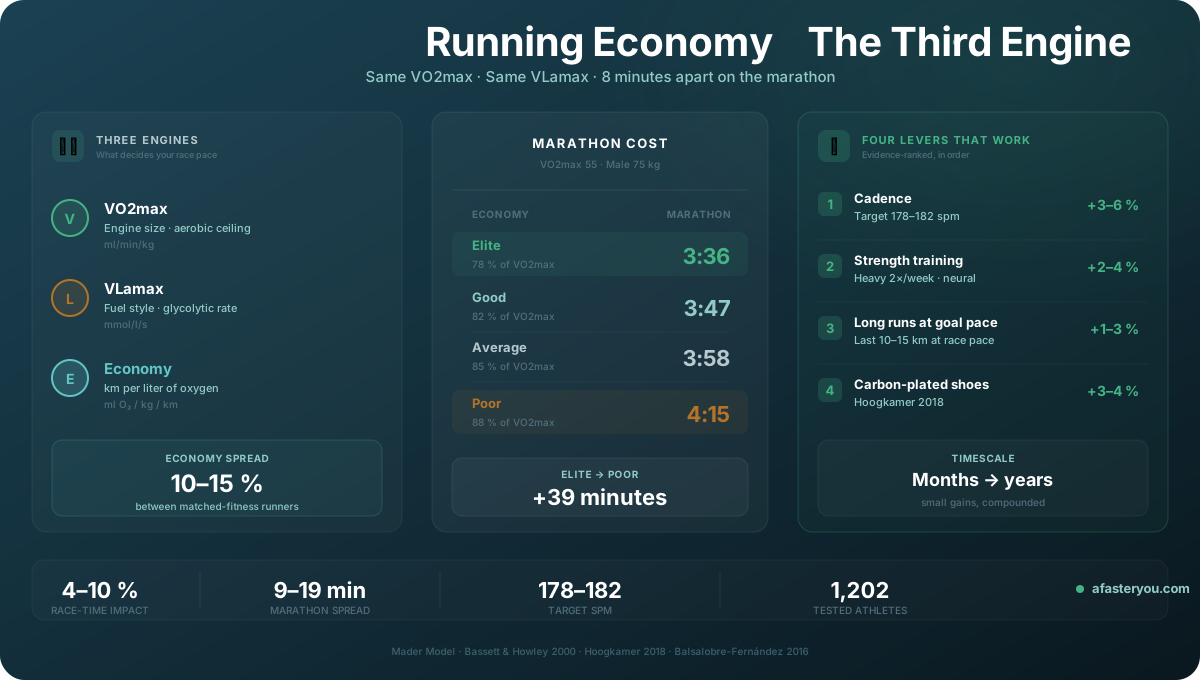
Two runners. Same VO2max. Same VLamax. Same weight, same training history. Come race day, one finishes the marathon in two-fifty-two. The other rolls in at three-hundred. Eight minutes apart. Same engine, same fuel system.
What explains it? One thing: running economy. The third engine. The one nobody talks about.
Until now.
What running economy actually is
Running economy is simple to define and easy to misunderstand. It's the amount of oxygen you burn to cover a kilometer at a given pace — measured in milliliters of oxygen per kilogram of bodyweight per kilometer (ml O₂/kg/km).
Two runners can have the same VO2max — the same aerobic ceiling — but burn very different amounts of oxygen to hold 4:30/km. One runs that pace at 78 % of VO2max. The other runs it at 85 %. Same pace, completely different cost. The efficient runner has room left at kilometer 30. The inefficient one is cooked.
Think of it this way:
- VO2max is how big your engine is
- VLamax is how it burns fuel
- Running economy is how many kilometers per liter you actually get out of it
Two cars with the same engine and the same transmission can still differ 15 % in fuel economy. Running is the same — with one key difference: in running, the efficient athlete gets the better engine and the better mileage.
How much it actually costs
Here's the part that matters. Running economy varies roughly 10–15 % across trained athletes with matching VO2max and VLamax (Bassett & Howley, 2000; Saunders et al., 2004). That translates to 4–10 % of race time — because you either hold goal pace at a lower percentage of VO2max (efficient) or you burn through your buffer early (inefficient).
On the marathon, that 4–10 % is 9 to 19 minutes.
| Economy | % of VO2max at goal pace | Marathon at VO2max 55 | Marathon at VO2max 63 |
|---|---|---|---|
| Elite (low cost/km) | ~78 % | 3:36 | 2:55 |
| Good | ~82 % | 3:47 | 3:03 |
| Average | ~85 % | 3:58 | 3:12 |
| Poor (high cost/km) | ~88 % | 4:15 | 3:25 |
Values from Mader-model predictions with economy-adjusted sustainable fraction. A 10-percentage-point economy gap adds ~30 minutes at VO2max 55.
A sub-3 marathoner with poor economy has to run at 88 % of VO2max to hold 4:16/km. A peer with good economy holds the same pace at 82 %. The efficient runner has six percentage points of buffer — against heat, against glycogen depletion, against the 30K wall. The inefficient one cashes out early.
This is why two athletes with matched physiology still finish minutes apart. It's not mindset. It's not pacing. It's economy.
The uncomfortable truth about improvement
Running economy responds more slowly than the other two engines. VO2max moves in weeks. VLamax in 8–12 weeks. Economy — years. Small gains, compounded.
Which is why elite athletes with matched VO2max still separate themselves over decades. The ones with the patience to chip 0.5 % off their economy every few months win the ones who only chase VO2max numbers.
The four levers below work. Running more easy miles alone doesn't. Random drills don't. Stretching doesn't (Baxter et al., 2017 meta-analysis — no effect). The levers that move the meter, in the order the evidence supports them:
The four levers that actually move economy
1. Cadence — the free 3–6 %
Most recreational runners run at 165–170 steps per minute. The target for economy optimization is 178–182 spm.
Why it matters: shorter stride length means less vertical bounce, less eccentric braking at foot-strike, less time spent pushing your bodyweight back up against gravity between steps. That time is oxygen you didn't need to spend.
Worth 3–6 % of economy in recreational athletes running below 170 spm (Heiderscheit et al., 2011; Ogueta-Alday et al., 2014). Easiest lever to measure — your GPS watch already records it. Hardest part is the 4–8 week adaptation: shorter stride initially feels slower while your nervous system rewires. Hold it through the awkward phase.
2. Strength training — the neural lever
The meta-analysis work is clean. Heavy resistance training, 2×/week, improves running economy in trained runners (Balsalobre-Fernández et al., 2016 Journal of Strength and Conditioning Research; Beattie et al., 2014 Sports Medicine).
Core movements: squats, deadlifts, calf raises, Nordic hamstring curls. Heavy — 80–90 % of 1 RM, 3–5 reps. The mechanism is neural, not muscular: you learn to produce the force of each stride more efficiently, with less wasted activation. No bulking. No speed loss. Pure economy gain.
Most distance runners skip this. Don't.
3. Long runs at marathon pace — the neuromuscular pattern
The last 10–15 km of your weekly long run, held at goal pace, builds the neuromuscular pattern that shows up on race day. It's not training your VO2max. It's not training your VLamax. It's training your coordination under fatigue — the subtle posture, stride, foot-strike, breathing pattern that your body reverts to when you're tired.
Runners who never run at goal pace beyond km 15 discover on race day that their body hasn't pre-programmed the movement. They overstride, slow their cadence, and bleed economy as fatigue climbs. The fix: end every long run with 10–15 km at race pace for the last 8 weeks before a marathon.
4. Shoes — the 3–4 % you can buy
Carbon-plated super-shoes contribute 3–4 % economy improvement over traditional trainers (Hoogkamer et al., 2018 Sports Medicine). The original Nike Vaporfly 4 % data was 4.2 % mean improvement; subsequent independent testing confirms 2.7–4.2 % depending on running style and pace.
Not magic. Not cheating. Real, measurable, biomechanical — the plate reduces ankle-joint work, the foam returns more elastic energy, the geometry rolls you through toe-off.
For the marathon, the right shoe is worth more than a year of easy mileage. For shorter events, the benefit is smaller but still present. Whatever your opinion, the data is the data.
Why the rest doesn't matter much
- Stretching: Baxter et al. 2017 meta-analysis — no significant effect on economy (often a small negative in the short term).
- Running drills: useful for skill, negligible for economy in trained athletes.
- Minimalist shoes: mixed results. For some runners a small win; for others an injury trap.
- Altitude: works primarily through VO2max and hematology, not economy. Doesn't count as an economy lever.
If your program budget is limited, spend it on the four above.
How to measure yours
This is where it gets hard. Running economy in the lab is a mask test at a fixed pace, measuring oxygen consumption directly. Few athletes have access to that.
Outside the lab, you can infer economy from GPS pace plus heart rate plus your known VO2max. The A Faster You AI does exactly this across every activity, tracking your economy trend over months. If you've done a Powertest, we already have your VO2max baseline. From there, every run builds the picture: what percentage of VO2max you held at a given pace, how that percentage is drifting over time, where you rank against our 1,202-athlete cohort (April 2026).
You don't need a lab. You need consistent training data and the right model to read it.
Your next step
Running economy is the third engine — and the most expensive one to ignore. Four to ten percent of your marathon time sits in this metric, and no amount of VO2max training will unlock it.
Cadence. Strength. Long runs at goal pace. The right shoes. Four levers. Work them over months, not weeks.
Start your free trial on A Faster You → — we track all three engines (VO2max, VLamax, economy) from every training session and tell you exactly which one your next block should target.
One more thing — recovery
One last thing, for the curious.
We've now covered the three engines: VO2max (the ceiling), VLamax (the fuel-style), and running economy (the efficiency). Here's the catch: none of it matters if you can't recover.
Adaptation doesn't happen during the hard session. It happens between sessions — and the window is narrower than most athletes realize. Push too hard, you don't adapt. Pull too easy, there's nothing to adapt to. The sweet spot is narrow and moves with your sleep, HRV, nutrition, and accumulated load.
That's a topic of its own. Recovery load, sleep, HRV, and what we call Body Reserve on our platform — the 0–100 metric that decides whether your training sticks or grinds you into the ground. Next article.
For now, you have the physiology in three clean parts. Go build it — and let it rest.
FAQ
What is running economy exactly? Running economy is the amount of oxygen (or energy) required to run at a given submaximal pace, expressed as ml O₂/kg/km or kcal/kg/km. Lower is better — a more economical runner burns less oxygen to hold the same pace, leaving more capacity for the finish.
How much does running economy affect race time? A 10–15 % spread in economy across trained athletes with matching VO2max translates to roughly 4–10 % in race time. On the marathon, that's 9–19 minutes. On the 10K, 2–4 minutes.
Can I improve my running economy? Yes, but slowly. The four evidence-based levers are: cadence (178–182 spm target), heavy strength training 2×/week, long runs with the last 10–15 km at goal pace, and carbon-plated super-shoes. Expect 0.5–2 % per training block, compounding over years.
Is running economy the same as efficiency? Close but not identical. Economy measures oxygen cost per kilometer. Efficiency (gross or net) measures mechanical work per oxygen consumed. The terms are often used interchangeably in non-scientific contexts — in this article we use "economy" in the physiological sense.
Do carbon-plated shoes really improve economy? Yes — 2.7–4.2 % in independent testing, depending on running style and pace (Hoogkamer et al., 2018; follow-up studies 2019–2023). The effect is real, biomechanical, and scales across recreational-to-elite runners. Whatever your opinion on fairness, the data is consistent.
Does strength training make me heavier and slower? No. Meta-analysis evidence (Balsalobre-Fernández 2016, Beattie 2014) shows heavy strength training 2×/week improves running economy in trained runners without meaningful hypertrophy or pace loss. The mechanism is neural, not muscular.
Why does my cadence feel unnatural at 180 spm? Because your nervous system has coded a different pattern. Expect 4–8 weeks of "awkward" feeling before 178–182 spm becomes automatic. Hold it — shorter steps, same pace, less bounce. Use a metronome app or a BPM-matched playlist during easy runs to train the new pattern.
Can I measure my running economy without a lab? Partly. You can't measure it directly without a mask and gas analyzer. But you can infer it from GPS pace + heart rate + known VO2max — which is exactly what the A Faster You AI does on every training session. Trends over months are visible even without absolute-lab values.
Should I prioritize economy over VO2max training? No — VO2max sets the ceiling, economy determines how close you get to it. Think of them as sequential: build the engine (VO2max) first, then optimize the efficiency (economy). Most trained recreational runners benefit from alternating blocks: 8–10 weeks of VO2max focus, then 6–8 weeks of economy (strength + cadence + long runs). If you're not sure whether your ceiling is where it should be for your age, see where your number ranks on the VO2max chart by age before you decide which engine to chase first.
Do different shoes work for different runners? Yes. Super-shoe response varies from 1 % to 6 % across individuals. Test in training — the same shoe that gives a heel-striker 4 % might give a fore-foot-striker 2 %. If your long-run shoe doesn't feel right for marathon pace, try a different plate geometry.
How does running economy relate to running form? Form is one input to economy, not the output. A runner with "ugly" form can be highly economical if the movement is efficient for their body (Zatopek is the classic example). Don't chase aesthetic form — chase the four measurable levers above.
Running economy research: Bassett & Howley (2000), Medicine & Science in Sports & Exercise — classic VO2max × economy framework. Saunders et al. (2004), Sports Medicine — economy determinants in trained runners. Cadence: Heiderscheit et al. (2011), Med Sci Sports Exerc 43(2):296–302; Ogueta-Alday et al. (2014), Int J Sports Med 35(11):952–957. Strength: Balsalobre-Fernández et al. (2016), J Strength Cond Res; Beattie et al. (2014), Sports Medicine. Shoes: Hoogkamer et al. (2018), Sports Medicine. Stretching null effect: Baxter et al. (2017), Journal of Strength and Conditioning Research. Cohort statistics from 1,202 A Faster You athletes (Powertest dataset, April 2026).