Zwift Categories A/B/C/D Explained: Racing Score Decoded (2026)
You raced as a C, finished 12th, and the next morning Zwift quietly bumped you to B. Your power numbers did not change — and you never crossed the famous 3.2 W/kg line. Welcome to the 2026 categorisation system, where two scores decide your tier and only one of them is on your power meter.
The 2026 Category System in One Paragraph
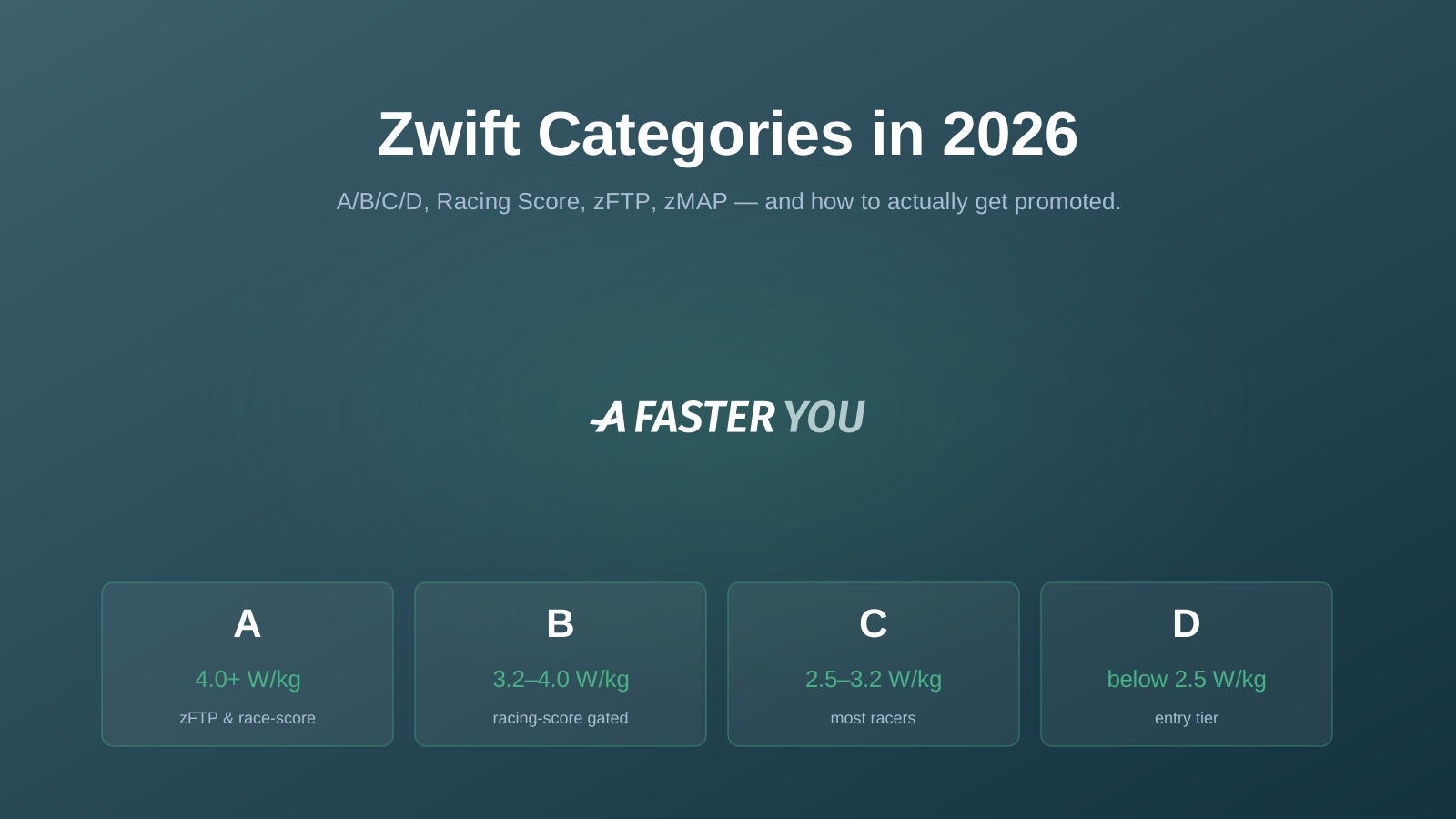
Zwift now sorts racers using two parallel signals. The old W/kg cutoffs (A 4.0+, B 3.2–4.0, C 2.5–3.2, D below 2.5) are still on the books and still gate entry for casual race lobbies. Alongside them sits the Racing Score (zRS) — a 0-to-1000 number that learns from your finishing positions, race fields, and (most importantly) your zFTP. When zRS and W/kg disagree, the higher of the two wins for promotion purposes. That is the rule that catches most riders by surprise.
Are the Old Wattage Cutoffs Still Relevant?
Yes — as a floor, not a ceiling.
A rider with a 3.0 W/kg average for 20 minutes still races C in entry-tier events. The cutoffs are the published baseline and the only thing visible to a beginner browsing the events list. But the moment you start collecting race results, Racing Score begins to override the W/kg picture. A C-category rider who keeps finishing top-5 in their lobby will be flagged for B before their power numbers say so — because zRS has decided your performance belongs in B, even if your power still looks like C.
If you have been racing for two seasons, expect Racing Score to be the dominant input. If you are doing your first race this Saturday, W/kg is still the gate.
zFTP, Tested FTP, and Pcrit — Three Numbers, Three Uses
Three "threshold" numbers float around the Zwift universe and they are not interchangeable.
- Tested FTP is the number you set after a Ramp, 20-min, or Grade test. It is your declared baseline. Zwift uses it for ERG-mode workouts.
- zFTP is Zwift's own auto-derived value, recomputed from your 20-minute personal records over the last 90 days. If zFTP differs from your set FTP by more than 5%, Zwift quietly switches to zFTP for race-categorisation and many group-workout calculations — without notifying you.
- Pcrit (Critical Power) is the underlying physiology number that a Mader-model Powertest returns. It is typically 3–8 W lower than FTP and is the value your training plan should actually be built from.
When you check your category, Zwift reads zFTP first. When you do a workout, it reads tested FTP. When your coach plans your block, they should be using Pcrit. Three different numbers, three different jobs.
zMAP — The Number You Have Never Heard Of
Zwift also maintains a second auto-value called zMAP — your maximal aerobic power, roughly your sustainable one-minute output. It serves the same anchoring role on the short-duration side that zFTP serves on the threshold side, and it is used by Racing Score to detect mismatches between your steady-state ability and your top-end punch.
For coaching purposes, zMAP correlates closely with the VO2max-anchored power the Mader model returns — roughly 110–130% of your Pcrit, depending on rider type. If your zMAP is high relative to your zFTP (a "punchy" profile), expect Racing Score to weight your finishes more aggressively. If the two are tightly stacked (a "diesel" profile), zRS will track zFTP almost one-for-one.
The Real 2026 Category Boundary Table
| Cat | W/kg | Typical zFTP | Typical Racing Score |
|---|---|---|---|
| A | 4.0+ | 4.0+ W/kg | 600–1000 |
| B | 3.2–4.0 | 3.2–4.0 W/kg | 400–650 |
| C | 2.5–3.2 | 2.5–3.2 W/kg | 200–450 |
| D | Below 2.5 | Below 2.5 W/kg | 0–250 |
The W/kg and zFTP columns are nominally identical because Zwift derives zFTP in W/kg terms. The interesting column is Racing Score: the bands overlap deliberately, so a "fast C" and a "slow B" can sit at zRS 425 for weeks before a single race result tips one of them into the new category.
How Promotions Actually Trigger
Two routes get you promoted:
- The zFTP route. Hit a new 20-minute PR that lifts your auto-FTP past the W/kg boundary, and the next time the system recomputes (usually within 24 hours of the qualifying ride), you move up. This is the route most riders expect and the route most riders never actually take — the 20-minute PR has to happen during an event Zwift counts, not in a free ride.
- The Racing Score route. Accumulate enough top-half finishes in your current category, and zRS will cross the band threshold even if your zFTP stays put. This is the route most riders find themselves on, and the one that produces the "I never crossed 3.2 but I'm in B now" complaint that opens every Zwift-racing thread.
Both routes share one thing: fitness, not gear, is what moves them. Aero wheels, a tighter draft strategy, and weight-doping a power meter will not promote you. A Mader-anchored block that lifts your true Pcrit by 8–12 W will — through both routes at once.
The 4-Week Promotion Blueprint (Teaser)
If you are sitting at zFTP 3.0 W/kg and your goal is the C-to-B jump, you need roughly +0.2 W/kg on zFTP in the next month. That works out to roughly +15 W for a 75 kg rider — achievable with the right block, very rarely achievable without one.
The block we run our athletes through has three weekly pillars:
- Two threshold sessions (4 × 8 min at 100–105% of Pcrit, Tuesday and Saturday). These shift the zFTP-related portion of the curve directly.
- One VO2max session (5 × 4 min at 115–120% Pcrit, Thursday). Pushes zMAP up and pulls zFTP up indirectly.
- One long aerobic ride (90–120 min Zone 2, Sunday). Builds the mitochondrial base that keeps the threshold work absorbable.
Three weeks of stimulus, one week of cut-back, and a fresh test on day 28. The full block — with exact watt targets per rider type, the cut-back week structure, and the mistakes that wipe out the gain — is the next read in this series:
Coming next week: The 4-Week VO2max Block: From C to B, Watt by Watt. If you are reading this near publish day, the deep-dive lands the following Tuesday.
In the meantime, the Zwift FTP test you pick decides which protocol you use to measure the gain at the end of the block, and the Powertest comparison → tells you how much of that gain you can trust.
When the Real Number Beats the Auto Number
zFTP and zMAP are convenient because Zwift maintains them for free. They are also lossy: both are inferred from race-day power data, both are noisy on small samples, and both lag a fitness change by 30–60 days. If you want to plan the block above with actual zone boundaries — not Racing-Score guesses — a Mader-model Powertest takes 25 minutes and returns Pcrit, VO2max, and VLamax directly.
Start a free trial of A Faster You and your first Powertest sets the baseline. From there, the plan schedules every interval at the right watts — not the watts Zwift thinks you can hold.
FAQ
Why was I bumped to B after a single race? Racing Score reacts to large performance swings even on small samples. A C-category podium against a strong field will push zRS over the band threshold even if your W/kg has not moved. Lower-field finishes inside the same category tend not to demote you, but they slow the next promotion down.
Can I sandbag back to C if I get promoted too early? Not deliberately. Zwift's anti-sandbag logic flags riders whose zFTP and zRS both drop in the same window — frequent enough to trigger an automated review. Riders who stop racing for 90 days will see their zRS decay, and if the new value falls under the band ceiling, the next race will place them lower. But it is a long, ugly path.
Does zMAP override zFTP? For category placement, no — zFTP is the dominant input. For Racing Score, zMAP is a secondary input that catches riders whose short-duration power vastly exceeds their threshold. If your zMAP is 6+ W/kg and your zFTP is 2.8 W/kg, expect zRS to read you as "stronger than the W/kg suggests" and place you accordingly.
What if my tested FTP is higher than my zFTP? Zwift uses zFTP for category gating in this case. The fix is to put in a hard 20-minute effort during a counted event so the zFTP estimate catches up to your declared FTP. Or accept that the lower zFTP is the safer racing tier and re-test in 4–6 weeks.
Do bots or AI-assisted training accounts get treated differently? No. Zwift's category logic does not distinguish how the plan was generated. A rider following an A Faster You plan, a Coggan-style block, or self-prescribed intervals enters the same Racing-Score machinery. What differs is the rate of fitness change, and that is where a Mader-anchored plan tends to compound faster than generic templates.
Where do I find my zFTP and zMAP? Both live under Settings → Profile → Power. Tap the value to see the source ride and the date it was last recomputed.
Sources: Mader, A. (2003) — Glycolysis and oxidative phosphorylation as a function of cytosolic phosphorylation state and power output of the muscle cell. Eur J Appl Physiol, 88(4–5), 317–338. Mader, A. & Heck, H. (1986) — A theory of the metabolic origin of the "anaerobic threshold". Int J Sports Med, 7 Suppl 1, 45–65. Buchheit, M. & Laursen, P.B. (2013) — High-intensity interval training, solutions to the programming puzzle. Sports Medicine, 43. Zwift help docs and Racing Score documentation as of 2026-05. Mader-model cohort: 1,202 A Faster You athletes, 15,000+ Powertests, 1M+ analysed training sessions (2026 baseline).