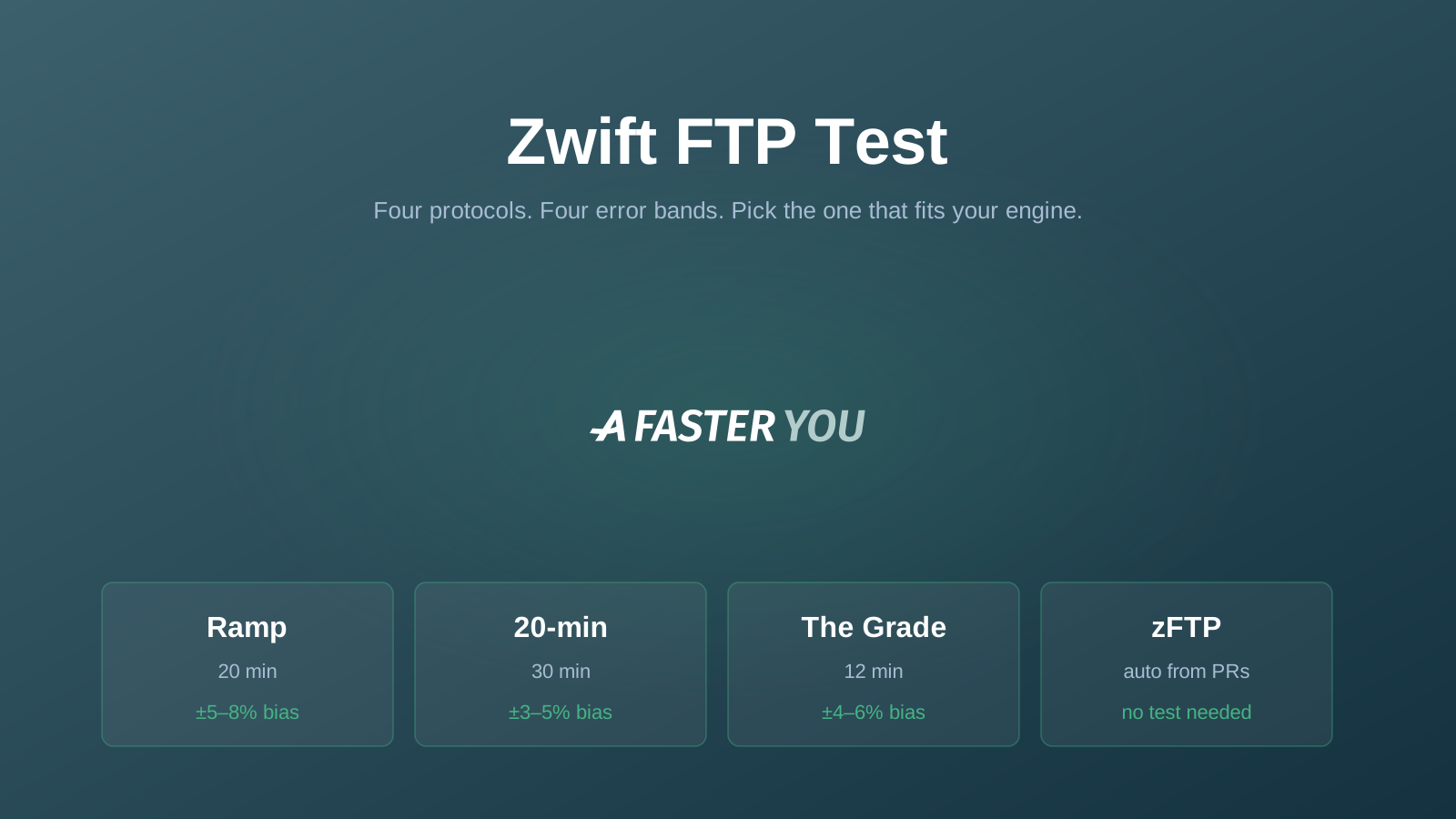
Zwift FTP Test: Ramp vs 20-min vs The Grade vs zFTP (2026)
Zwift now gives you four ways to measure your FTP — Ramp, 20-min, The Grade, and a quietly running fourth one called zFTP. Only one of them matches the engine you actually have.
Why FTP Matters Inside Zwift
FTP is the wattage you can hold for about an hour. Get the number wrong, and every Zwift workout in ERG mode runs at the wrong intensity. Three points wrong on FTP means 9–12 W mis-targeted in every Zone 4 interval for the rest of the block — too easy and you under-train, too hard and you over-cook recovery.
A note on language: in this article "FTP" means the Zwift convention — your sustainable hour-power. In our coaching engine we call the same underlying value TP (Threshold Power, derived from a Critical-Power model rather than a 60-minute test). The numbers are usually within 3–8 W of each other; the methodology is what differs.
The Four Zwift FTP Protocols
| Protocol | Duration | Format | Error band vs Mader TP | Best-fit rider type |
|---|---|---|---|---|
| Ramp | 20 min | +20 W/min step ramp until failure | ±5–8% | VO2-dominant (diesel) |
| 20-min | 30 min | warm-up → 5-min opener → recover → 20-min all-out | ±3–5% | Balanced or VO2-dominant |
| The Grade | 12 min | warm-up → 8-min progressive → 4-min all-out | ±4–6% | VLamax-balanced |
| zFTP | 0 min | Zwift auto-derives from your 20-min PRs | ±5–10% | Anyone with recent racing data |
Error bands above come from comparing each protocol's result to Mader-model Threshold Power on our cohort of 1,200+ A Faster You athletes and 15,000+ Powertests. They are not Zwift-published numbers — they are what we see when athletes do both tests inside a single training block.
Protocol 1 — The Ramp Test
A 20-watt-per-minute step ramp until your legs give up. Easy at the start (you ride 80 W for the first minute), brutal at the end (most riders fail somewhere between 320–420 W). FTP is then calculated as 75% of the highest one-minute power you sustained.
Who wins. VO2-dominant cyclists — diesel engines who can grind progressively. The ramp's steady increase rewards your ability to keep producing aerobic power as oxygen demand climbs. The 75% multiplier maps cleanly to your sustainable threshold.
Who loses. High-VLamax sprinter types. Your big anaerobic engine carries you 30–60 seconds past where your sustainable aerobic ceiling sits. The 75% multiplier then over-predicts your FTP — sometimes by 20–35 W. Your ERG workouts after a Ramp test will feel impossible.
Fatigue cost. Low. You can ride hard the next day.
Protocol 2 — The 20-Minute Test
A 5-minute all-out effort to open the legs, a 10-minute recovery, then 20 minutes at the highest power you can sustain. FTP equals 95% of that 20-minute average.
Who wins. Balanced riders and VO2-dominant cyclists who pace well. Twenty minutes is long enough that you cannot fake the number with anaerobic capacity — your aerobic system is the bottleneck.
Who loses. High-VLamax sprinters in the opposite direction — the 5-minute opener cooks them and they bleed power in the 20-minute block. Also anyone who has never paced a 20-minute effort; expect 5–10% pacing error on a first attempt.
Fatigue cost. High. Plan an easy day before and a recovery day after.
Protocol 3 — The Grade
Zwift's newest protocol, released in Q4 2025. Eight minutes of progressive ramp, then four minutes all-out. FTP is computed from the final four-minute average plus a small correction factor for the ramp segment.
Who wins. Most riders. The Grade was engineered to sit between Ramp (too anaerobic) and 20-min (too long), and our cohort data shows it produces tighter FTP estimates than either alternative for VLamax-balanced cyclists. It is the closest of the four to a Mader Threshold Power read for a typical age-grouper.
Who loses. Pure diesel engines whose 4-minute power barely exceeds their 20-minute power. You will under-read by 2–3% here. The Ramp is still the better choice for you.
Fatigue cost. Moderate. Lighter than 20-min, heavier than Ramp.
Protocol 4 — zFTP
This is the one most Zwift users do not know they are using. Zwift now silently maintains a zFTP value, auto-derived from your 20-minute personal records across all rides in the past 90 days. If your zFTP differs from your set FTP by more than 5%, Zwift will quietly use zFTP for ERG scaling on group workouts and race categorisation — without telling you.
Who wins. Anyone with regular hard racing or fast group rides on Zwift. The data already exists, so the estimate is free, and on a deep recent dataset it tracks the truth surprisingly well.
Who loses. Anyone who has not done a hard 20-minute effort in three months. zFTP decays based on the available data, not your actual fitness; it can drift 10% off the truth in either direction.
Important. zFTP is not a protocol you choose — it is a value Zwift maintains in the background. The real question is whether you let Zwift override your tested FTP with it. Check the toggle under Settings → Profile → FTP and decide deliberately.
How Rider Type Maps to the Right Protocol
If you have ever done an A Faster You Powertest, you already know your VO2max/VLamax balance. The map below tells you which Zwift test to pick from there.
| Your engine | Take this test | Skip this one |
|---|---|---|
| High VO2max, low VLamax (diesel) | Ramp · zFTP | The Grade — under-reads by 2–3% |
| High VLamax, modest VO2max (sprinter) | 20-min · The Grade | Ramp — over-reads by 20–35 W |
| Balanced (allrounder) | The Grade · 20-min | None outright bad |
| Untested rider | The Grade | — |
The single most common mistake is a high-VLamax rider taking a Ramp test, ending up with an FTP 25–35 W too high, and then collapsing in the first Zone 4 ERG workout of the new block. If your Sweet-Spot intervals feel harder than they should, your protocol is the first place to look.
A Note on the Zwift–A Faster You Integration
If you are reading this in late May 2026 or later, direct Zwift integration is rolling out as part of the A Faster You plan. Once enabled, your scheduled workouts sync directly to Zwift with the right ERG power targets, and your Zwift rides flow back into your plan as completed sessions. No more FIT-file exports through the upload page. The setup option lives at Settings → Connections → Zwift.
The plan still uses your tested FTP, not Zwift's auto-derived zFTP — so the choice you make in this article carries straight into your sync.
When You're Ready for the Real Number
All four Zwift protocols are useful when you do not have access to anything else. None of them measure what actually matters for training prescription: your underlying VO2max plus your VLamax, which together set your true threshold and your individualised training zones.
A Mader-model Powertest — a 15-second sprint plus a 12-minute all-out, recorded on the trainer or outdoors with one-second data — takes the same time as a Ramp test and returns both numbers, plus the zone boundaries that Zwift cannot compute. Most of our athletes do their first one in week one of the plan and re-test every 4–6 weeks after that.
If you want to see exactly how much the protocol you picked above costs you in watts versus a Powertest, the next read in this series breaks it down with cohort data: Zwift FTP Test vs Powertest: When 300W Aren't 300W →
Start a free trial of A Faster You and your first Powertest sets the baseline. The AI schedules every interval, threshold session, and recovery day after that.
FAQ
Can I run two Zwift FTP tests in the same week to compare? You can, but the second result will read 3–5% low because of residual fatigue from the first. Space them at least 5 days apart, with two easy days in between.
What does Zwift do if my zFTP is higher than my set FTP? For solo rides and structured ERG workouts, Zwift uses your set FTP. For races and many group workouts, Zwift uses zFTP behind the scenes — even if you never enabled it. Check your race result after a hard event: if the categorisation looks off, zFTP is the reason.
Should I do the Ramp test if I have a heart-rate monitor but no power meter? No — none of the four protocols work without power. Use a Zwift-compatible smart trainer or a power-meter pedal. Heart-rate-based FTP estimation is too noisy to set ERG targets from.
Does The Grade work for triathletes or only cyclists? The protocol is identical for both. The interpretation changes slightly: triathletes with low VLamax (typical) tend to under-read by 2–3% on The Grade. If you race triathlon, the Powertest is a much better baseline than any of the four Zwift options.
My Ramp test gave 280 W but my Sweet-Spot intervals at 235 W feel hard. What went wrong? You are likely a VLamax-dominant rider whose Ramp result is 20+ W too high. Repeat the test using The Grade or a 20-minute protocol. If the result drops by 15 W or more, trust the lower number and re-build your zones from it.
How often should I re-test in Zwift? Every 4–6 weeks during a focused training block, or whenever your prescribed workouts start feeling consistently too easy or too hard. If you are on an A Faster You plan, the system flags the right moment for you.
Sources: Mader, A. (2003) — Glycolysis and oxidative phosphorylation as a function of cytosolic phosphorylation state and power output of the muscle cell. Eur J Appl Physiol, 88(4–5), 317–338. Mader, A. & Heck, H. (1986) — A theory of the metabolic origin of the "anaerobic threshold". Int J Sports Med, 7 Suppl 1, 45–65. Buchheit, M. & Laursen, P.B. (2013) — High-intensity interval training, solutions to the programming puzzle. Sports Medicine, 43. Zwift help docs as of 2026-05. Mader-model cohort: 1,202 A Faster You athletes, 15,000+ Powertests, 1M+ analysed training sessions (2026 baseline).