The 4-Week VO2max Block for Cyclists: From C to B, Watt by Watt (2026)
Your VO2max has not moved in six months. You ride hard on Tuesday, hard on Thursday, hard on Saturday, and the number on your Powertest report keeps coming back the same. The plateau is rarely genetic. It is almost always the wrong interval structure — and the fix is a four-week block.
Why Block Training Beats the Tuesday–Thursday–Saturday Routine
The classic VO2max prescription places one hard session every third day. It is gentle, it fits a normal training week, and it lands roughly 8 VO2max sessions in a typical month. The problem: each session is large enough that it leaves the rider tired enough to under-perform the next one, and the spacing keeps the stimulus just below the level needed for adaptation.
Block training does the opposite. Three VO2max sessions on consecutive days, followed by genuine recovery. Same total stimulus per month, less recovery cost per day, more total volume in the block. Rønnestad et al. (2014, 2016) showed cyclists doing block VO2max training gained roughly twice the VO2max of a matched group on the classic spacing — same total work, different schedule.
The mechanism is protein turnover. A single very hard session triggers two to three days of cellular rebuilding before another hard stimulus can land productively. Three shorter, controlled VO2max sessions in a row each trigger a smaller turnover spike, and the cumulative signal at the end of the block is larger than what one big session produces in isolation. Our coaching playbook has run this principle for years on athletes with tight weekly time budgets; the consecutive structure is intentional, not accidental.
Who This Block Is For
The plan below is calibrated for cyclists sitting in the 50–65 ml/min/kg VO2max range — recreational to trained, riding 6–10 hours a week, with at least six months of consistent cycling behind them. 5,660 athletes (48.6% of our valid cycling Powertests) sit in this bucket, and the prescription targets the realistic +2–4 VO2max-point delta they can expect over four weeks.
If you are below 50 ml/min/kg, you will get more from raising your aerobic base before chasing VO2max — extensive Zone 2 work for 6–8 weeks first, then this block. If you are above 65 ml/min/kg, the gains compress: expect +1–2 points, with VLamax-reduction often becoming the more productive target.
Who This Block Is Not For
Do not run this block if any of the following apply:
- Untrained or returning from a long off-season — start with a base block first.
- Within 4 weeks of any illness, vaccination reaction, or surgery — the immune cost of consecutive hard sessions is real.
- Currently injured or in pain that limits 100% efforts.
- Within 14 days of a key race — this is a build block, not a peak block.
- Sleeping less than 6.5 hours/night on average — recovery will not absorb the load.
Skipping the safety filter here is the single most common way an ambitious athlete turns a strong block into a three-week dig that wipes out gains.
The 4-Week Structure at a Glance
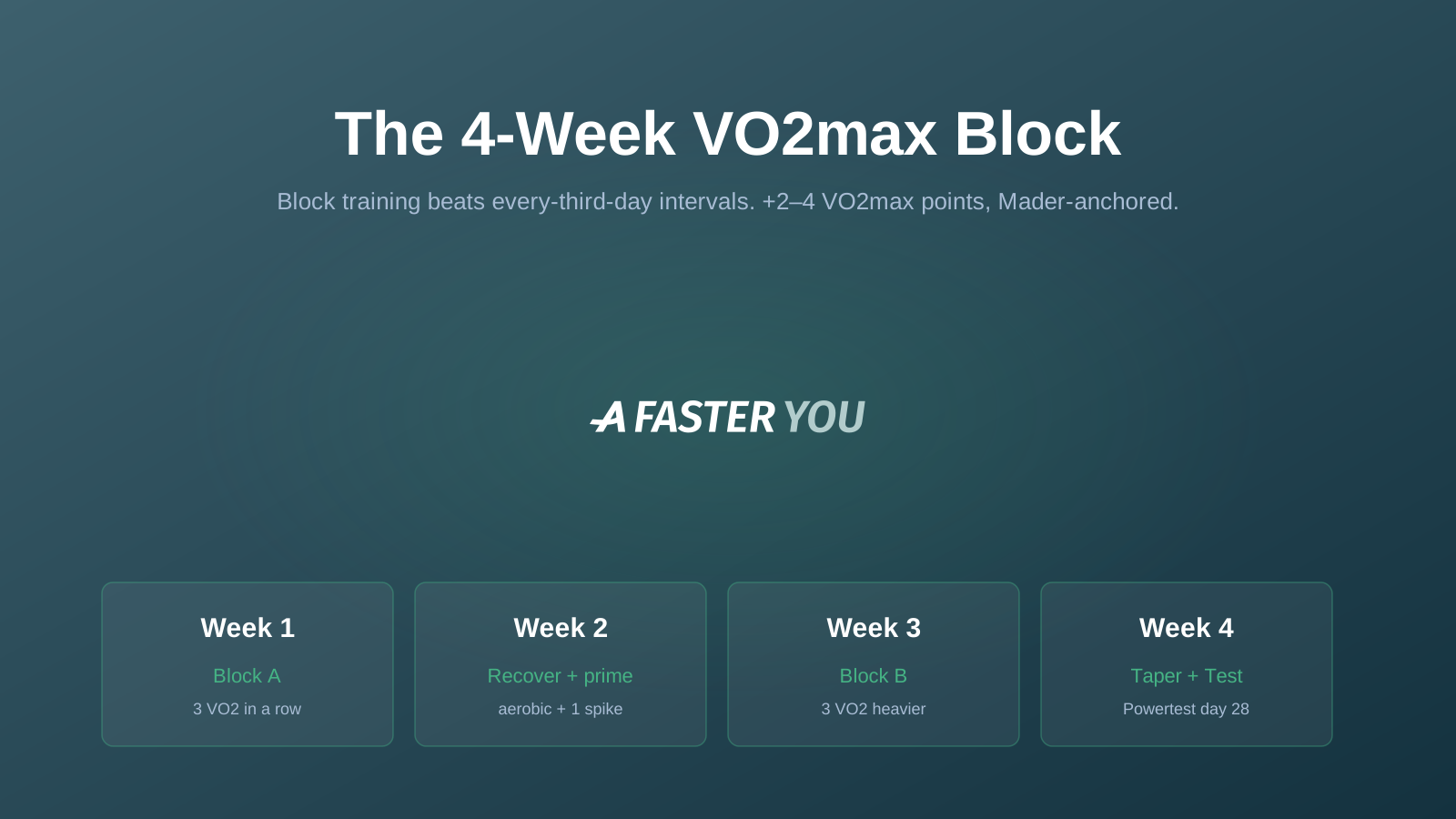
| Week | Theme | VO2 sessions | Z2 rides | Total time |
|---|---|---|---|---|
| 1 | Block A | 3 (consecutive) | 1 long | 6–9 h |
| 2 | Recovery + 1 prime | 1 short | 2 easy | 5–7 h |
| 3 | Block B (heavier) | 3 (consecutive) | 1 long | 7–10 h |
| 4 | Taper + Powertest | 1 short opener | 2 easy + test | 5 h |
Total VO2max sessions across the block: 8 — the same monthly count as the classic Tuesday–Thursday–Saturday plan, redistributed.
Week 1 — Block A
Three VO2max sessions on consecutive days. The pattern that works for most riders is Tuesday → Wednesday → Thursday (or Monday → Tuesday → Wednesday if your weekend is heavier).
- Session 1 (Tue): 5 × 4 min at V100 (115–120% of Pcrit), 4 min easy between intervals. Total 60–75 min including warm-up and cool-down.
- Session 2 (Wed): 6 × 3 min at V100, 3 min easy. Total 60 min. Slightly shorter intervals because cumulative fatigue is real.
- Session 3 (Thu): 8 × 2 min at V100, 2 min easy. Total 55 min. Shortest intervals of the block, but the same V100 power target. This is the session where the cumulative stimulus lands.
Friday is full rest. Saturday is a long Zone 2 ride (90–120 min at 55–75% of Pcrit). Sunday is full rest. Total week-1 time: 6–9 hours depending on the long ride.
If "Pcrit" is unfamiliar, it is the underlying threshold value that a Mader-model Powertest returns — typically 3–8 W lower than your set FTP. For deeper context, Zwift FTP test vs Powertest → walks through the conversion.
Week 2 — Recovery + One Prime
The cellular rebuilding from week 1 lands here. Do not push through it.
- Monday: full rest.
- Tuesday: 60 min Zone 2.
- Wednesday: the prime session. 4 × 3 min at V100, 3 min easy. Just enough VO2max touch to keep the adaptation pathway open without re-loading fatigue.
- Thursday: 60 min Zone 2.
- Friday: full rest.
- Saturday/Sunday: one easy ride (60–90 min Z2), one full rest.
Total week-2 time: 5–7 hours. If your legs still feel heavy on Wednesday morning, swap the prime session for another Z2 ride and pick the block back up the next week.
Week 3 — Block B
Same three-day structure as week 1, with two adjustments: total time at V100 is longer, and recovery between intervals is shorter.
- Session 4 (Tue): 5 × 5 min at V100, 4 min easy. 8 minutes more total work than session 1.
- Session 5 (Wed): 6 × 4 min at V100, 3 min easy. Tighter recovery than session 2.
- Session 6 (Thu): 10 × 2 min at V100, 90 seconds easy. The block's hardest session by accumulated time-at-VO2max.
Friday rest, Saturday long Z2 (90–120 min), Sunday rest. Total week-3 time: 7–10 hours.
Week 4 — Taper + Powertest
Recovery wins the block. Do not add intervals here.
- Monday: full rest.
- Tuesday: 60 min Zone 2 with 3 × 30 seconds Sprint near the end (priming the neuromuscular system).
- Wednesday: 30–40 min easy ride to flush the legs.
- Thursday: full rest.
- Friday or Saturday: Powertest — a 15-second sprint plus a 12-minute all-out, with one-second recording enabled.
The taper week's purpose is single-minded: arrive at the Powertest with fresh legs and tested calibration. Total week-4 time: roughly 5 hours including the test.
Fueling the V100 Sessions
A typical 60-minute VO2max session burns 100–200 g of carbohydrate. This is not high; it is what intensity above threshold costs in fuel. The fat-burning machinery cannot supply energy fast enough above your Pcrit, so the body shifts to almost-exclusive carbohydrate combustion. Most riders chronically under-fuel these sessions and then wonder why they bonk on session 3.
Practical rules:
- Pre-session (2–3 hours before): 60–80 g of carbohydrate. Oats, banana, white rice, anything you digest cleanly.
- During the session: 30–60 g/hour from a sports drink or gel, sipped between intervals.
- Post-session (within 30 minutes): 30–60 g of carbohydrate plus 20 g of protein. The protein supports the turnover process the block is engineered around.
Under-fueling the block is the second most common way to lose the gain.
Expected Delta — Honest Range
The +2–4 VO2max point expectation is calibrated to literature and our coaching observations, not to a measured before-and-after cohort from our own database. The honest framing:
- Literature anchors: Billat 2001 reported +5–10% VO2max gains over six weeks of vVO2max intervals; Helgerud et al. 2007 found +5.5% over eight weeks with a 4×4 protocol. Compressed to four weeks, the realistic ceiling drops to roughly +2–4 absolute points for the 50–65 starting bucket — about 4–7% — with first-time block-trained athletes reaching +5–6 points.
- Coach experience: roughly three VO2max points on average across four-week blocks in our coached riders, with substantial spread above and below.
- What we do not have yet: a clean before/after Powertest cohort delta filtered for "athlete followed a four-week VO2-block plan". Building that pull is on the roadmap, and a future revision of this article will replace the range with measured numbers.
If your post-block Powertest comes back with no change, the most likely cause is under-fueling or under-sleeping, not a training defect. Re-test in 14 days after a recovery week before drawing conclusions.
Verify the Gain
The day-28 Powertest is the only honest measurement. Watch-based VO2max estimates lag a real change by 30–60 days and average +3 points of bias in the recreational range, which would mask a successful block almost completely (see our Garmin VO2max accuracy report → for the bias curve).
The Powertest takes 25 minutes and returns VO2max and VLamax together. The plan should be re-calibrated from the new numbers the same day; the vo2max-table reference → is the benchmarking context for what the new value means in race-time and Zwift-category terms.
Bonus Outcome: Zwift Category Promotion
A +2–4 VO2max gain typically translates to a +0.2–0.3 W/kg increase in Mader-derived Pcrit — close enough to the W/kg boundary movement many Zwift racers chase. If you are sitting at zFTP 3.0 W/kg and racing C, a successful block lands you near the 3.2 boundary and lets Racing Score start moving you toward B without further fitness work. The mechanics of how that promotion actually triggers are covered in Zwift Categories Explained →; the block above is what produces the watts that trigger it.
FAQ
Can I run this block on Zwift? Yes — every interval translates cleanly to ERG mode. The V100 zone is 115–120% of your set FTP in Zwift; if your tested FTP and zFTP differ by more than 5%, plan the block from the tested FTP and ignore the zFTP for the four weeks.
Can I do this as a runner instead of a cyclist? The structure transfers, but the absolute V100 paces are very different. The cycling-specific session times above are calibrated for the bike. A running version with target paces and a session-by-session walkthrough is on the roadmap.
Why three VO2 sessions in a row instead of spacing them? Protein-turnover cost scales non-linearly with single-session load. Three shorter, controlled VO2 sessions on consecutive days produce a larger total adaptation signal than three large sessions distributed across a week, and they leave more recovery space at the end of the block. Same principle, opposite execution from the classic prescription.
What if I miss a session in a block? Skip it. Do not stack two on the same day, do not push the block out by a day. Block training is high-stimulus; a missed session reduces the dose but does not break the structure.
Can I keep doing this every month? No. The block is engineered for one repetition every 8–12 weeks. Run it back-to-back and you will run into accumulated central fatigue. Use the intervening weeks for VLamax work, race-specific sharpening, or a recovery base block.
Should I drop weight during the block to lift W/kg further? No. The block needs full carbohydrate availability to land. A simultaneous calorie deficit will compromise the session quality and the turnover repair window. Plan the weight cut for a separate four-week block before or after this one.
Sources: Mader, A. (2003) — Glycolysis and oxidative phosphorylation as a function of cytosolic phosphorylation state and power output of the muscle cell. Eur J Appl Physiol, 88(4–5), 317–338. Rønnestad, B.R. et al. (2014) — Effects of 12 weeks of block periodization on performance and performance indices in well-trained cyclists. Scand J Med Sci Sports, 24(1), 34–42. Rønnestad, B.R. et al. (2016) — Block periodization of high-intensity aerobic intervals provides superior training effects in trained cyclists. Scand J Med Sci Sports, 26(1), 18–24. Helgerud, J. et al. (2007) — Aerobic high-intensity intervals improve VO2max more than moderate training. Med Sci Sports Exerc, 39(4), 665–671. Billat, V. (2001) — Interval training for performance: a scientific and empirical practice. Sports Medicine, 31(1), 13–31. Mader-model cohort: 1,202 A Faster You athletes, 15,000+ Powertests, 1M+ analysed training sessions, 5,660 valid cycling Powertests in the 50–65 VO2max target bucket (2026 baseline).