VLamax Explained (2026): What 13,000 Powertests Reveal
Your watch shows your VO2max every morning. Forty-eight, fifty-two, fifty-five. You glance at it, you nod, you go run. But there's a second number — the one your watch will never show you — and it decides whether your half-marathon goes to plan or unravels at kilometer 16.
That number is VLamax. And once you understand it, you'll never read your "VO2max only" stats the same way again.
What VLamax actually is
VLamax is your maximum lactate production rate — how fast your muscle cells can burn carbohydrates without oxygen. The unit is millimoles per liter per second (mmol/l/s).
Think of your engine in two halves. VO2max is the aerobic side: how much oxygen you can pull in and burn. VLamax is the glycolytic side: how aggressively your body breaks down sugar to make energy fast — paying for that speed with lactate as a byproduct.
The clean coach-level definition: VO2max is your aerobic ceiling, VLamax is your sugar-burning rate. They live in the same metabolism, share the same body, and decide your race together — and a single Powertest reads them both.
Here's why VLamax is a big deal: a low VLamax means you sip carbohydrates slowly, spare glycogen for hours, and hold marathon pace without bonking. A high VLamax means you can kick, sprint, attack — and burn through your fuel tank twice as fast. Neither is universally better. The optimum depends on what distance you want to win.
Typical ranges from real measurement:
| VLamax range | What it tells you | Typical athlete |
|---|---|---|
| 0.20–0.35 mmol/l/s | Strong endurance profile | Marathoner, ultra runner, GC cyclist |
| 0.40–0.55 mmol/l/s | Balanced all-rounder | 10K runner, road racer |
| 0.60–1.00+ mmol/l/s | Glycolytic-dominant | Track sprinter, criterium rider, 400/800m runner |
Why you've probably never heard of it
Open the English Wikipedia article on VO2max. Search for "VLamax". You won't find it. Not a sentence, not a footnote — the term doesn't appear on the page.
That gap is not because VLamax is fringe science. The Mader model that defines it has been peer-reviewed since 1986 and runs every metabolic-software back-end you've ever used in a coaching app. The gap exists because measuring VLamax in the lab is hard: you need a maximal sprint, blood lactate samples, and a metabolism specialist to interpret the curve. Most amateur coaches simply don't have it on the menu, so it never gets translated into popular content.
The result: athletes get told their VO2max is the only number that matters. Half the picture, dressed up as the whole one.
How VLamax is measured: the 15-second sprint
The Mader protocol nails the measurement down to a single test: 15 seconds, all-out, from a controlled start.
In a lab, the sprint is paired with blood-lactate samples taken before, immediately after, and at minute three, five, and seven post-effort. The peak lactate value combined with body composition and the work performed during those 15 seconds gives you VLamax through the Mader equations.
In our system the same protocol runs from your normal training setup. You ride or run a 15-second maximal sprint as part of the Powertest. The model — the same Mader engine that the labs use — combines that sprint with your ramp-test results to extract both VO2max and VLamax in one session. No mask, no needles, no €350 lab fee.
The accuracy you give up is small. The accessibility you gain is huge: you can retest every six to eight weeks instead of once a year, which is the cadence that actually matters for periodized training.
Where do you land? 13,000+ real Powertests
Here's the part nobody else can publish: a clean look at where real athletes actually sit. Across our platform, 13,282 valid Powertests with measured VLamax — 11,666 from cyclists and 1,616 from runners — give us the largest publicly-discussed VLamax dataset outside elite-coaching software.
| Sport | n | Median VLamax | P25 | P75 |
|---|---|---|---|---|
| Cycling | 11,666 | 0.51 mmol/l/s | 0.40 | 0.64 |
| Running | 1,616 | 0.35 mmol/l/s | 0.24 | 0.44 |
The cycling-running gap is the headline. Cyclists test 47% higher VLamax than runners on the same platform, with the same protocol. That's not noise. The discipline shapes the metabolism — short cycling power-peaks (attacks, climbs, position changes) drive glycolytic capacity up, while running's more uniformly aerobic load pushes it down.
If you've ever wondered why the cyclist friend who crushes you on the bike struggles to break 50 minutes in a 10K — the metabolic profile is half the answer.
Methodology: How We Built This Cohort
Every Powertest in this dataset comes from a real athlete on the A Faster You platform — not aggregated, not modeled, not borrowed. We measure each Powertest using the Mader protocol (15-second sprint plus a 12-minute time-trial), apply the validity rules from the model (VO2max between 18 and 100 ml/min/kg, VLamax between 0.05 and 1.3 mmol/l/s, every derived power value calculable), and only valid tests enter the statistics. No invalid tests, no estimates, no "best guess" filling. The numbers above are pure measurement.
Where you fit in the distribution
The histogram tells the bigger story. In running, more than half the cohort sits between 0.20 and 0.45 — a clean endurance-cluster. In cycling, the distribution shifts visibly to the right, with the largest single bucket sitting between 0.50 and 0.60.
| VLamax bucket | Cycling % | Running % |
|---|---|---|
| <0.30 mmol/l/s | 13.7 % | 37.2 % |
| 0.30–0.50 mmol/l/s | 33.1 % | 46.0 % |
| 0.50–0.70 mmol/l/s | 35.0 % | 10.5 % |
| >0.70 mmol/l/s | 18.2 % | 6.2 % |
If your VLamax is 0.45 and you mostly run, you're sitting near the top of the running endurance band — solid for half-marathons, slightly above optimum for marathon. The same 0.45 in cycling lands you mid-pack for road racing — perfect, neither too peaky nor too efficient. Same number, two different stories. That's the discipline-context that pure-VO2max charts will never give you.
The marathon penalty: where VLamax actually shows on race day
Now the calculator. Fix the body — male, 75 kg, 15 % body fat, VO2max 55 ml/min/kg. The only thing that changes is VLamax. Run the Mader simulation across realistic running distances:
| VLamax | 5K | 10K | Half Marathon | Marathon |
|---|---|---|---|---|
| 0.25 mmol/l/s | 22:55 min | 46:47 min | 1:40 h | 3:21 h |
| 0.40 mmol/l/s | 22:55 min | 46:47 min | 1:40 h | 3:31 h |
| 0.55 mmol/l/s | 22:55 min | 46:47 min | 1:44 h | 3:49 h |
| 0.70 mmol/l/s | 22:55 min | 46:47 min | 1:51 h | 4:06 h |
| 0.85 mmol/l/s | 22:55 min | 46:47 min | 1:58 h | 4:24 h |
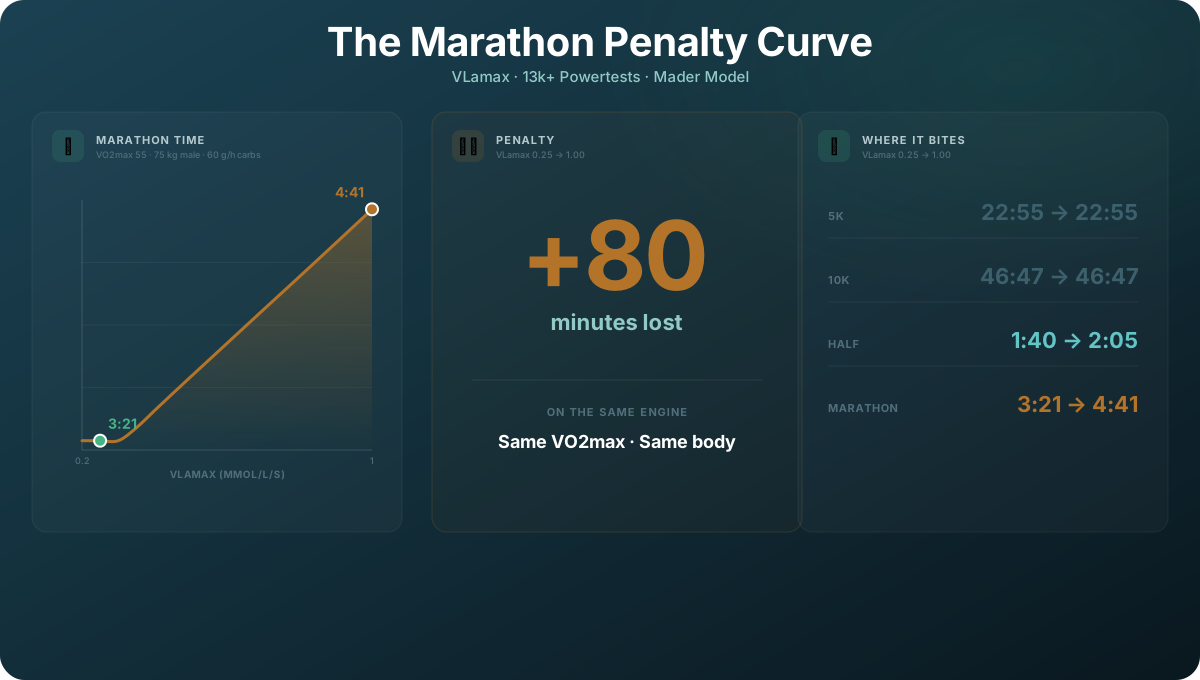
| 1.00 mmol/l/s | 22:55 min | 46:47 min | 2:05 h | 4:41 h |
Mader-model simulation, 75 kg male, VO2max 55 ml/min/kg, 15 % body fat, 60 g/h race carbs. Simulated with the same engine that produces your Powertest report.
Two truths jump out of this table.
First, VLamax is invisible up to 10K. Same person, VLamax 0.25 or 1.00 — same 22:55 over 5K, same 46:47 over 10K. The reason: at race intensities for short distances, your VO2max is the binding constraint, your carb stores aren't even close to limiting, and the Mader model is honest about that. The popular claim "lower VLamax always means faster running" is wrong below the half-marathon.
Second, VLamax becomes a giant lever in the marathon. Same body, same VO2max, VLamax goes from 0.25 to 1.00 — and your marathon time slides from 3:21 to 4:41. That's an 80-minute penalty for the high-glycolytic profile. Not a fitness difference. Not a training difference. Pure metabolic style on the same engine.
The pattern is exponential. From VLamax 0.25 to 0.40 the marathon costs you 10 minutes. From 0.40 to 0.55, another 18 minutes. From 0.85 to 1.00, another 17 minutes. The further you go, the more your VLamax taxes you. This is why ultra athletes test in the 0.20–0.30 band: above that, the marathon turns into a hour-by-hour glycogen battle that math will eventually decide.
For a half-marathoner targeting sub-1:40, VLamax below 0.45 buys you the cushion. For a 5K specialist, it doesn't matter — go train your VO2max instead.
How to lower your VLamax (when you want to)
If your race is the half, marathon, or anything longer, lowering VLamax is one of the highest-leverage adaptations available. The methods are well-known: long zone-2 rides and runs, fasted long sessions, and carefully periodized depletion intervals.
The crucial detail nobody talks about: your carb intake during the workout has to be balanced to the training load, not zero. Train fully fueled, you block the fat-oxidation adaptation. Train chronically depleted, you trigger overtraining and crash your VO2max along with your VLamax.
Our system runs this math automatically. A long zone-2 ride scheduled to lower your VLamax gets paired with a specific carb prescription — usually around 0 to 30 g/h depending on the goal — designed to sit in the sweet spot where the adaptation fires but the recovery still works. Done right, VLamax drops by 0.05 to 0.10 over an 8-12 week block, with VO2max preserved. Done wrong, both numbers fall together.
That's not a trivial control problem. The brittle middle is the reason "just do more zone 2" advice often doesn't deliver the promised marathon time.
For a deeper read on the zone-2 mechanism, the dosing rules, and how to fit it into your week without losing top-end speed — see our base-training breakdown (Base Training: How to Build Your Aerobic Base the Right Way).
How to raise your VLamax (and what it costs)
For 800m runners, criterium cyclists, track sprinters — VLamax is the engine. You don't want it low. You want it high.
The training is short, sharp, and well-fueled. Maximal 10-30-second sprints with full recovery, plyometric and strength work, and high-resistance hill repeats all push glycolytic capacity up. A focused six-week sprint block typically raises VLamax by 0.05 to 0.15 points, sometimes more if you started low.
The catch: when VLamax goes up, VO2max often goes down. In our longitudinal data — athletes who've taken multiple Powertests over months and years — the two numbers track loosely with each other. Push glycolysis hard for weeks, and aerobic capacity drifts. Push the long aerobic side, and your sprint suffers. You cannot maximize both at the same time.
Periodization is the solution. Build VO2max in winter, sharpen VLamax close to your peak races, hold a balanced base in between. The exact ratio depends on the discipline — a track cyclist spends more weeks high-glycolytic than a marathoner ever should.
Why the Powertest matters
Without measurement, you're guessing. You don't know whether your VLamax is 0.30 (marathon-friendly) or 0.65 (a problem for everything beyond 5K). You don't know whether your VO2max-focused training is also accidentally raising your VLamax. You don't know whether the long zone-2 block your favorite influencer recommended is a good idea for your profile or actively wrong for it.
A single Powertest gives you both numbers. Six to eight weeks later, you retest and see whether the training did what it was supposed to do. That's the cadence that turns periodization from theory into a feedback loop.
Your next step
Know your VO2max. Now know your VLamax. Most athletes spend years optimizing one half of the metabolic equation while ignoring the other — and never figure out why their marathons stall, why their 800m won't drop, or why "more easy miles" stopped working.
The first Powertest costs you one hour and gives you the missing number. The second tells you whether your training is moving you in the right direction. After that, the system you train inside should be doing the periodization math for you.
Start your free trial on A Faster You → — science-based plans that track both VO2max and VLamax in real time and adjust the focus across your race calendar.
One more thing — the cycling trade-off
There's a flip side to this education-first article. If you're a road cyclist or criterium racer, the same VLamax number plays a completely different game — climbing your way through Gran Fondo wattage versus covering attacks in a crit are almost opposite metabolic problems on the same physiology.
We've written that one too. VLamax vs VO2max: The Second Number Behind Every Race → breaks down the cycling archetypes, the FTP-versus-attack-power trade-off, and the 1-minute power swing of 255 watts that VLamax buys you.
Read this article first to know what VLamax is. Read that one to know what to do with it on the bike.
FAQ
What does VLamax measure exactly? VLamax is your maximum lactate production rate, expressed in millimoles per liter per second (mmol/l/s). It captures how fast your muscle cells can produce lactate via glycolysis when you push at maximum effort. In plain terms: how aggressively you can burn sugar without oxygen. It is not a measure of your endurance — that's VO2max — but of the kinetics of your fuel-burning when speed matters.
What is a normal VLamax value? Across 13,000+ measured Powertests on our platform, the cycling median is 0.51 mmol/l/s and the running median is 0.35 mmol/l/s. Endurance-focused athletes typically test between 0.20 and 0.40. Balanced all-rounders sit between 0.40 and 0.55. Sprint-trained athletes — track cyclists, 400/800m runners — test between 0.55 and 1.00 or higher. The "right" value depends entirely on the distance you race.
How is VLamax different from lactate threshold? Lactate threshold is a derived intensity — the power or pace at which blood lactate begins accumulating faster than you can clear it. VLamax is the underlying maximum rate at which your muscle cells produce lactate at all-out effort. Threshold is the balance point between production (driven by VLamax) and clearance (driven by VO2max). VLamax is one of the levers that decides where threshold falls; threshold is the result, not the cause.
Can my Garmin or Apple Watch measure VLamax? No. VLamax requires a maximal sprint and either lactate sampling or a Mader-model interpretation of power-and-time-trial data. Consumer watches don't sample lactate, don't run the Mader equations, and don't ask you for the all-out 15-second effort the model needs. Your watch's VO2max is a heart-rate-and-pace estimate; VLamax cannot be derived from that data alone. The Powertest protocol — used in labs and now portable to your normal training setup — is the standard.
Does VLamax matter for 5K and 10K runners? Less than the internet would have you believe. In our Mader-model simulation at fixed VO2max 55, your 5K and 10K times are essentially unaffected by VLamax across the entire 0.25 to 1.00 range. At those distances VO2max is the binding constraint and your carb stores aren't close to running out. VLamax becomes a serious lever from the half-marathon onward, and a giant one in the marathon.
Is lower VLamax always better for endurance? For long-distance running and cycling — half-marathon, marathon, ultra, gran fondo — yes, broadly speaking. Lower VLamax means slower glycogen burn, longer fueling window, less risk of bonking. But "lower" has a floor: VLamax below about 0.20 starts costing you sprint capacity, race-finish kick, and even VO2max if you crash it through chronic carb restriction. The Mader model defines the practical floor at 0.20–0.25 for elite endurance athletes; below that, the body can't sustain even moderate accelerations.
Can I train both VO2max and VLamax at the same time? Not in the same block, no. In our longitudinal Powertest data, athletes who push glycolysis hard often see VO2max drift down, and vice versa. The numbers track each other loosely — and the body can only run one adaptation at a time. The fix is periodization: a VO2max block in the off-season, a VLamax-shaping block close to the race, and a balanced base between them. That's the science behind why the same training plan won't take you to peak in both a 5K and a 100-miler.
How do I know if my VLamax is hurting my marathon? Two signs. First, your half-marathon-to-marathon time-ratio is worse than 2.1 (most healthy endurance runners hit 2.1 or under). Second, you bonk between km 28 and 35 despite race-pace fueling. Both point at glycogen running out faster than your aerobic engine can compensate — a high-VLamax fingerprint. The fix is a structured zone-2 block with carb-anchored periodization, retested with a Powertest after 8-12 weeks.
Based on the metabolic model by Prof. Alois Mader (Mader, 2003; Mader & Heck, 1986), European Journal of Applied Physiology and International Journal of Sports Medicine. Cohort statistics from 13,282 valid Powertests on the A Faster You platform (cycling n = 11,666; running n = 1,616), aggregated 2026. Race-time predictions generated with the powerTEST Mader simulation engine (v1.6.6). VLamax periodization mechanisms: review in Maunder et al. (2021), Journal of Sports Science & Medicine.