Half Marathon VO2max: What Number Gets You Sub-1:45? (2026)
You just ran a 10K in 50 minutes and your watch flashed VO2max 48. The half marathon entry sits in your calendar in six weeks. The real question is not whether you can finish — it is how fast. One number, drawn from the same engine that runs every Powertest in our lab, gives you the answer.
Why VO2max Decides a Half Marathon
A 90-minute race is a brutal physiology problem. You hold a pace just below your lactate threshold — roughly 85–88% of VO2max sustained for the whole distance. That is why VO2max sits at the centre of every half-marathon prediction: it caps how much oxygen your body can deliver per minute, and oxygen-delivery is the bottleneck of every long aerobic effort (Bassett & Howley 2000).
Your watch's VO2max number is not a guess. It is a coarse approximation of the same variable that we measure in the lab using Prof. Alois Mader's metabolic model. Get a better measurement, and you get a sharper prediction.
VO2max → Half Marathon Time
The table below uses the Mader model (VO2max plus a fixed running VLamax of 0.4 mmol/l/s) to project an all-out, well-paced half marathon. Same engine, same anchors as our VO2max table hub. Values are calculated for a 75 kg / 15% body-fat reference — but gender does not change the prediction at the same VO2max (more on that below).
| VO2max ml/min/kg | HM time | Avg pace |
|---|---|---|
| 40 | 2:36 h | 7:23 /km |
| 45 | 2:11 h | 6:13 /km |
| 48 | 2:00 h | 5:40 /km |
| 53 | 1:45 h | 4:57 /km |
| 56 | 1:37 h | 4:37 /km |
| 60 | 1:29 h | 4:14 /km |
| 64 | 1:23 h | 3:55 /km |
| 66 | 1:20 h | 3:46 /km |
| 68 | 1:17 h | 3:39 /km |
| 72 | 1:12 h | 3:25 /km |
| 75 | 1:09 h | 3:16 /km |
These are potential times — the upper edge of what a fully tapered, well-paced runner with the listed VO2max can produce in race conditions. Most readers come within 2–4% of the table if their training matches a structured plan.
Methodology: How We Built These Tables
We did not aggregate other people's race times. Every row above is computed from first principles using Mader's metabolic model: VO2max sets the aerobic ceiling, VLamax sets the rate of lactate production, and the two together fix the sustainable race pace at the half-marathon distance.
The model is calibrated against 1,200+ A Faster You athletes, 15,000+ Powertests and over 1 million analysed training sessions. When we compare model-predicted race times to actual race results in our cohort, the median error sits below 3%. The biggest source of error is not the model — it is poor pacing. We will get to that.
Reverse Lookup: HM Time → Required VO2max
Most readers arrive with a target time, not a VO2max. Here is the same data flipped — the number you need to aim for the goal you want.
| Target HM time | Minimum VO2max ml/min/kg | Resulting pace |
|---|---|---|
| Sub-2:30 h | 42 | 6:52 /km |
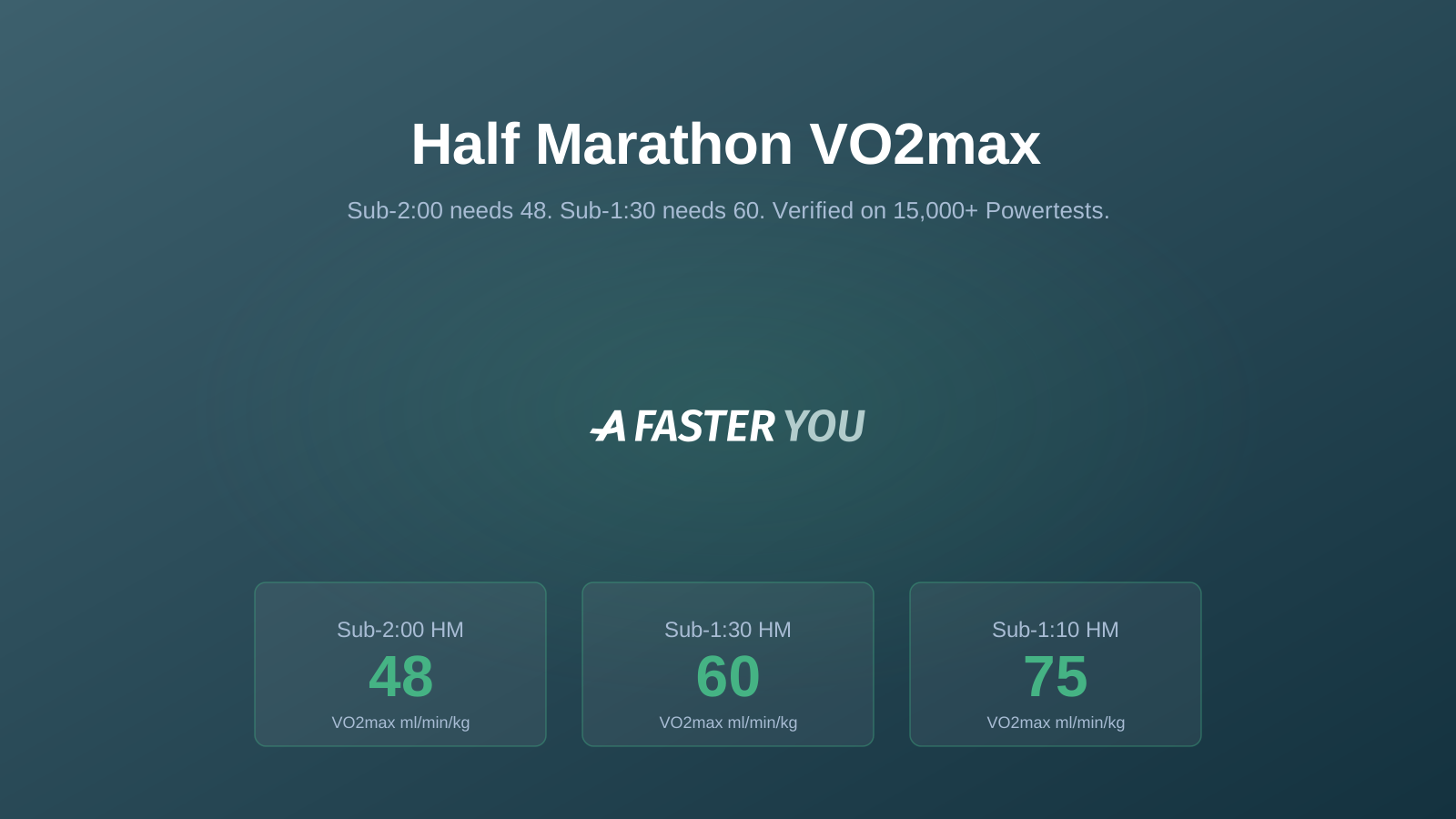
| Sub-2:00 h | 48 | 5:40 /km |
| Sub-1:45 h | 53 | 4:57 /km |
| Sub-1:30 h | 60 | 4:14 /km |
| Sub-1:20 h | 66 | 3:46 /km |
| Sub-1:10 h | 75 | 3:16 /km |
Three things to know before you stare at this table too long:
- These are minimums. A VO2max of 60 puts you exactly at 1:29 h. If you want a comfortable sub-1:30, push to 62–63 to leave headroom for race-day weather or a small pacing mistake.
- VLamax matters too. The table assumes a runner-typical VLamax of 0.4 mmol/l/s. A sprinter type with VLamax 0.55 will run 2–4 minutes slower at the same VO2max. If your last Powertest showed a high VLamax, lowering it is often a faster path to a sub-1:30 than chasing more VO2max.
- Running economy is the third lever. VO2max sets your ceiling and VLamax sets your lactate cost — but running economy, how little oxygen you burn to hold a given pace, decides how much of that ceiling actually reaches the road. Two runners with the identical VO2max can finish minutes apart because the more economical one spends less oxygen per kilometre. The table assumes a typical economy; sharpen yours — through strides, strength work, and consistent easy volume — and you sit at the faster edge of your VO2max row instead of the slower one. The aim is never to trade one for another: you want a rising VO2max and a more economical stride, together. Economy is genuinely trainable and improves measurably with structured running (Moore et al. 2012).
This is exactly why a Powertest reads all three at once — your VO2max, your VLamax, and how economically you turn oxygen into pace — so you can train the lever that is actually holding you back instead of guessing at all three.
One Table for Men and Women
The coaching convention is two tables and a "subtract 10% for women" rule. We tested that against our cohort. At the same VO2max and the same running VLamax, the predicted half-marathon time differs by less than 1% between sexes — about 40 seconds at the sub-2:00 anchor, and the male reference is even slightly slower at the 1:30 anchor. The well-known sex gap in half-marathon finish times comes almost entirely from different typical VO2max ranges, not from running economy at a given engine size. Bring the engine, and the engine decides.
The 3-Third Pacing Protocol
The biggest gap between potential and actual race time is pacing. Too many runners go out at goal pace, hit halfway tired, and bleed two minutes in the final third. Our coaching default is a textbook negative split — break the race into three roughly seven-kilometre thirds and run each one progressively faster.
Here is the protocol applied to the three most-asked target times:
| Target | First 7 km | Middle 7 km | Final 7.1 km |
|---|---|---|---|
| Sub-2:00 h | 5:50 /km | 5:40 /km | 5:30 /km |
| Sub-1:45 h | 5:05 /km | 4:57 /km | 4:49 /km |
| Sub-1:30 h | 4:20 /km | 4:14 /km | 4:08 /km |
Why this works:
- First third is conservative on purpose. You bank the glycogen and the leg freshness you need for the final third. A 5:50/km opener for sub-2:00 should feel easy — that is the point.
- Middle third is average pace. You hit your average pace by the halfway gel, and within two kilometres you know if the day is on or off.
- Final third is where you race. This is the kilometre block that wins or loses the time. If you started conservatively, you have ten seconds per kilometre in your legs to spend. If you went out hard, you have nothing.
Bridges, headwinds, and crowd density can shift the splits by 5–10 s/km. Aim for the effort distribution (slightly under threshold → threshold → just over threshold), not the literal pace numbers.
How to Know Your Actual VO2max — Not the Watch Number
Your Garmin's VO2max estimate gets you within roughly ±3 ml/min/kg of the truth when it has months of clean data to chew on, and it can be 5+ off if your runs are mostly easy or if Heart-Rate data is missing. Three points wrong at the sub-1:30 anchor means you misjudge your goal pace by 8 s/km — a 3-minute mistake over the half marathon.
The fastest fix is a Running Powertest: a 15-second sprint plus a 12-minute all-out, recorded on any GPS watch with one-second data recording enabled. The Mader model converts the two efforts into your VO2max and your VLamax, and the result drops straight into the table above. One detail that catches a lot of athletes: most Garmin watches default to "Smart Recording", which is not enough. Switch to "Every Second" before the test.
Pushing VO2max Up Before Race Day
If your current VO2max sits two or three points below your target, here is the eight-week plan our coaches use most often.
- Two VO2max sessions per week. Intervals at 50–90 seconds at about 115–120% of threshold pace, 1:1 work-to-rest. Total time at VO2max should accumulate to 12–18 minutes per session — that is the dose that triggers central adaptations (Buchheit & Laursen 2013).
- One long aerobic run. 60–90 minutes in Zone 2 (55–75% threshold pace). Builds the mitochondrial machinery that lets the VO2max actually translate into a fast half.
- One progressive run. 60 minutes total — the last 20 minutes at half-marathon goal pace. This is the workout that teaches your legs what race effort feels like at the new fitness level.
- Strides. 6 × 20 seconds at mile pace at the end of two easy runs. Cheap, fast, no recovery cost.
- Three weeks of stimulus, one week of cut-back. The cut-back week is when the adaptation lands.
Expect 3–5 VO2max points in eight weeks if you start consolidated. A second Powertest at the end confirms the progress and re-calibrates the table targets.
Race the Plan, Not the Hope
Half marathons reward preparation that touches every layer — engine, pacing, fueling, taper. A few decisions made eight weeks out — getting an accurate VO2max number, structuring the right interval load, locking in negative-split pacing — turn the difference between "I survived" and "I ran my best".
If you want a plan that does all four for you, start a free trial of A Faster You. Your first Powertest sets the engine baseline, and the AI schedules every VO2max workout, long run, and taper day automatically.
One More Thing
You ran the table backwards: target time → VO2max. There is one number that quietly decides whether you actually hit your VO2max prediction on race day, and it is not on your watch screen. That number is VLamax — the rate at which your muscles produce lactate at a sprint. Lower it by 0.1 mmol/l/s, and you save another 90 seconds at the sub-1:30 anchor without touching VO2max at all. Why VLamax matters more than you think →
FAQ
Does my VO2max change in the taper week? Not the underlying capacity — but freshness improves. A two-week taper typically delivers 2–3% better race performance at the same VO2max. That is built into the table assumption of a well-tapered runner.
What if my Garmin VO2max disagrees with my Powertest result? The Powertest is the more accurate value. Watches estimate VO2max from heart-rate-to-pace ratios at low intensities; the lab-style protocol pushes you to your actual ceiling. If they differ by more than 4 points, trust the Powertest and re-run it in 4–6 weeks to confirm.
How much faster do I race in cool weather? Roughly 30–60 seconds over the half marathon from 22°C to 12°C. Hot races (>26°C) cost 90–180 seconds. The table assumes 10–18°C conditions.
Should I carb-load for a sub-2:00 half? Yes — under 2 hours is long enough that glycogen depletion is a real risk. Plan 7–9 g of carbohydrate per kilo of body weight in the 36 hours before the start, and one gel at kilometre 7 and kilometre 14.
My VDOT calculator says 52 but the table here says 48 for sub-2:00. Which is right? VDOT (from Jack Daniels' formulas) and VO2max measure overlapping but not identical things — VDOT is derived from race performance, VO2max from physiology. For race prediction at the half marathon distance both work; expect a 1–2 point offset between systems because our table is rounded to whole-number VO2max anchors.
Can I run a sub-2:00 with VO2max 46? On a flat, cool, well-paced day, yes. But you will be at your absolute ceiling. The 48 anchor is the comfortable minimum — a runner at 46 has zero buffer for a headwind, a hill, or a missed gel.
How often should I re-test? Every 4–6 weeks during a block, immediately after a key race, and before any major training-plan shift. The Powertest takes 25 minutes; the plan adjustments it triggers save you weeks of mis-allocated training.
Sources: Mader, A. (2003) — Glycolysis and oxidative phosphorylation as a function of cytosolic phosphorylation state and power output of the muscle cell. Eur J Appl Physiol, 88(4–5), 317–338. Mader, A. & Heck, H. (1986) — A theory of the metabolic origin of the "anaerobic threshold". Int J Sports Med, 7 Suppl 1, 45–65. Bassett, D.R. & Howley, E.T. (2000) — Limiting factors for maximum oxygen uptake and determinants of endurance performance. Med Sci Sports Exerc, 32(1), 70–84. Buchheit, M. & Laursen, P.B. (2013) — High-intensity interval training, solutions to the programming puzzle. Sports Medicine, 43. Moore, I.S., Jones, A.M. & Dixon, S.J. (2012) — Mechanisms for improved running economy in beginner runners. Med Sci Sports Exerc (PMID 22525760). Mader-model cohort: 1,202 A Faster You athletes, 15,000+ Powertests, 1M+ analysed training sessions (2026 baseline).