Your Test Road Decides Your Aero Numbers
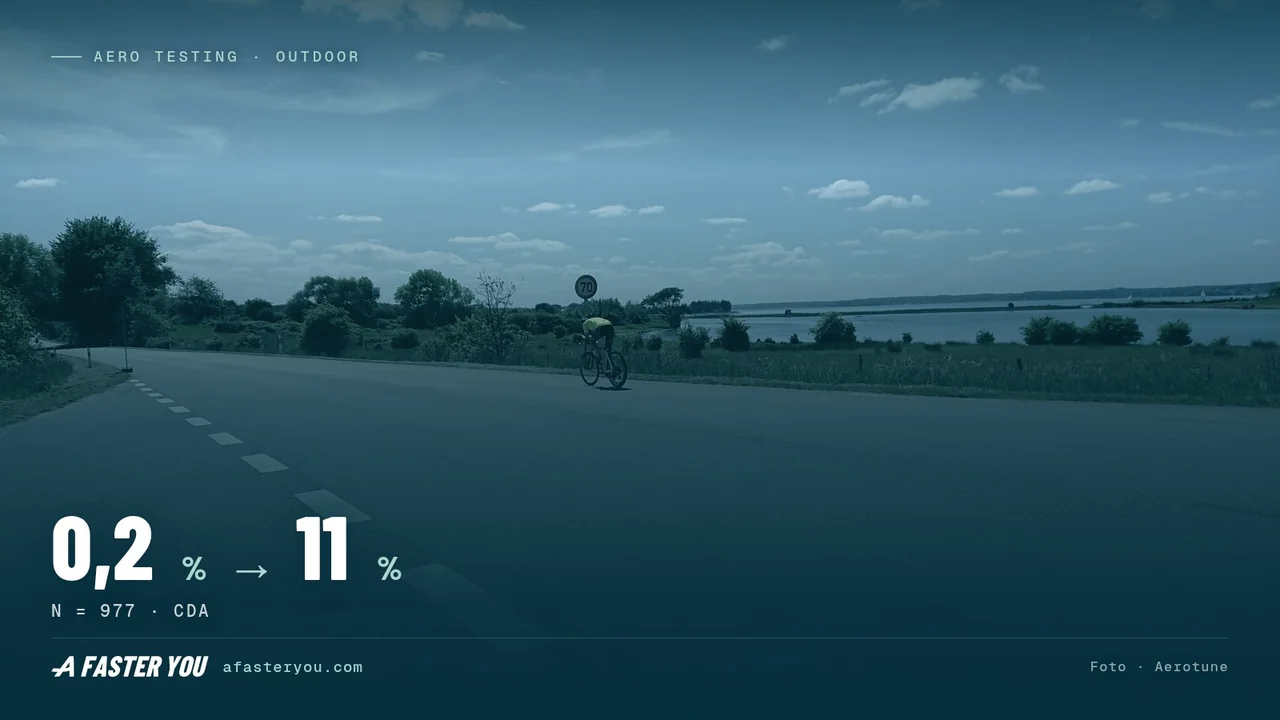
You ran the same skinsuit, the same power, the same protocol — just on a different road — and the scatter tripled. Outdoors, the single biggest thing standing between you and a trustworthy aero number isn't your kit or your legs. It's the stretch of tarmac you chose. Across our platform, the same out-and-back method ranges from wind-tunnel-clean on the best roads to essentially unusable on the worst — a more than twentyfold difference in measurement noise, driven by the road alone.
New to how we measure "resolution"? Start with How Fast Must You Ride to Measure an Aero Gain? — this piece is the outdoor companion.
The finding: the road is the biggest variable
We looked at 8,566 out-and-back setups across 977 test roads. For each road we measured the run-to-run scatter of CdA — the pure repeatability of the method there. Ranked from cleanest to noisiest:
| Roads, by measurement scatter | Typical CdA scatter (CoV) |
|---|---|
| The cleanest 10 % of roads | 0.9 % or better |
| The median road | 1.8 % |
| The noisiest 10 % of roads | 3.0 % or worse |
| Best individual road | 0.2 % (a single outlier) |
| Worst individual road | 11 % (unusable) |
Same physics engine, same kind of riders. The spread is the road.
On a clean road you resolve a real aero change of a couple of watts. On a noisy one, a 10-watt helmet difference vanishes into the run-to-run wobble — you'd walk away thinking "no difference" when there was one. The road didn't just add noise; it hid your result.
The road sets the ceiling — but it isn't the only thing. On top of it, the same factors that matter indoors still move your number: how steadily you hold power, how carefully you build each setup, and the power meter you use. Two riders on the same road can still land apart. So the order is: pick a good road first, then test cleanly on it. Get both right and the best outdoor sessions rival the velodrome; get either wrong and even big kit changes disappear.
Why the road matters so much
The out-and-back method — the road version of Robert Chung's "virtual elevation" approach — is honest by design: ride a stretch one way, ride it back, and the systematic effects of wind and gradient are supposed to cancel between the two directions. They cancel only if the road lets them.
- Wind that shifts or gusts hits the out and the back legs unequally. What should cancel doesn't — and the leftover shows up as CdA scatter.
- Gradient and surface changes along the stretch break the out/back symmetry the method leans on.
- Traffic, junctions and corners force micro-accelerations that the model reads as drag noise.
A flat, straight, sheltered, quiet, smooth road lets the physics do its job. A rolling, exposed, busy one fights it the whole way. Our cleanest roads are exactly the ones you'd guess — long, flat, wind-sheltered stretches with almost no traffic. The noisiest are hilly, crosswind-exposed or interrupted. (Our route metadata is too thin to fit a gradient coefficient, but the physics — and the ranking — are unambiguous.)
What the wind actually does
Most riders picture wind as pure chaos — impossible to describe, so impossible to test in. It isn't. The wind-energy literature models a wind signal as four parts: a steady base, the fine turbulence around it, and — now and then — two discrete events, a gust (a smooth surge) and a ramp (a slower build) (Attya & Hartkopf, 2011). It's the same four-part model we simulate the wind from when we train our aero engine, turbulence and all (Shinozuka & Jan, 1972).
The out-and-back is built to erase the first two. A steady base helps you one way and hinders you the other; over the round trip it nets out. The turbulence averages away over enough distance. Picture a sailboat — or your own bike at 40 km/h: both carry enough momentum that they aren't thrown around by every small fluctuation. The base and the turbulence are the part the method removes by design.
The gusts and ramps are what it can't remove. They arrive sporadically, hit your out and back legs unequally, and nothing about them is symmetric enough to cancel. They are the real source of scatter — and they almost always travel along the prevailing wind direction.
That's the lever. Put the wind on your side — a road that runs across the prevailing direction, or one sheltered by buildings or a tree line — and the gusts and ramps stop landing along your direction of travel. Your out-and-back tightens dramatically. It's the same reason the platform scores your roads before you ride them: a good road is simply one the prevailing wind never gets a clean run at.
Methodology: how we built this
For each road we pool the run-to-run deviations of every setup measured there (each setup centred on its own mean, so rider and position differences drop out) and express the residual scatter as a CoV of CdA. That isolates one thing: how consistently the road returns the same answer. Out-and-back setups typically have just a couple of runs, so pooling across a road's setups is what gives a stable read — and the per-road spread above is scored only on the 223 roads with enough repeat sessions (at least 8 setups each). Every figure comes straight from stored test data — 13,000+ outdoor sessions since 2018; this analysis uses 8,566 setups across 977 roads. As of August 2026.
Speed still helps — but only so far
Riding faster sharpens outdoor tests too, for the same reason it does indoors: aerodynamics is a bigger share of the power at speed.
| Test speed | CdA scatter (CoV) |
|---|---|
| under 35 km/h | 4.0 % |
| 35–40 km/h | 2.7 % |
| 40–45 km/h | 2.1 % |
| 45–50 km/h | 2.2 % |
| over 50 km/h | 1.9 % |
But notice it flattens out around 2 % above 40 km/h. Indoors, resolution keeps improving with speed toward 1.3 %. Outdoors it hits a floor — because past a certain point the road, not the speed, is what's limiting you. You cannot out-ride a bad road.
Indoor vs outdoor, honestly
The velodrome is the sharper instrument: a clean indoor session resolves to 1.3–1.6 % and holds it — in the same 1–2 % band independent wind-tunnel work reports (García-López et al., 2008). Outdoors, the best roads reach that same level, and the very cleanest even beat it — the single best road we've measured sits near 0.2 %, an outlier. That the method can hit wind-tunnel-class outdoors at all is proof it's sound. But the typical road sits near 2 %, and outdoor velodromes (open to the sky and wind) are noisiest of all at 3.9 %. Outdoor testing isn't worse testing; it's testing whose ceiling is set by where you do it.
And that ceiling can sit above the track's median. One flat, sheltered out-and-back on our platform — a stretch of Munich's Olympic Regatta course — resolves to 1.4 %, sharper than our velodrome median of 1.6 %. Ridden in the dead-calm of early morning, a road like that returns data most riders can't get anywhere else, on their own equipment. It even sidesteps the track's one structural trade-off: on a velodrome the corners, the cornering speed, and a centre of mass that traces a tighter line than the wheels the speed is read from all add a little error a straight road simply doesn't carry. None of that makes the velodrome the wrong call — it's still the only place you can test on any day, in any weather, without waiting for a wind window. But find a genuinely great road, ride it when the air is still, and outdoors can match the track.
How to pick a test road that tells the truth
- Flat and straight. Every metre of gradient or bend is noise the method has to fight. Long, level, straight wins.
- Sheltered, and test in a calm window. Wind is the number-one enemy. Tree lines, cuttings, early mornings.
- Quiet. No traffic, no junctions, no stop-starts — clean, uninterrupted runs.
- Smooth surface. Rough tarmac adds both rolling noise and buffeting.
- Long enough for steady runs, and keep conditions equal out and back. Bracket kit changes with a repeated baseline so you can see the road's own noise floor before you trust a delta.
Find a road that scores well once, and reuse it. A good test road is an asset.
Beyond the road: the setup that lets it deliver
- Keep two or three roads on file, in different orientations — a north–south, an east–west, one on the diagonal. Check the wind forecast, then ride the one that puts the wind on your side. Most days you can see the right choice before you leave the house.
- Run standard wheels for position tests — not deep-section or disc. In a crosswind an aero wheel sails, and it sails harder in some gusts than others; that variable side-force lands straight in your CdA as noise. Isolate the position change with shallow box-section wheels.
- Beware the funnel. Shelter is gold — but a gap that channels wind (a forest ride, a cutting between hills) accelerates it into exactly the sporadic ramps you're trying to avoid.
- Fix your equipment and keep it fixed. A flapping jacket is sporadic drag you can't test through; a single-sided power meter or a missing speed sensor each cost you resolution. Same bike, same sensors, every session.
Test it yourself
Every out-and-back session you fit on afasteryou.com reports its own measurement error, so you can see immediately whether your road — and your run — cleared the noise. Start a free trial →
FAQ
Why is my outdoor CdA noisier than a friend's, with the same kit? Most likely the road. The same method ranges from 0.2 % to 11 % scatter across roads on our platform. Wind, gradient and traffic on your stretch are probably the difference — not your equipment.
Can I just ride faster to fix a noisy road? Only partly. Speed helps down to about 2 %, then it flattens — above 40 km/h the road, not your speed, sets the floor. A better road beats a faster run.
Is outdoor testing unreliable, then? No — the best outdoor roads reach velodrome-class precision. Outdoor testing is only as good as the road; choose well and it's excellent.
What makes a road "clean"? Flat, straight, sheltered from wind, low traffic, smooth surface — and a calm-weather window. Those let the out-and-back symmetry actually cancel wind and slope.
Besides the road, what else moves my number? The same things that matter on the track: how steadily you hold power, how carefully you set up, and your power meter. The road sets the ceiling; those decide where under it you land.
How much data is this based on? 13,000+ outdoor out-and-back sessions since 2018; this analysis pools 8,566 setups across 977 distinct test roads. As of August 2026.
Aerodynamic power model: P = ½·ρ·CdA·v³. Road-level and speed-level measurement scatter computed from stored per-lap test data (pooled within-setup residuals), August 2026. Independent repeatability benchmark: García-López et al. (2008), J Sports Sci 26(3):277–286 (wind tunnel, CoV < 2 %). Wind model (steady base + turbulence + gust + ramp): Attya & Hartkopf (2011), EPQU; turbulence synthesised after Shinozuka & Jan (1972), J Sound Vib 25(1):111–128. Roads are anonymized; all figures are platform-anonymous aggregates.