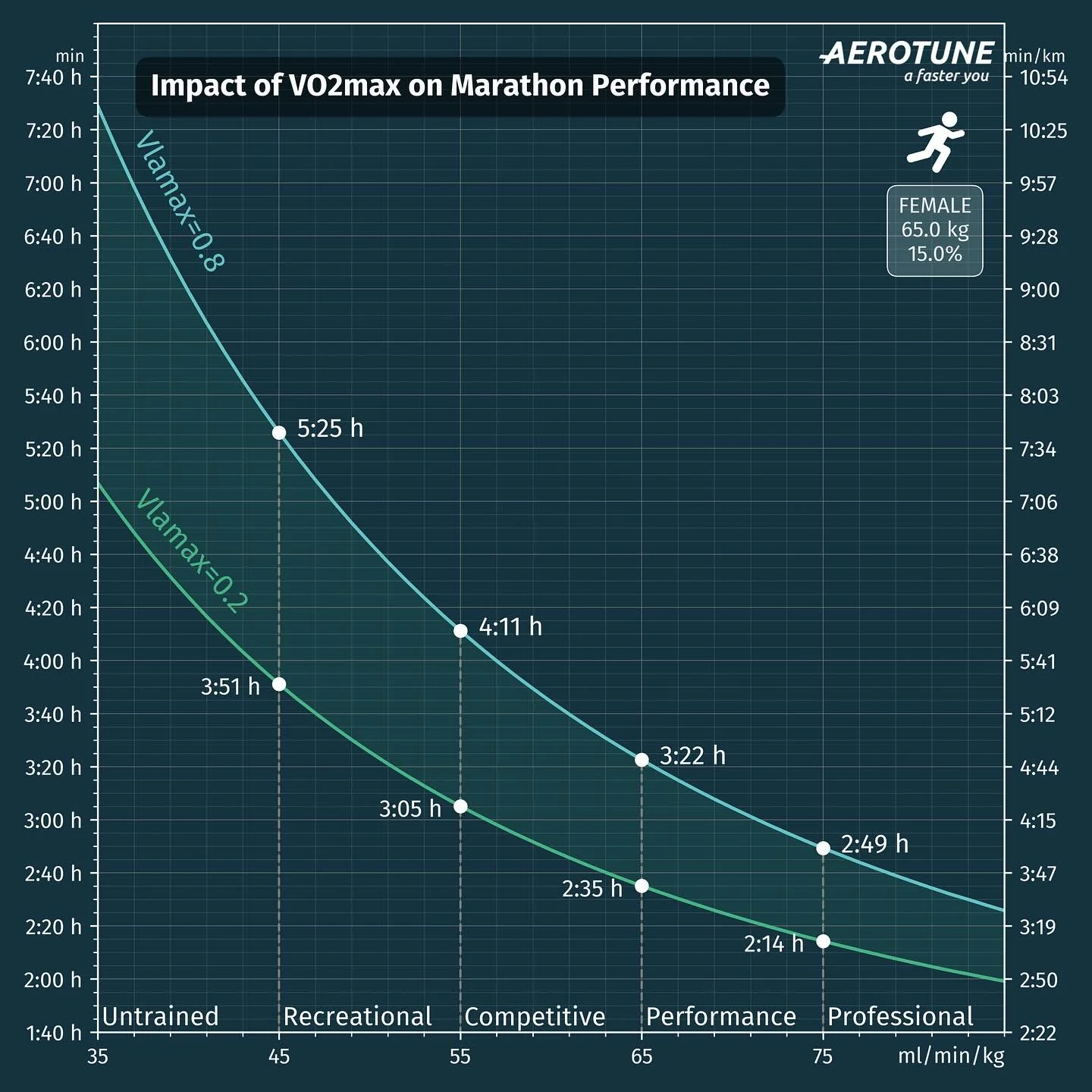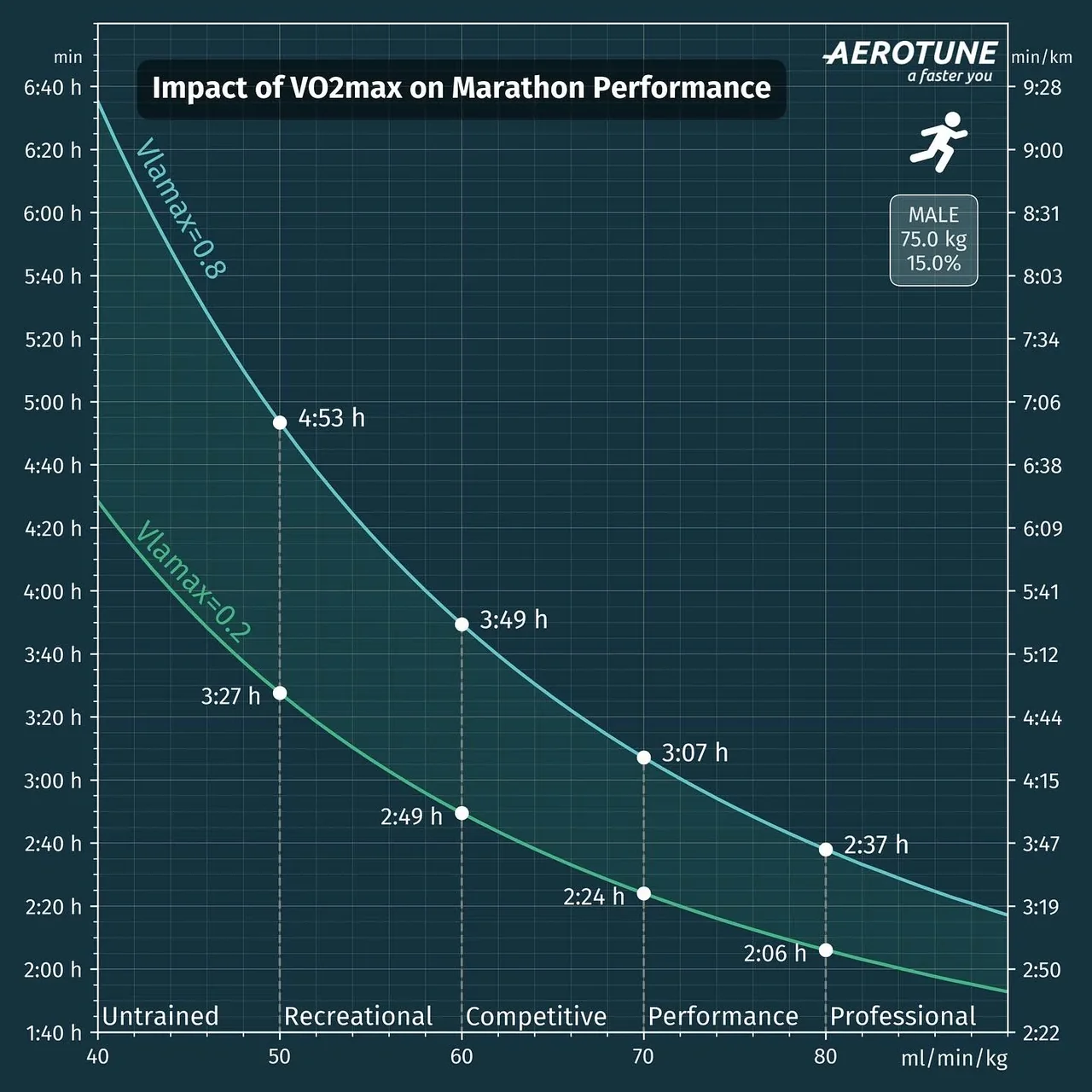
Marathon VO2max Guide: Sub-3, Sub-4, Sub-5 — What You Actually Need
Forty-two kilometers. Three, maybe four, maybe five hours on your feet. The marathon is the purest endurance distance there is — and it punishes every weakness you bring to the start line. One number decides more about your finish time than any other: VO2max. Everything else — pacing, fueling, intervals — orbits around it.
Why the marathon is VO2max's fuel test
VO2max measures how much oxygen your body can use at maximum effort, expressed in ml/min/kg. It's the ceiling on sustainable pace.
On the half marathon, a trained runner holds 85–90% of VO2max across the entire distance. On the marathon — the distance is too long for that. You sustain roughly 75–80% of VO2max across forty-two kilometers. That sounds less dominant, but it's not. The absolute pace your body can sustain is still anchored to your VO2max ceiling. A runner with VO2max 60 running at 78% of max moves a lot more mass a lot faster than a runner at VO2max 50 doing the same thing.
What changes at the marathon is the second constraint: fuel. On the half, you don't run out of glycogen. On the marathon, you can — and the interaction of VO2max with fuel economy is where races are won and lost. More on that below.
On our platform, we've measured VO2max on 1,000+ athletes, drawing on 1 million+ training sessions, so the benchmarks that follow aren't theoretical. They're cohort-validated against the Mader metabolic model.
Marathon VO2max benchmarks — by goal time
Finish times calculated with the Mader metabolic model at typical trained-athlete parameters (15% body fat, well-paced execution, proper in-race fueling). The VO2max column shows the minimum required to break each goal time.
| Goal time | Min. VO2max (ml/min/kg) | Goal pace (min/km) | Athlete profile |
|---|---|---|---|
| Sub-5:00 h | 42 | 7:07 | First-time finisher |
| Sub-4:00 h | 50 | 5:41 | Recreational, 3 runs/week |
| Sub-3:30 h | 56 | 4:58 | Consistent hobby runner |
| Sub-3:00 h | 63 | 4:16 | Serious age-grouper |
| Sub-2:45 h | 68 | 3:54 | Competitive age-grouper |
| Sub-2:30 h | 74 | 3:33 | National-class |
| Sub-2:15 h | 82 | 3:12 | Elite |
A note on men vs. women. At the same body composition, men (~75 kg) and women (~65 kg) run almost the same marathon time at identical VO2max — the Mader model and our cohort data both confirm this. The visible gender gap in race times comes from different typical VO2max ranges, not different running economy. Trained male marathoners typically test in the 50–65 band; trained female marathoners 45–58. A woman at VO2max 60 runs close to the same marathon time as a man at VO2max 60.
Read carefully: Sub-3 is not VO2max 60. It's 63. The difference between 60 and 63 is 10 minutes on the marathon clock. A lot of training plans miss this — the ceiling for sub-3 is stricter than most sources admit.
VO2max chart by age and gender →
Reverse lookup — what's my marathon time for a given VO2max?
If you already know your VO2max (from a Powertest, lab spirometry, or GPS-watch estimate), here's the reverse map.
| Your VO2max | Predicted marathon time | Avg pace (min/km) |
|---|---|---|
| 40 | 5:14 | 7:26 |
| 45 | 4:31 | 6:25 |
| 48 | 4:10 | 5:55 |
| 50 | 3:57 | 5:37 |
| 53 | 3:41 | 5:14 |
| 55 | 3:31 | 4:58 |
| 58 | 3:16 | 4:38 |
| 60 | 3:10 | 4:30 |
| 63 | 2:59 | 4:14 |
| 65 | 2:53 | 4:05 |
| 68 | 2:44 | 3:53 |
| 70 | 2:39 | 3:45 |
| 75 | 2:27 | 3:28 |
Values assume proper marathon fueling (see below). Poor pacing costs 10–20 minutes against these targets. Bonking from glycogen depletion costs 30+ minutes.
The 30K wall — where VO2max meets fuel
Between kilometer 30 and 35, something happens that most runners blame on their legs. It's not their legs. It's their glycogen.
Your body stores roughly 500–600 g of carbohydrate — about 2,000 kcal. At marathon pace, you burn 60–80 g per hour of that. Do the math. Three and a half, four hours in, you've either topped up during the race or you've emptied the tank. An empty tank means pace collapses, because your body switches to fat oxidation — which produces ATP fine, but much slower.
The fix is mechanical, not mental:
Carb-loading the two days before (36–48 h out)
The research here is settled. Trained athletes store measurably more muscle glycogen after 36–48 hours of high-carb intake at 7–9 g per kg of bodyweight per day (Burke et al., 2011; Hearris et al., 2018). For a 75 kg runner: 525–675 g carbs per day for two days. That's not hard to eat if you plan for it — but most runners undereat carbs and wonder why they bonk.
In-race fueling — 60–90 g per hour
Real data from trained athletes on our platform and in published studies converges on this range. Sub-3:30 runners typically target 60–70 g/h, sub-3 runners 80–90 g/h, elites push to 100+. That's gels, drinks, or solid food every 20–25 minutes from kilometer 5 onward. Don't start fueling at km 20 — by then you're already behind.
Train your gut
The single biggest reason athletes fail at race fueling is untrained GI tolerance. Practice race fueling in long runs for 8+ weeks before the marathon. If your long run sits at 40 g/h because more upsets your stomach, you can't magically go to 80 g/h on race day.
You train VO2max for months. Don't let fueling throw it away in the last ten kilometers.
How to pace sub-3, sub-4, and sub-5 — the three-third rule
Marathon pacing is not half-marathon pacing stretched. The physiology shifts across the distance: glycogen depletes, core temperature rises, neuromuscular fatigue accumulates, and VO2 drift pushes your oxygen cost up 5–7% at the same pace by the final third.
The rule: run the first third 10 seconds per kilometer slower than goal pace (not 5 like the half — the penalty for going out hot is bigger). Run the middle third at goal pace. Earn the final third with whatever you have left.
Sub-3 example (4:16/km avg): - km 0–14: 4:26/km - km 14–28: 4:16/km - km 28–42.2: 4:06–4:12/km
Sub-3:30 (4:58/km): - km 0–14: 5:08/km - km 14–28: 4:58/km - km 28–42.2: 4:48–4:55/km
Sub-4 (5:41/km): - km 0–14: 5:51/km - km 14–28: 5:41/km - km 28–42.2: 5:30–5:38/km
Sub-5 (7:07/km): - km 0–14: 7:17/km - km 14–28: 7:07/km - km 28–42.2: 6:55–7:05/km
Why this works physiologically: the first 15 km are run on roughly-full glycogen and a cool core. Going 10 s/km easier here costs you 2–3 minutes against schedule, but preserves 15–20% more late-race fuel and keeps lactate below the slow-component inflection. Athletes who go out on pace from km 1 run the back half 30–60 seconds per kilometer slower than goal — a net loss of 6–12 minutes.
Boring first 10 kilometers. Committed middle. Earned finish.
Running economy — the silent third factor
VO2max is your ceiling. Your fuel-system efficiency (which we'll come back to) sets your fraction of it. But running economy — how much oxygen you burn per kilometer at a given pace — decides how far that ceiling actually takes you.
A sub-3 runner with good running economy holds 78% of VO2max at race pace. The same VO2max with poor economy holds 82% — and bonks earlier. Economy accounts for the 5–10% of marathon time that physiology alone can't explain.
Levers that improve economy: - Cadence — most recreational marathoners run at 165–170 steps/min. Target 178–182 for reduced ground contact time and less eccentric braking. - Strength training — 2×/week heavy lifting (squats, deadlifts, calf raises) systematically improves running economy in trained runners (Balsalobre-Fernández et al., 2016 meta-analysis). Not bulking, neural. - Long runs at marathon pace — last 10–15 km of your weekly long run at goal pace builds the neuromuscular pattern that shows up on race day. - Shoes — modern carbon-plated super-shoes contribute 3–4% economy improvement over traditional trainers (Hoogkamer et al., 2018). Not magic, but real.
Economy is the reason two runners with the same VO2max can finish 8 minutes apart.
How to actually raise your VO2max
Running more easy miles alone won't move VO2max. The adaptation requires time spent near your oxygen ceiling.
30/30 intervals — the stimulus
Véronique Billat's work showed that 30 seconds at VO2max pace, 30 seconds easy jog, repeated 10–20 times produces more cumulative "time at VO2max" than traditional long intervals (4 × 4 min, 5 × 3 min) with meaningfully less neuromuscular cost.
The critical factor: intensity must match your individual VO2max. A runner at VO2max 50 needs a completely different target pace than a runner at 63. Generic "5K pace" recommendations undershoot for some and overshoot for others. The A Faster You AI training plan calculates your exact interval pace from Powertest results.
Weekly structure for marathon training
- 2× VO2max sessions per week during build phase
- 1× tempo / threshold session
- 3–4× easy aerobic runs
- 1× long run progressing toward 30–35 km
Body Reserve — our 0–100 metric for accumulated training fatigue — needs to stay in 35–50 to actually adapt. Above 60, the stimulus is below the adaptation threshold. Below 35, injury risk climbs with no additional benefit. Most ambitious marathon runners dip below 35 during peak weeks and blow up in race week.
Metabolic periodization — why fixed phases are out
Classic marathon plans use fixed blocks: base → build → peak → taper. The A Faster You system uses metabolic periodization instead — continuous adjustment based on where your metabolic parameters actually sit today, not where the calendar says they should be. Far from race day: push VO2max hard. Approaching race day: shift to threshold work and fasted long runs to optimize fuel economy.
This is why generic 16-week plans miss more runners than they help. Your metabolism isn't on a calendar.
Measure your VO2max — the Powertest
Your GPS watch gives you a solid VO2max estimate without any test — ideal for following the trend. How close it gets we measured for Garmin, bike against bike: across 108 paired Powertests it lands almost exactly on the measured value for trained athletes (+1.41 points) and at the elite end (+0.21), and reads higher below that (+8.67 in untrained athletes, +2.91 on average), with a spread of 5.29 points (the full comparison). Once you set race pace on the number, precision counts: 5 points of VO2max equal 20+ minutes on the marathon.
The A Faster You Powertest gives precise VO2max and VLamax using a standardized protocol based on the Mader metabolic model. You run it from your normal training setup — no lab, no mask. How close it lands to the lab we measured on the bike: mean bias −1.8 ml/min/kg across 43 athletes with parallel spirometry (the full validation) — for running our validation is still ongoing, and we deliberately don't quote a number yet. Test at least once a year — more often is better. Between tests, AI prediction updates your VO2max from each training session.
That prediction doesn't wait for your first test: connect your watch or training account — two minutes, no protocol to run — and from then on every long run you upload feeds your VO2max curve, with the Powertest as the precision upgrade on top.
Your next step
Know the target. Train at the right intensity. Fuel the race. Pace the distance. Let the data do the coaching.
Start your free trial on A Faster You → — science-based training plans built on the Mader model, not generic pace tables.
One more thing — VLamax (the marathon twist)
Two runners with the exact same VO2max can finish a marathon 15 minutes apart. Same engine, very different race.
That's because there's a second number — VLamax — your maximum lactate production rate. And here's the marathon twist: unlike the half marathon, where a slightly higher VLamax can help, for the marathon you want VLamax low (0.25–0.35 mmol/l/s). A low VLamax means your body burns fat efficiently and spares glycogen — and it's glycogen that decides whether you run through km 35 or walk through it.
High VLamax is what hits the wall at 30K, even with a good VO2max. Periodizing both values — pushing VO2max up, guiding VLamax down as race day approaches — is what separates structured training from generic marathon plans. The A Faster You system tracks both in real time and shifts emphasis automatically based on your race calendar.
FAQ
What VO2max do I need for a sub-3 marathon? Approximately 63 ml/min/kg — for both trained men (~75 kg) and women (~65 kg) at similar body composition. Values from the Mader metabolic model, cross-checked against our 1,000+ athlete Powertest cohort.
What VO2max for sub-4 or sub-5? Sub-4 requires roughly VO2max 50. Sub-5 requires about 42. These are Mader-model minimums and match the interactive calculator on this page exactly.
Is VDOT the same as VO2max? No. VDOT is a performance-derived pseudo-VO2max developed by Jack Daniels — a number that predicts race time but doesn't measure your actual metabolic ceiling. VO2max (from a Powertest or lab spirometry) measures true oxygen utilization. VDOT is useful for pacing zones; VO2max is useful for tracking the adaptation. They often differ by 3–8 points in trained runners.
Why do I hit the wall at 30 kilometers? Glycogen depletion. Your body stores 500–600 g of carbs (~2,000 kcal). At marathon pace you burn 60–80 g/h. Without in-race fueling at 60–90 g/h plus pre-race carb-loading at 7–9 g/kg/day for 36–48 h, you run out between km 30 and 35. VO2max doesn't matter if the fuel is gone.
How much carbs should I eat the day before a marathon? 7–9 g per kg of bodyweight per day, for the 2 days before race. For a 75 kg runner: 525–675 g carbs/day. Start 48 hours out, not the night before. Research shows measurably higher glycogen stores with the 48 h window (Burke et al., 2011; Hearris et al., 2018).
Do women really need the same VO2max as men for the same marathon time? Yes — at the same body composition, the Mader model predicts nearly identical marathon times. The visible race-time gap between genders comes from different typical VO2max ranges (trained men 50–65, trained women 45–58), not different running economy.
How long does it take to improve VO2max? With consistent, properly dosed interval training (2× weekly), most runners see measurable VO2max improvements within 4–8 weeks. Untrained athletes improve faster in the first block (5–10% gains), trained athletes slower (2–5%).
Can I run a sub-3 marathon with a VO2max of 58? Very difficult. VO2max 58 predicts 3:16. You'd need exceptional running economy AND aggressive VLamax optimization to break 3:00 from that base. Realistic path: get to VO2max 62–63 first. Targeted training typically adds 3–5 points per 12-week block.
Is VO2max the only factor for marathon performance? No — VLamax, running economy, fueling, and pacing all matter. VO2max is the strongest single predictor and sets the ceiling. The other factors determine how close you get to that ceiling.
Should I do a Powertest before starting a marathon plan? Strongly recommended. A Powertest gives accurate baseline values for VO2max and VLamax, which lets the AI set your training zones precisely from day one. Without it, the system uses AI predictions from your activities — still good, but a Powertest is the gold standard.
Why does my Garmin VO2max differ from my Powertest value? Your Garmin estimates VO2max from your everyday heart rate and pace — no test, no lab — and in our 108 paired comparisons (measured on the bike) it lands almost exactly on the measured value for trained and elite athletes (the full comparison). Below that it tends to read higher. If you build zones, fuelling and a plan on the number, a Powertest measures it — and adds VLamax. Connect your Garmin account and you stop guessing which number is closer: your watch's estimate and a prediction built from your own training data sit side by side, and a Powertest later anchors both to a measured value.
Based on the metabolic model by Prof. Alois Mader (Mader, 2003; Mader & Heck, 1986), European Journal of Applied Physiology and International Journal of Sports Medicine. Carb-loading: Burke et al. (2011), J Sports Sci; Hearris et al. (2018), Nutrients 10(3):298. Interval protocols: Billat et al. (2000), Medicine & Science in Sports & Exercise; Tabata et al. (1996), Medicine & Science in Sports & Exercise. Running economy: Balsalobre-Fernández et al. (2016), J Strength Cond Res; Hoogkamer et al. (2018), Sports Med.