What "AI Training" Has to Mean in 2026 — and Six Reasons to Walk Away
It's 2026, and every training app you can download is now an "AI training platform." The plans are "AI-generated." The coaching is "AI-powered." The future is here, apparently, and it costs fifteen dollars a month.
Look closer, and in most of these apps the only artificial intelligence on board is a chatbot. It answers questions. It's friendly. It has opinions about your protein intake. And it steers your training off a number you typed into a settings screen yourself. Fifteen dollars a month for a number you guessed yourself isn't cheap — it's overpriced at any price.
We build AI for training — real neural networks, with error margins we publish — so this bothers us more than it probably should. Here is what we think the words AI training platform actually have to mean, as six tests you can run on any app in five minutes. Our advice is the same each time: if the answer is no, walk away.
1. It knows your VO2max — by testing it, and by predicting it
It's 2026. The single most important marker in endurance sport is, without serious dispute, your VO2max — the size of your aerobic engine. It predicts your race performance. And in the large cohort studies, few numbers we can measure are more strongly tied to how long you'll live.
So ask: does the platform know your VO2max? Can it compute it? Does it offer a performance test to determine it?
If a company claims AI training and cannot answer your most important number — don't believe them. To be fair: platforms built on critical power and W′ are working with something real. Measured mechanics are honestly better than a guessed FTP. But mechanics describe what your engine outputs, not what it is — it's still not the full picture.
And "knows" has a measurable meaning. The lab side of this chart is not outsourced: Björn Kafka, in his work with Clemens Hesse (Hesse/Kafka), has run hundreds of spirometry tests — and our validation cohorts go back to 2022. Athlete by athlete, lab versus Powertest:
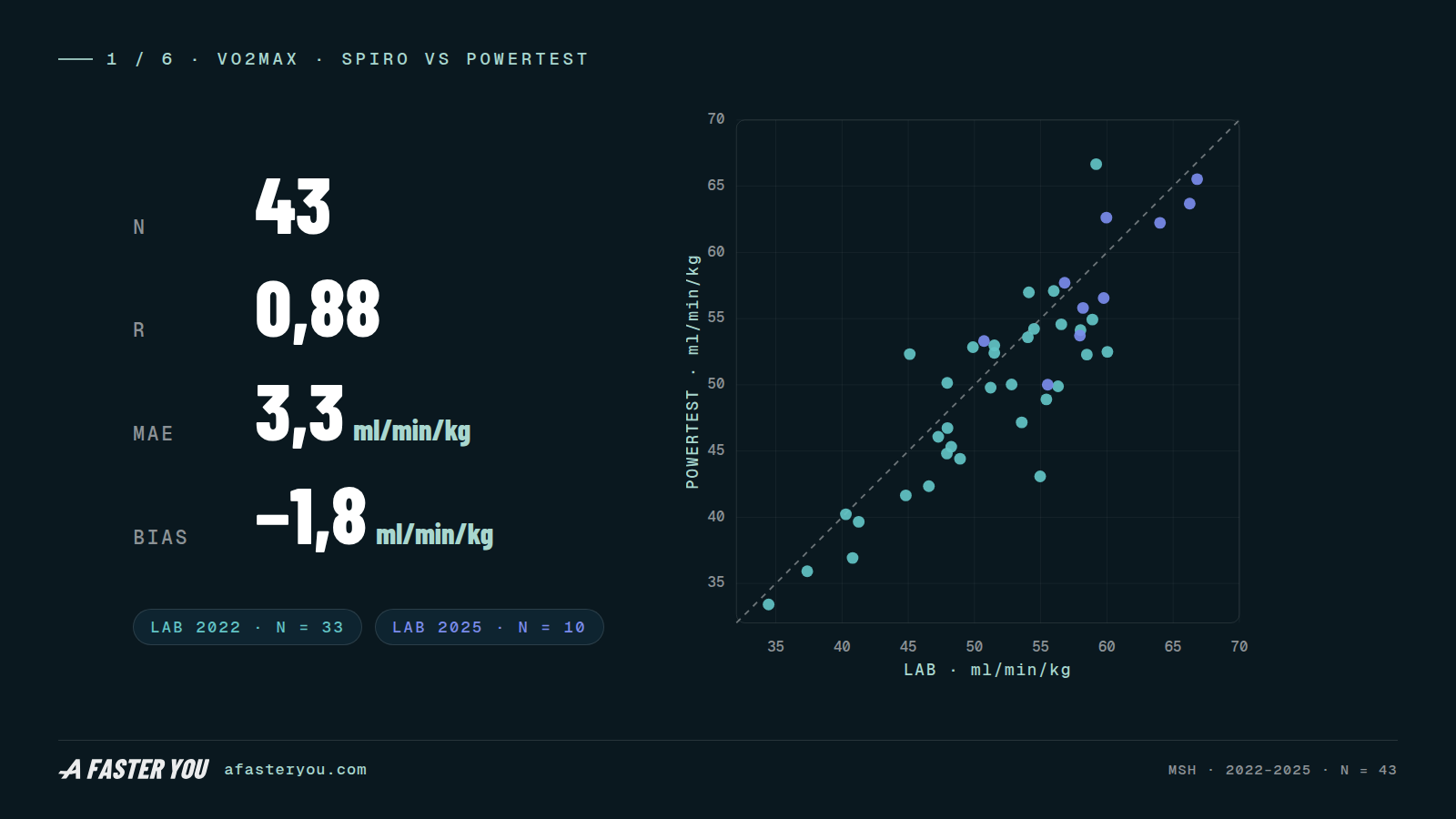
That mean miss — 3.3 ml/min/kg, about six percent — is in the range of how much a measured VO2max drifts from one lab day to the next anyway. The lab doesn't agree with itself much better than we agree with the lab.
2. It knows whether you're a diesel or a sprinter
Two athletes, same VO2max, completely different races. The variable between them is VLamax — your glycolytic power, the rate at which you produce lactate. We've written about it; few in this market have.
Here's why it matters for AI: without VLamax, you cannot steer training. Raising VO2max and lowering VLamax are competing adaptations — the intense work that builds one often feeds the other. A plan that doesn't know which engine type you are will, with full confidence, train the sprinter like a diesel and wonder why the threshold never moves (the zones say the same: same HRmax, up to 23 beats apart at threshold).
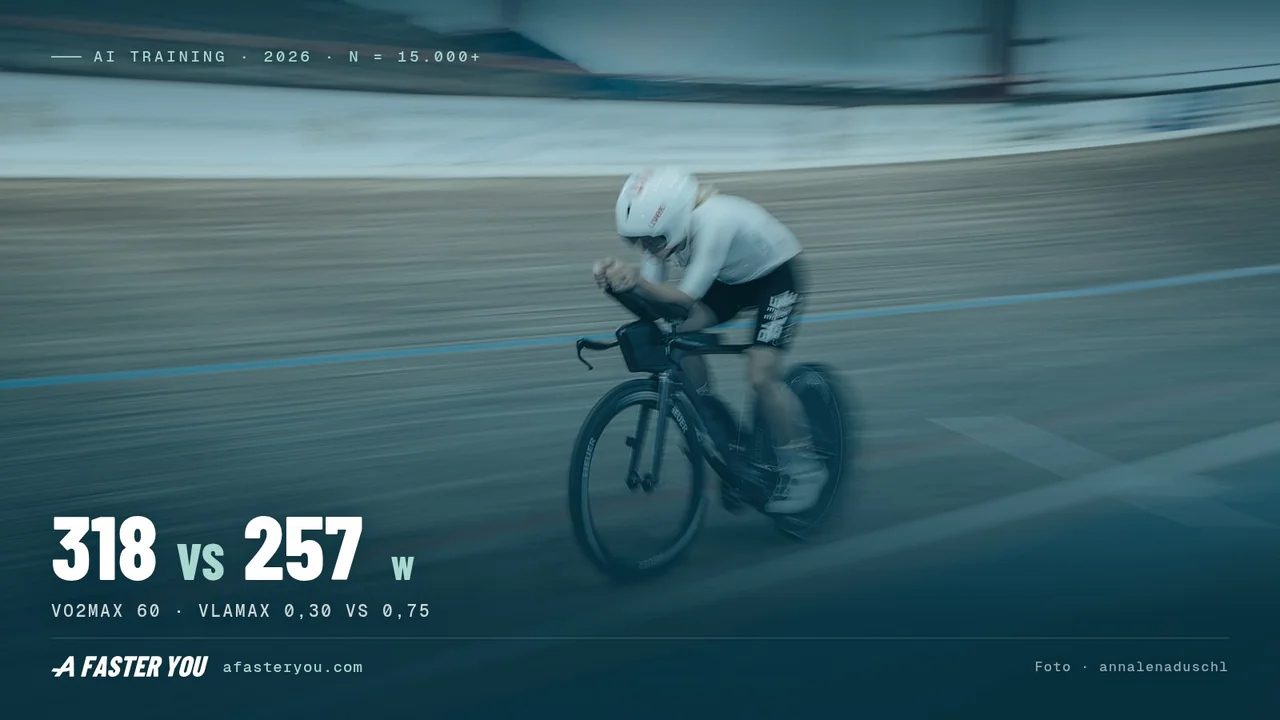
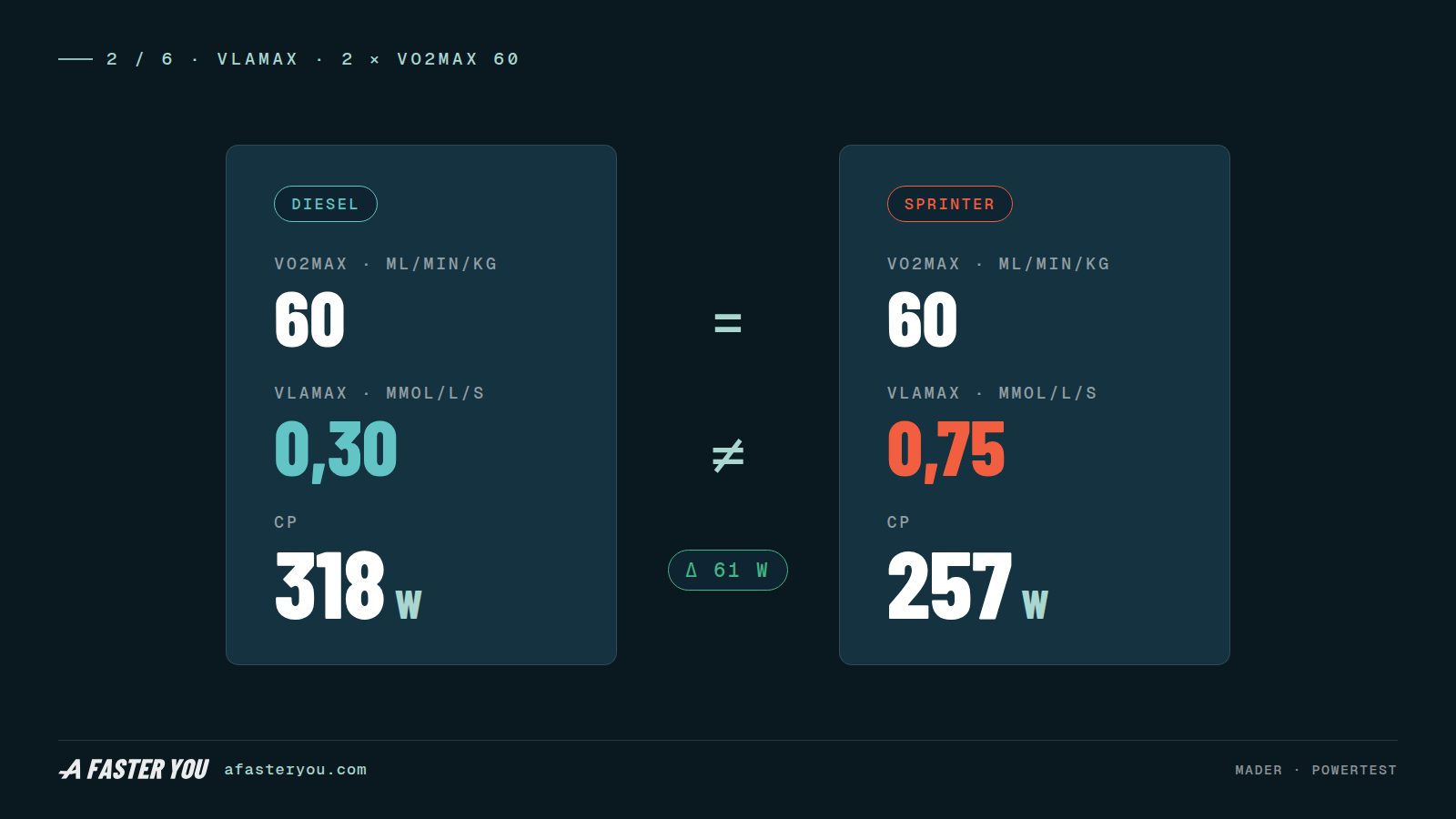
Put numbers on it with the Mader model — the same math our Powertest runs on. Two athletes, both at a VO2max of 60: one with a VLamax of 0.30, one at 0.75. Identical engine size — and their critical power sits 61 W apart, 318 versus 257 W. A plan that only sees the 60 cannot tell these two athletes apart.
Anyone claiming "AI training" in 2026 without a concept of this trade-off doesn't understand training steering. Walk away.
3. It talks to you about carbohydrates
VLamax isn't only trained — it's fed. Carbohydrate availability is one of the main levers that modulates your glycolytic system, and the hard sessions that develop your VO2max don't work on empty glycogen stores — not at the intensities that make them count. You cannot develop the engine you want while fueling for a different one.
And the lever turns both ways. An athlete who chronically under-fuels will very likely push their VLamax down — the substrate for lactate production simply isn't there anymore. In our athlete data, VO2max tends to follow it down. That can be exactly right: a high-VLamax athlete chasing economy wants that shift. And it can be exactly wrong at the start of a season, when the engine is supposed to grow. Same fueling, opposite outcomes. Good for what? — a plan can only answer that question if it knows your profile and your phase.
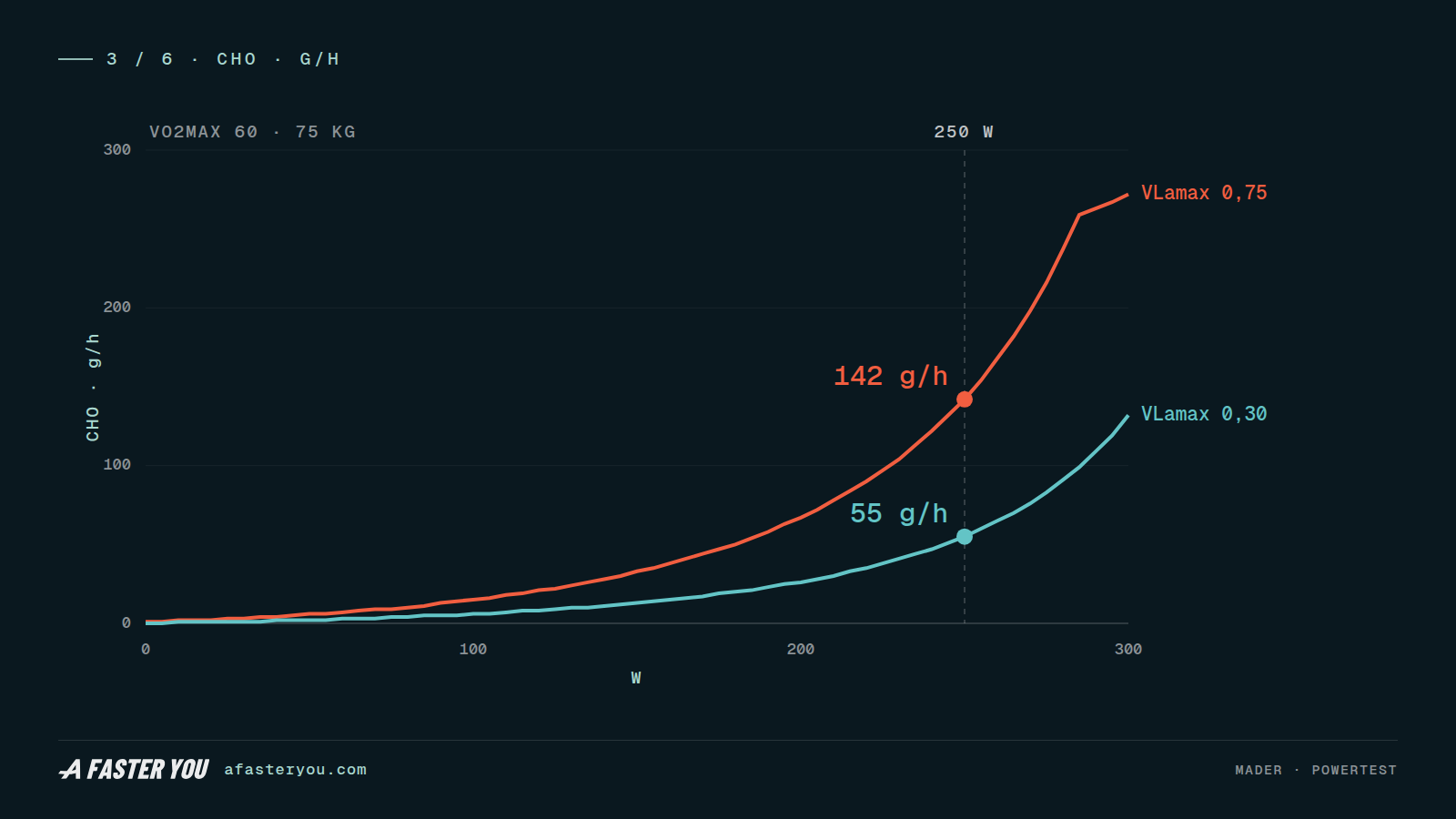
And your carb burn is not a population average — it's a function of your metabolic profile. Take the same two athletes from test 2, riding at 250 W: the Mader model puts the 0.30 diesel at roughly 55 g/h of carbohydrate — and the 0.75 sprinter at 142 g/h. Same power output, nearly three times the fuel. A platform that doesn't know your VLamax cannot know what you burn; whatever it recommends is generic by construction.
A platform that steers your training but has no carbohydrate guidance is steering with one hand off the wheel. No fueling concept? Walk away.
4. …but it doesn't pretend dinner is the workout
The flip side, because the pendulum has swung hard: nutrition matters, and knowing your exact intake — especially in the context of your VLamax — is genuinely useful. But nutrition doesn't replace training in the right zones. It never has. In our reading, training itself still accounts for something like 80 % of the result; fueling makes the training possible, it doesn't substitute for it. The science puts a number on that pendulum: across 88 randomized trials, even optimally dosed carbohydrate supplementation moves endurance performance by single digits — up to about six percent. Training builds everything underneath.
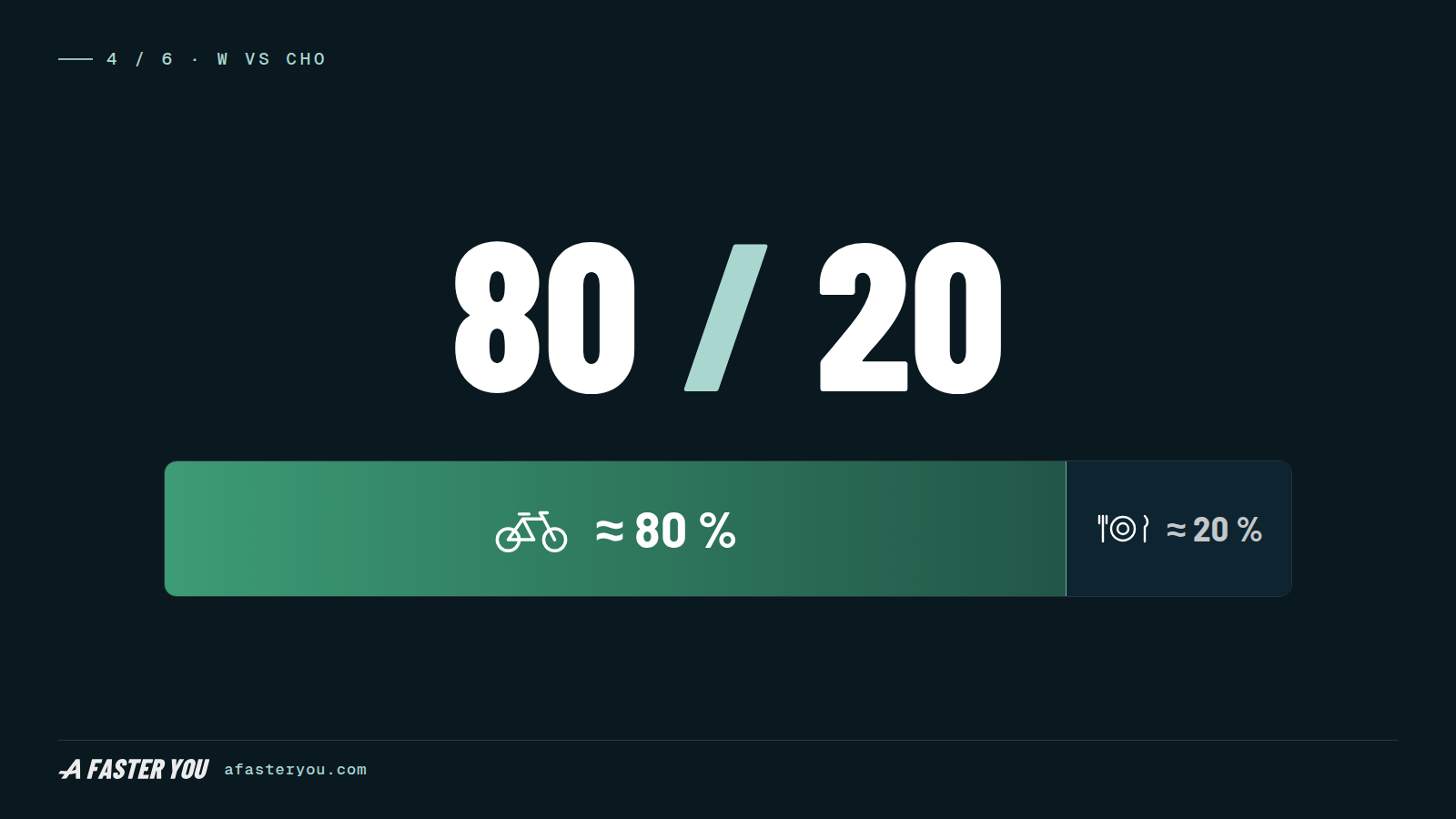
There are plenty of features where AI genuinely helps — meal photos included. But an AI training platform has to point its AI at the 80 %: at VO2max, at VLamax, at continuously adapting your training. Not at the garnish.
If an app's main intervention is analyzing photos of your meals, that's a nutrition app with a plan attached. No, uploading a picture of your dinner does not fix your threshold.
5. It treats HRV, resting heart rate and sleep as what they are
Recovery signals. Good ones. Useful for deciding what today should look like. But your fitness doesn't live in your sleep score — these numbers tell you about recovery, not about your engine, and no amount of them will reveal your VO2max or your VLamax.
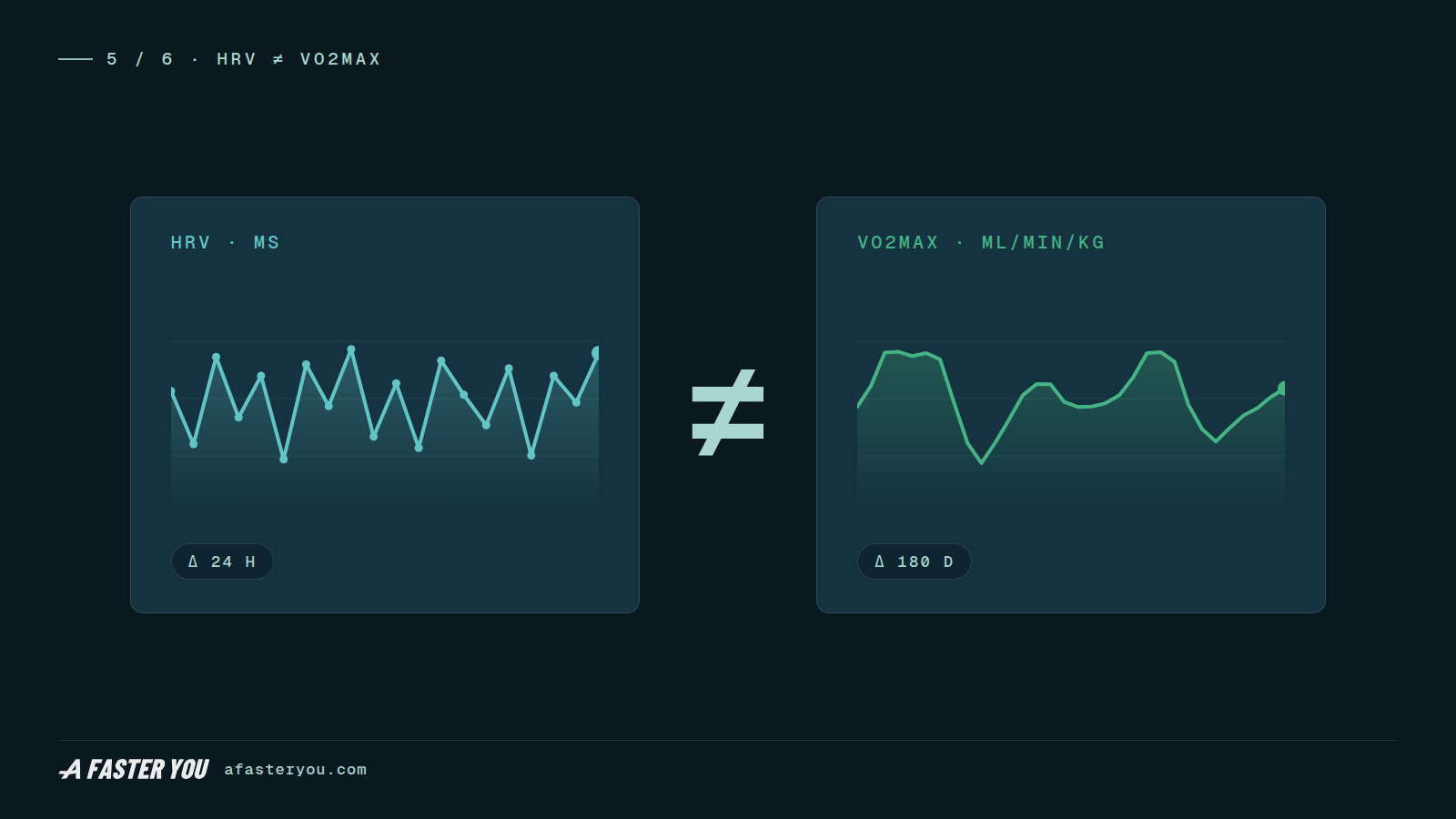
A platform that ingests your HRV and adjusts today's session has taken a fine first step. It is not training intelligence. And it is definitely not fitness.
6. It predicts your key metrics continuously — or it's flying blind
This is the test that separates dashboards from coaches. If a platform cannot continuously predict your VO2max and VLamax — or at minimum your critical power and W′ — then it has no way of knowing whether your training is working. It can schedule workouts. It cannot evaluate them. Every adaptation decision is a guess wearing a confidence interval it never computed.
This is what continuous prediction looks like in practice — a real athlete's season, tracked week by week from every ride, anchored by two Powertests. Only a curve like this can tell whether an athlete is actually adapting:
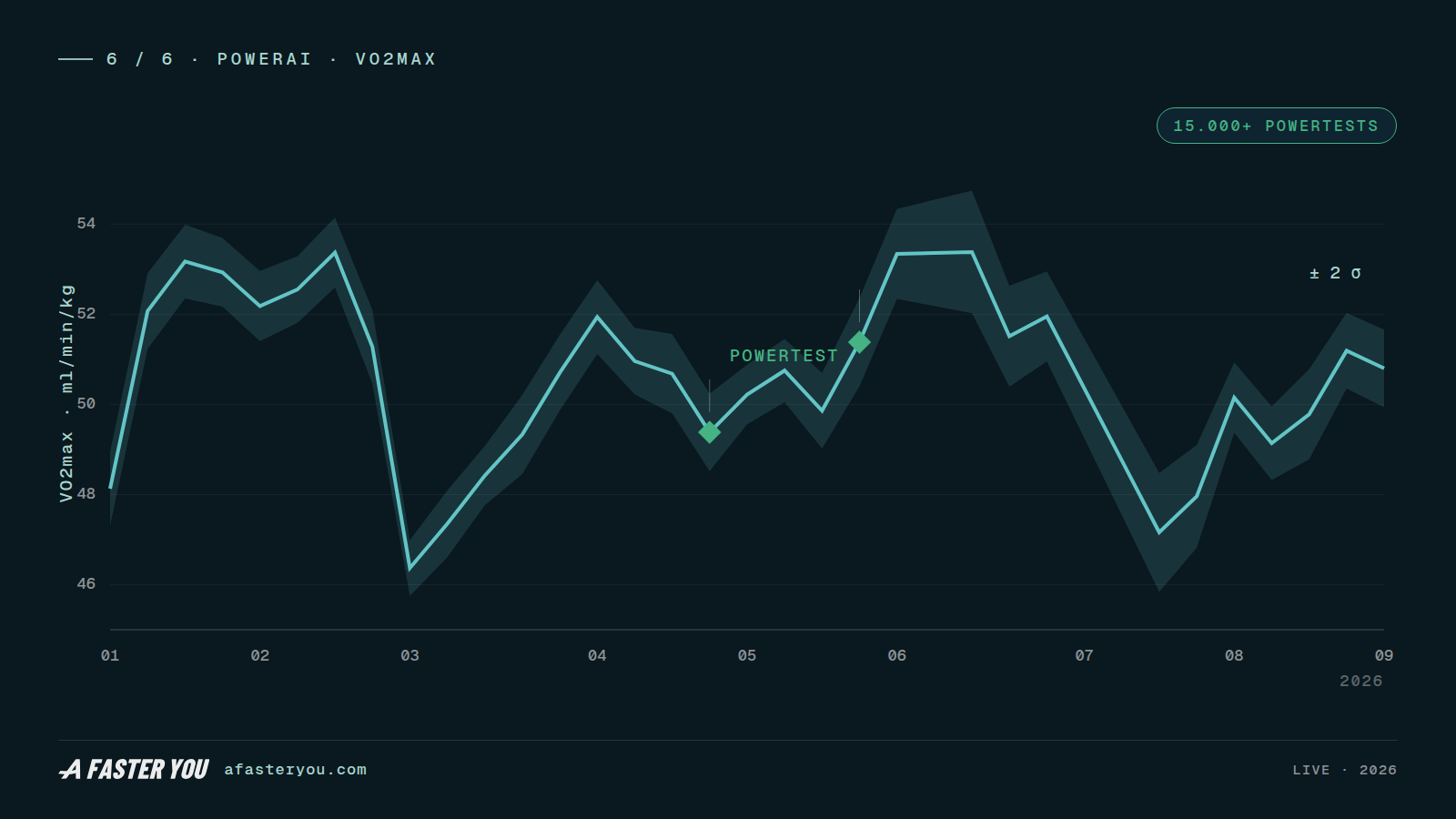
And stay skeptical about the training data behind such a claim: a model like this has to learn from something. powerAI learns from our 15,000+ labeled Powertests — measured maximal tests, not typed-in FTPs. A platform without a dataset like that cannot train a comparable model, whatever its marketing page says.
Try it: ask your app what changed — in your body, not your calendar — to make tomorrow's workout change. Silence is an answer.
2026, an AI claim, and no continuous prediction of your key metrics? Walk away.
The six tests at a glance
| # | Ask the platform | Walk away if |
|---|---|---|
| 1 | Can it determine and predict my VO2max? | It only stores a number you typed |
| 2 | Does it know my VLamax — diesel or sprinter? | One-size-fits-all zones |
| 3 | Does it guide my carbohydrates? | No fueling concept at all |
| 4 | Does it keep nutrition in its place? | Dinner photos as the main coaching |
| 5 | Are HRV and sleep treated as recovery? | Recovery sold to you as fitness |
| 6 | Does it predict my key metrics continuously? | It schedules workouts but never evaluates them |
What we built instead
You've noticed the pattern: every test above is a measurement question. That's not an accident — it's the whole philosophy.
One more distinction before the receipts, because the marketing language blurs it on purpose: "machine learning" very often means fitting a curve to your history. Useful, sometimes. When we say AI, we mean the deep end of that field: neural networks — models with an architecture, trained on measured data, with error margins we publish. That's the difference between a sticker and a system:
- The Powertest — a standardized maximal test on your own equipment: it measures your power output and derives your VO2max and VLamax through the Mader model. The VO2max estimate is validated against lab spirometry: mean bias −1.8 ml/min/kg, mean absolute error 3.3 ml/min/kg, across 43 athletes — the full validation.
- powerAI — a real neural network, now in its fourth generation, paired with a Kalman filter, that tracks your VO2max between tests from every training session you ride; the Mader model turns that into your zones.
- aeroAI — a real neural network predicting your CdA, your aerodynamic drag. Real enough that it holds a granted European patent (EP4451162B1).
- intervalAI — a real neural network for interval detection: the system knows what you actually trained, not what the plan said.
- And the training plan itself? Here we hold ourselves to our own label: the planner is machine learning, not a neural network — and we say so. It plans on cohort analyses of how much energy an athlete has to turn over to trigger adaptation, in a closed loop with your measured VO2max and VLamax, steered through VLamax. No AI sticker needed — every number in that loop is measured.
One more thing, because most platforms leave athletes in the dark about what is actually possible. The holy grail of endurance sport is a real neural network that predicts training adaptation itself. That is exactly what we are working on — and powerAI, in its fourth generation, is the cornerstone. Not optionally: a neural network for adaptation needs your VO2max and your VLamax, week by week — and those only exist if you can predict them in the first place. No VO2max and VLamax prediction, no training-plan AI. For anyone.
Our goal is as clear as it gets: to be the first company in the world with a real training-plan AI. We are getting closer step by step, and we look forward to putting the best technology we can build in front of our athletes at a fair price — because nothing makes us happier than successful, healthy athletes.
Ask the six questions
The other tests? The plan speaks carbohydrates — per session, from your metabolic profile — and reads your HRV, resting heart rate and sleep as exactly what they are: recovery.
Ask your platform the six questions. We'll happily answer all six — with numbers.
Cohort and validation figures: A Faster You athlete data, 15,000+ Powertests; lab validation n=43 (see linked article). Model examples in tests 2 and 3: Mader model, two reference athletes at VO2max 60 ml/min/kg and 75 kg, VLamax 0.30 vs 0.75 mmol/l/s — computed with the same engine that powers the Powertest. Chart in test 6: one athlete's 2026 season from our live data, shown anonymously. Day-to-day biological variability of measured VO2max: Katch VL, Sady SS, Freedson P. Biological variability in maximum aerobic power. Med Sci Sports Exerc. 1982;14(1):21–25 (≈5–6 %). Fueling effect size: Vandenbogaerde TJ, Hopkins WG. Effects of acute carbohydrate supplementation on endurance performance: a meta-analysis. Sports Med. 2011;41(9):773–792 (88 randomized trials; effects up to ≈6 %). Data as of August 2026.
Try it on us
The fastest way to check our answers is to run the test yourself: one standardized Powertest on your own equipment, and the platform starts working from your measured engines — not from a number in a settings screen.
Connect your device and train on measured numbers →
FAQ
Is a chatbot an AI coach? A chatbot is an interface, not a coach. The question is what sits behind it: does a measured model of your physiology steer your zones and your load — or does the chat steer you back to a number you typed in yourself?
What is VLamax, and why does it show up in every test here? Your glycolytic power — the rate at which you produce lactate. It decides why two athletes with the same VO2max race completely differently, and it changes how your zones and your fueling should look. Start here: VLamax explained.
Can a platform built on FTP or critical power be "AI training"? If the numbers come from real maximal efforts, that's a real basis — clearly better than a typed-in FTP. But mechanics describe your output, not your engine. Without a metabolic model, a plan cannot know why your threshold sits where it does — or how to move it.
My app adjusts workouts from my HRV — isn't that AI? It's a useful recovery feature. But recovery signals don't reveal fitness: they can shape what today should look like, not tell you whether your engine grew. Judge a platform by the model behind the adjustment, not by the adjustment itself.