VO2max Chart by Age & Gender
Your Garmin shows 48 ml/min/kg. Your training buddy has 55. But what do these numbers actually mean — and where do you stand?
VO2max is the single most important metric for endurance performance. It measures the maximum amount of oxygen your body can use during intense exercise, expressed in ml/min/kg. The higher your VO2max, the more power you can sustain over time.
But "good" or "bad" depends on your age, gender, and training background. Here are the reference values — updated July 2026 and benchmarked against our own cohort drawn from 1 million+ training sessions, distilled into 15,000+ standardized Powertests.
VO2max Norms: Men by Age
The following values are based on classifications from the American College of Sports Medicine (ACSM) and Cooper Institute research. All values in ml/min/kg.
| Age | Poor | Below Average | Average | Above Average | Good | Excellent |
|---|---|---|---|---|---|---|
| 20–29 | <33 | 33–36 | 37–41 | 42–45 | 46–52 | >52 |
| 30–39 | <31 | 31–34 | 35–39 | 40–43 | 44–50 | >50 |
| 40–49 | <28 | 28–32 | 33–36 | 37–40 | 41–47 | >47 |
| 50–59 | <25 | 25–28 | 29–33 | 34–37 | 38–44 | >44 |
| 60–69 | <22 | 22–25 | 26–30 | 31–34 | 35–41 | >41 |
| 70+ | <19 | 19–22 | 23–27 | 28–31 | 32–38 | >38 |
VO2max Norms: Women by Age
All values in ml/min/kg.
| Age | Poor | Below Average | Average | Above Average | Good | Excellent |
|---|---|---|---|---|---|---|
| 20–29 | <24 | 24–28 | 29–32 | 33–36 | 37–41 | >41 |
| 30–39 | <22 | 22–26 | 27–30 | 31–34 | 35–39 | >39 |
| 40–49 | <20 | 20–24 | 25–28 | 29–32 | 33–37 | >37 |
| 50–59 | <18 | 18–21 | 22–25 | 26–29 | 30–34 | >34 |
| 60–69 | <16 | 16–18 | 19–22 | 23–26 | 27–31 | >31 |
| 70+ | <14 | 14–16 | 17–20 | 21–24 | 25–29 | >29 |
How to Read the Chart
Test modality matters. These reference values come from treadmill testing. A cycle-ergometer test reads a few points lower for the same person, because you drive a smaller muscle mass — so cyclists comparing a bike test against these rows will slightly underrate themselves.
Find your age group in the left column and see which category your VO2max falls into. "Average" refers to the general population — if you train regularly, you should be aiming for at least "Above Average."
Important: These charts represent the general population. Dedicated endurance athletes typically fall in the "Good" to "Excellent" range — and professionals are well beyond that. Below, we compare our own athlete cohort to these norms.
These charts tell you where you stand — not what you can achieve. See your own predicted times in our interactive Race Predictor
VO2max Percentiles by Age and Gender
The chart above sorts you into a category — "Average," "Good," "Excellent." Useful, but blunt. If you want to know exactly where you stand, you need percentiles: what share of people your age you're actually ahead of.
These come from the FRIEND registry (Fitness Registry and the Importance of Exercise National Database) — the largest reference set of measured VO2max in the US, built from maximal cardiopulmonary exercise tests, not watch estimates (Kaminsky et al., 2015). Read a row like this: a 40-year-old man at 42 ml/min/kg sits between the 50th and 75th percentile — fitter than most, with room above him.
One honest caveat before you find your number: everyone in FRIEND completed a maximal lab test, so this is already a more active slice of the population than the ACSM "Average" category above. If anything, it sets a higher bar.
Men — measured VO2max percentiles (treadmill). All values in ml/min/kg.
| Age | 10th | 25th | 50th | 75th | 90th |
|---|---|---|---|---|---|
| 20–29 | 32.1 | 40.1 | 48.0 | 55.2 | 61.8 |
| 30–39 | 30.2 | 35.9 | 42.4 | 49.2 | 56.5 |
| 40–49 | 26.8 | 31.9 | 37.8 | 45.0 | 52.1 |
| 50–59 | 22.8 | 27.1 | 32.6 | 39.7 | 45.6 |
| 60–69 | 19.8 | 23.7 | 28.2 | 34.5 | 40.3 |
| 70–79 | 17.1 | 20.4 | 24.4 | 30.4 | 36.6 |
Women — measured VO2max percentiles (treadmill). All values in ml/min/kg.
| Age | 10th | 25th | 50th | 75th | 90th |
|---|---|---|---|---|---|
| 20–29 | 23.9 | 30.5 | 37.6 | 44.7 | 51.3 |
| 30–39 | 20.9 | 25.3 | 30.2 | 36.1 | 41.4 |
| 40–49 | 18.8 | 22.1 | 26.7 | 32.4 | 38.4 |
| 50–59 | 17.3 | 19.9 | 23.4 | 27.6 | 32.0 |
| 60–69 | 14.6 | 17.2 | 20.0 | 23.8 | 27.0 |
| 70–79 | 13.6 | 15.6 | 18.3 | 20.8 | 23.1 |
Two things worth knowing about these numbers. They're treadmill values — a cycle-ergometer test reads a few points lower for the same person, because you're driving a smaller muscle mass, so a cyclist comparing a bike test to this chart will slightly underrate themselves. And a 2022 update to the registry nudged the treadmill medians down by 1.5–4.6 ml/min/kg on a larger sample; we show the widely-cited 2015 standards here and cite both below.
Now put your own number in and see what it means — the race times it predicts, and where you sit against the tables above.
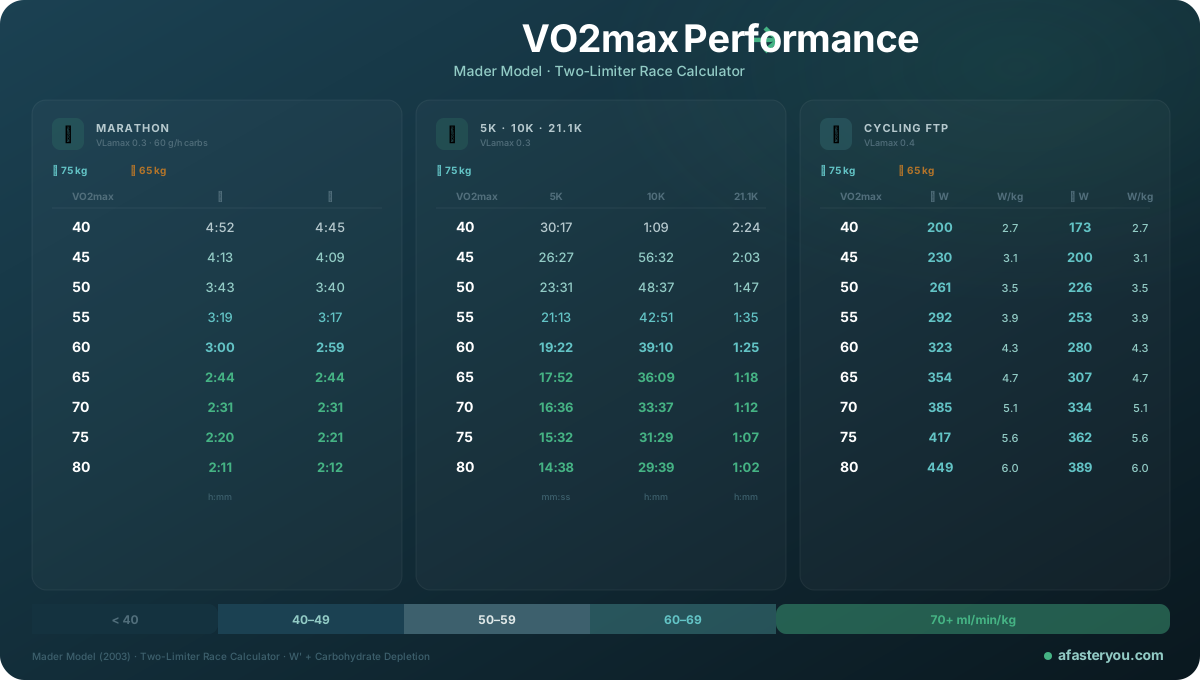
Your VO2max in Real Race Numbers
Pick your sport, your VO2max, and see what it translates to — based on the Mader metabolic model.
Predicted Race Times
Predicted Power Output
Percentile data: Kaminsky LA, Arena R, Myers J. Reference standards for cardiorespiratory fitness measured with cardiopulmonary exercise testing: data from the Fitness Registry and the Importance of Exercise National Database. Mayo Clin Proc. 2015;90(11):1515–1523. doi:10.1016/j.mayocp.2015.07.026. Updated standards (treadmill values 1.5–4.6 ml/min/kg lower): Kaminsky LA, Arena R, Myers J, et al. Mayo Clin Proc. 2022;97(2):285–293. doi:10.1016/j.mayocp.2021.08.020. Cycle-ergometer standards: Kaminsky LA, Imboden MT, Arena R, Myers J. Mayo Clin Proc. 2017;92(2):228–233. doi:10.1016/j.mayocp.2016.10.003.
Trained vs. Normal: How the A Faster You Cohort Compares
Two references, kept deliberately separate: the ACSM tables above answer "how do I compare to the general population?". The cohort tables here answer "where do I stand among trained endurance athletes?" — our users are self-selected and train consistently. This is not a norm; it's the bar set by committed athletes.
When we compared the A Faster You athlete cohort — drawn from 1 million+ training sessions, with 15,000+ Powertests — to the ACSM norms above, one thing stood out across every age group:
Trained athletes score roughly 40 to 70% above the general-population median, depending on age group — and a 55-year-old A Faster You athlete typically reaches values the norm tables only rate "Excellent" in a 30-year-old.
This isn't "A Faster You makes you fit." It's what structured training with continuous data feedback produces — in people who show up week after week, adjust intensity based on their own numbers, and don't leave adaptations to guesswork. The gap below shows what's possible, not what we uniquely deliver.
Women — A Faster You Cohort vs. ACSM Median
Our female cohort is still expanding — we'll refresh this table as the dataset grows through 2026.
All values in ml/min/kg.
| Age | Athletes (n) | A Faster You median | ACSM median | Δ |
|---|---|---|---|---|
| 20–29 | 46 | 57.1 ml/min/kg | 37 ml/min/kg | +54% |
| 30–39 | 85 | 51.0 ml/min/kg | 35 ml/min/kg | +46% |
| 40–49 | 34 | 50.4 ml/min/kg | 34 ml/min/kg | +48% |
Cycling cohort, one source, one date: the same Powertest distribution as the men's table below, each athlete counted once at her last valid test (as of August 2026). Bands under 30 measured athletes are not published — the female sub-cohort is growing.
What the numbers actually say
- A 20-something A Faster You man is, at the median, as fit as a top-tier 20-year-old talent in the general population.
- A 40-something A Faster You man sits well above the median of an untrained 20-year-old — two decades of consistent training more than offset two decades of age-related decline.
- Our 60-year-olds (49 ml/min/kg median) reach values that, in the general population, only top-fit 40-year-olds hit.
That's the real story of VO2max across a lifetime: age lowers the ceiling for everyone, but training slows the decline so dramatically that a trained 60-year-old outperforms an untrained 30-year-old.
Methodology: How We Built These Tables
We didn't take our numbers from population literature. We compute them from our own athletes' performance data.
Every value in the cohort tables above comes from a single source: the A Faster You Powertest — a standardized metabolic assessment protocol based on the Mader model (Mader, 2003), run by real athletes on their own training equipment.
What our cohort represents:
- A trained-athlete subset of the broader A Faster You platform (1 million+ training sessions). The tables above are computed from standardized Powertests — the athlete count (n) for each band is shown in the table itself.
- Validated VO2max measurements from standardized Powertests (Mader model)
- Stratification: grouped by ACSM-standard age bands and gender, using median (P50) rather than mean to resist outlier influence
- ACSM comparison baseline: the official norm tables from the American College of Sports Medicine + Cooper Institute
What we explicitly did not do:
- Blend public Garmin / Polar / lab datasets into a meta-average
- Weight or adjust values to match expected ranges
- Remove data points just because they were surprising
The cohort keeps growing — we're actively broadening the female sub-cohort, which is why women's data is still directional. The five-year table below updates automatically with every data refresh.
Where Trained Athletes Land: 15,000 Measured Powertests
The ACSM and FRIEND tables further up describe the general population. Here's what changes when you train with data and measure your values regularly.
Below are the VO2max percentiles from our own athletes, grouped into five-year bands so you can find yourself precisely. Every value comes from a standardized A Faster You Powertest — not a literature estimate, but what real, tracked athletes actually register on the day.
Cycling-dominated cohort (~88 % of tests measured on the bike). Each athlete counted once, at their last valid Powertest; age taken at test date. The table renders live from our cohort distribution and updates with every data refresh.
Men — measured A Faster You athletes. All values in ml/min/kg.
| Age | Athletes (n) | P10 | P25 | P50 (median) | P75 | P90 |
|---|---|---|---|---|---|---|
| <20 | 78 | — | 61.3 | 66.7 | 70.6 | — |
| 20–24 | 140 | 55.7 | 65.4 | 70.8 | 75.9 | 78.6 |
| 25–29 | 157 | 47.1 | 56.9 | 63.8 | 73.2 | 79.2 |
| 30–34 | 190 | 48.1 | 53.8 | 60.4 | 68.4 | 75.1 |
| 35–39 | 358 | 45.1 | 51.5 | 58.1 | 66.1 | 74.8 |
| 40–44 | 220 | 43.4 | 50.3 | 56.3 | 61.4 | 66.0 |
| 45–49 | 182 | 41.9 | 47.1 | 53.7 | 58.7 | 65.4 |
| 50–54 | 111 | 41.0 | 45.7 | 50.7 | 56.4 | 61.4 |
| 55–59 | 100 | 39.5 | 44.5 | 50.6 | 55.1 | 59.0 |
| 60+ | 88 | — | 43.5 | 48.9 | 54.1 | — |
P10/P90 shown from 100 athletes per band; bands under 30 athletes are not published. Data: 2026-10-12.
You may republish this table and the norm charts above — in articles, forums, or club newsletters — with attribution: "Source: A Faster You, afasteryou.com/blog/en/vo2max-table/". Journalists: we're happy to compute custom cuts of this dataset for your readership — get in touch.
Now line that up against the population percentiles. The median 40–44 man in our cohort sits in the mid-50s — clear of the FRIEND registry's 90th percentile for that decade (52.1), and FRIEND is already a tested, active population, not couch normals. A 50–54 athlete's median clears the FRIEND 90th percentile for their age outright. Because our tests are mostly on the bike — which reads lower than a treadmill — the real gap is, if anything, wider than it looks.
Be honest about what that does and doesn't mean. This isn't "A Faster You makes you superhuman." It's a self-selected group — people who test, track, and adjust, then show up again week after week. These numbers are what consistency plus honest feedback produce over time. They show you what's possible, not a result stamped on your first login.
See where your VO2max lands and the race times it predicts →
What Your VO2max Means for Performance
Your VO2max maps to concrete race times (5k to marathon) and cycling threshold power. Instead of scrolling static tables, use the interactive VO2max calculator — it converts any value into predicted running times, pace and FTP, for men and women. The method behind those predictions: the race time predictor explained.
VO2max and Longevity: Beyond Racing
VO2max doesn't just predict how fast you can run — it is also one of the most consistently observed markers of all-cause mortality risk. A 2018 JAMA Network Open study of 122,007 adults found that people in the "Elite" VO2max range had an 80% lower mortality risk than those in the "Low" range — comparable to or greater than the risk difference from smoking, diabetes, or heart disease.
Three findings that matter:
- Dose-response is linear. Every step up in fitness reduces risk further. Unlike cholesterol or blood pressure (where extremes flip to harm), there was no upper-plateau for cardiorespiratory fitness.
- The biggest gains are in the worst-fit. Moving from "Low" to "Below Average" was the single largest risk reduction the study measured.
- Age doesn't protect you. The effect was strongest in adults 70+, exactly the group that often stops pushing intensity.
When you look at the chart above, you're not just seeing race potential. You're seeing a rough projection of how long — and how well — your cardiovascular system will work.
Reference: Mandsager K, Harb S, Cremer P, et al. Association of cardiorespiratory fitness with long-term mortality among adults undergoing exercise treadmill testing. JAMA Netw Open. 2018;1(6):e183605.
How Accurate Is Your Sports Watch's VO2max?
Watches estimate VO2max from heart rate and pace with no test at all — excellent for the trend, with some spread on the absolute number. How close Garmin and Apple Watch get, and why: Garmin VO2max accuracy · Apple Watch VO2max accuracy.
And the question we owe you about ourselves: how accurate is our own test? We held it against lab spirometry — 43 athletes, mean bias −1.8 ml/min/kg: Powertest vs lab.
Measure Your VO2max Accurately: The Powertest
The A Faster You Powertest derives your individual VO2max from a standardized performance protocol using the Mader model — it measures performance data, not respiratory gases. No lab required — just your regular training equipment and a heart rate monitor.
How close that lands to the lab is measured, not claimed: across 43 athletes with parallel spirometry the mean bias is −1.8 ml/min/kg and the typical single-test error 3.3 — the full validation.
From your Powertest, you get:
- Your individual VO2max estimate
- Individual training zones — including the right intensity for VO2max intervals (and why two athletes with the same HRmax can sit 23 beats apart at threshold: measured max heart rate by age)
- Performance predictions for various distances
Between Powertests, our AI Prediction estimates your VO2max from every training session, so you can track your trend in real time.
How to Improve Your VO2max
The short version: HIIT in the right zone, consistency over hero workouts, a broad aerobic base — and patience with the age curve. The complete program with protocols (Billat, Tabata, Zone 2), progression and fueling: the VO2max training guide.
Train Based on Your Data
Whether you want to know where you stand or actively get faster — it starts with your numbers, not a generic chart.
Here's how it works: connect your device (Garmin, Wahoo, Zwift) and A Faster You reads your training data to estimate your VO2max — then builds an adaptive training plan around it, with your first Powertest scheduled in week two to lock in your exact values. Every session you upload refines the plan automatically.
Connect your device and get your VO2max + adaptive plan →
No device connected yet? You can still run a single Powertest — one upload gives you your VO2max estimate, VLamax, and training zones, then carries straight into your plan.
One More Thing: Meet VLamax
VO2max is your diesel engine — VLamax is your turbo. Only the pair explains why two athletes with the same VO2max race completely differently. What VLamax is and how to balance the two: VLamax explained · VLamax vs. VO2max.
FAQ
Is a VO2max of 50 good? For a man aged 30–39, 50 ml/min/kg sits right at the top of the "Good" band (44–50) — one point short of "Excellent". For a woman of the same age, that same number is comfortably "Excellent". For competitive endurance athletes, it's a solid starting point with room to grow — the median among A Faster You men in this age bracket is 57.
What VO2max do professional athletes have? Male professional endurance athletes typically range from 70–85 ml/min/kg, females from 60–75 ml/min/kg. The highest ever recorded is 97.5 ml/min/kg (Oskar Svendsen, cyclist).
How is VO2max measured? The gold standard is spirometry in a lab — a mask that measures oxygen in and out while you ramp up exercise intensity. More practically, the A Faster You Powertest uses the Mader metabolic model to determine your VO2max from a structured performance protocol you can run with your normal training setup and a heart rate monitor. Sports watches (Garmin, Apple Watch, COROS) estimate it from pace and heart rate without any test at all. For Garmin we can put a number on it: across 108 paired bike comparisons with the Powertest, the watch read +2.91 points high on average — +8.67 points in untrained athletes, +1.41 in trained ones, +0.21 at the elite end (the full comparison).
Can I improve my VO2max at any age? Yes. VO2max is improvable at any age through targeted interval training. The rate of improvement varies, but even in people over 60, research shows significant gains from structured training — our own cohort of 60–69 year-old athletes has a median VO2max of 49 ml/min/kg, well above the ACSM norm of 31.
Why does my Garmin show a different VO2max than the Powertest? Your Garmin estimates VO2max from your everyday heart rate and pace — no test, no lab — and in our 108 paired comparisons it lands almost exactly on the measured value for trained and elite athletes. Below that it tends to read higher. If you build zones, fuelling and a plan on the number, a Powertest measures it — and adds VLamax.
What does 5 ml/min/kg more VO2max give me? On the marathon: ~20–30 minutes faster (depending on starting level). On the half marathon: ~10–15 minutes. On 10K: ~5–7 minutes.
Can I improve VO2max on a low-carb diet? Probably not. What we see in coaching: athletes who ride their hard sessions consistently low-carb stop making VO2max progress. Carbs power the glycolytic demand that drives the adaptation. Fuel hard for VO2max sessions, even if you train lower-carb on easy days.
What's the average VO2max for my age? In measured terms, the median man runs from about 48 ml/min/kg in his twenties down to 33 in his fifties; the median woman from about 38 to 23 across the same span (FRIEND registry, treadmill tests). Those sit higher than the ACSM "Average" category, because everyone in that registry actually completed a maximal test.
What VO2max percentile am I in? Find your age band in the percentile tables above and see where your number falls between the 10th and 90th percentile. There is no universal percentile target: P75 in the general reference and P75 among trained athletes are very different levels. Use one reference consistently and track your own change within it. For reference, the median A Faster You athlete lands near the top of the general-population range.
What's a good VO2max for a 40-year-old man? By ACSM classification, a 40–49 man needs above 47 to rate "Excellent." In the measured FRIEND registry the median for that decade is about 38 and the 90th percentile about 52. Among A Faster You men aged 40–44, the median is about 57 — a number only the top few percent of the general population reach.
VO2max norms based on data from the American College of Sports Medicine (ACSM) and Cooper Institute. A Faster You cohort data: trained-athlete subset of a platform with 1 million+ training sessions; cohort tables derived from 15,000+ Powertests with VO2max validated through standardized Mader-model Powertests (Mader model). Performance predictions based on the Mader model (Mader & Heck 1986, Int J Sports Med; Mader 2003, Eur J Appl Physiol), assuming typical trained-athlete metabolic parameters (running VLamax 0.4 mmol/l/s, cycling VLamax 0.5 mmol/l/s, carbs scaled by distance). Longevity data from Mandsager et al., JAMA Network Open 2018. HIIT protocols: Billat V. Sports Med 2001; Tabata I. et al. Med Sci Sports Exerc 1996.
VO2max Percentile: Where Do You Rank?
Enter your VO2max and see where it lands among athletes we actually measured in a Powertest — by age group and gender.
About this cohort: these are measured Powertests, overwhelmingly cyclists and trained endurance athletes. Values therefore sit well above general-population norms — a mid-table result here is still a strong VO2max in absolute terms.